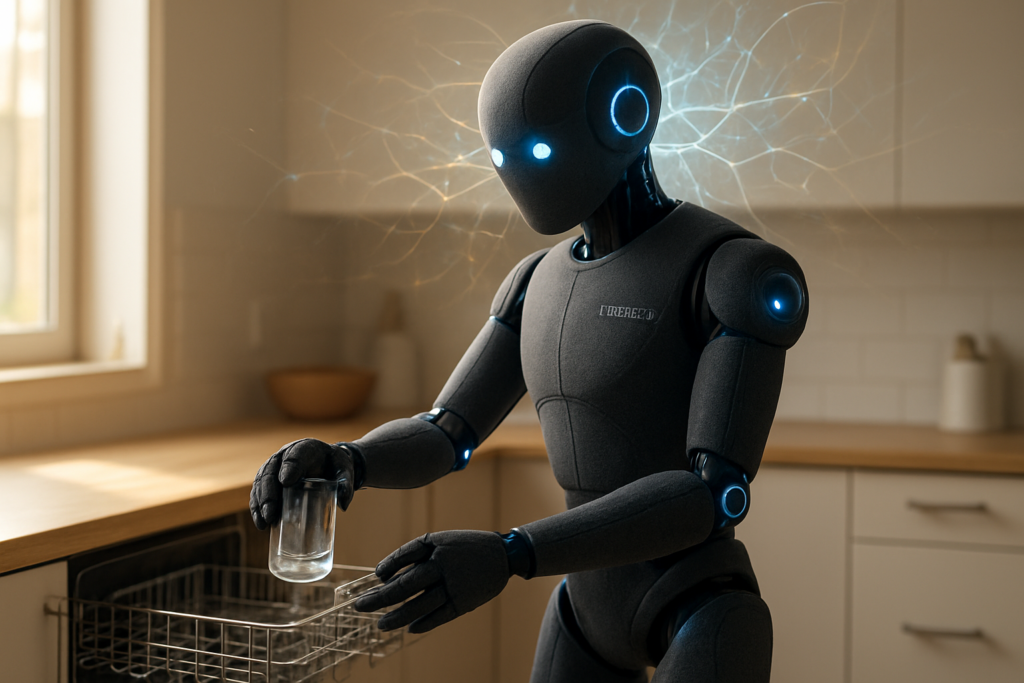
SUNNYVALE, CA — In what is being hailed as the "iPhone moment" for robotics, Figure AI has officially launched the Figure 03, its first humanoid robot designed specifically for the domestic environment. Moving beyond the industrial prototypes that defined the company’s early years, Figure 03 is a sleek, consumer-oriented machine capable of performing complex, long-horizon household chores—such as folding laundry and loading a dishwasher—entirely autonomously. The announcement marks a pivotal shift in the artificial intelligence landscape, as the industry moves from digital assistants on screens to "Physical AI" capable of navigating the messy, unpredictable reality of a human home.
The launch, which reached a fever pitch in early 2026, centers on a breakthrough in robot cognition known as the "Helix" unified neural network. Unlike previous generations of robotics that relied on rigid, hand-coded instructions for every movement, Figure 03 perceives its environment and plans its actions through a single, end-to-end AI architecture. This allows the robot to handle novel objects it has never seen before—like a uniquely shaped wine glass or a new brand of detergent—with the same fluidity as a human. As Figure AI scales production at its new "BotQ" facility, the company aims to prove that the age of the general-purpose robot butler is no longer science fiction, but a commercially viable reality.
A Technical Leap: The Anatomy of a Robot Butler
Technically, Figure 03 is a radical departure from its predecessor, the Figure 02. Standing at 168 cm (5’6”) and weighing a nimble 60 kg (132 lbs), the robot features a "home-safe" design covered in a soft, washable textile mesh rather than exposed metal or plastic. This design choice is intended to eliminate pinch points and make the robot approachable for children and pets. However, the true innovation lies under the hood. Figure 03’s hands are equipped with 20 degrees of freedom and custom tactile sensors in the fingertips capable of detecting forces as small as 3 grams—sensitive enough to pick up a paperclip or handle a fragile egg without a single line of explicit programming for those specific items.
At the heart of Figure 03 is the Helix 02 unified neural network, which utilizes a hierarchical "System 0/1/2" architecture. System 2 is a 7-billion parameter Vision-Language-Action (VLA) model that handles high-level reasoning; it listens to a command like "clean up the kitchen" and breaks it down into semantic steps. System 1 is a reactive policy that translates those steps into movement at 200 Hz, allowing the robot to adjust its grip instantly if a plate slips. Finally, System 0 is a 1 kHz low-level execution layer that manages balance and contact physics, replacing over 100,000 lines of traditional C++ code with a learned motion prior. This three-tiered AI approach allows Figure 03 to maintain human-level reaction speeds while reasoning about complex tasks in real-time.
Initial reactions from the AI research community have been overwhelmingly positive, with many experts noting that Figure has successfully solved the "latency gap" that plagued earlier VLA models like Google’s RT-2. While competitors have often struggled with "jittery" movements or long pauses between actions, Figure 03’s 4-minute unedited demo of unloading a dishwasher showcased a level of "loco-manipulation"—moving and grabbing simultaneously—that was previously thought to be years away. However, some skeptics, including former Meta AI chief Yann LeCun, argue that while Helix is a masterpiece of statistical learning, it still lacks a true "world model" capable of understanding causal physics in extreme edge cases.
The Trillion-Dollar Market: Silicon Valley’s Great Humanoid Pivot
The launch of Figure 03 has sent shockwaves through the tech industry, solidifying the positions of key backers. Microsoft (NASDAQ: MSFT) and NVIDIA (NASDAQ: NVDA), both major investors in Figure AI, stand to benefit immensely as the "Physical AI" stack becomes the next major frontier for cloud computing and specialized hardware. Nvidia’s Isaac platform has been instrumental in training Figure’s Helix model in simulation, and the success of Figure 03 validates Nvidia’s pivot toward becoming the foundational "brain" supplier for the robotics industry.
The competitive implications for Tesla (NASDAQ: TSLA) are particularly acute. While Elon Musk has touted the Optimus robot as Tesla’s most significant future product, Figure 03’s focus on domestic safety and high-fidelity dexterity puts it in direct competition for the "home assistant" market. While Tesla maintains a massive data advantage from its fleet of vehicles and focuses on high-volume factory automation, Figure’s move to end its partnership with OpenAI in late 2025 to develop Helix entirely in-house suggests a strategic bet on specialized, proprietary robotics AI. Meanwhile, 1X Technologies, backed by OpenAI, is also entering the fray with its "Neo" robot, creating a high-stakes race between the "soft robotics" approach of Figure and the "automotive-scale" approach of Tesla.
This development threatens to disrupt not only the robotics sector but also the multi-billion-dollar home appliance and service industries. If a $20,000 robot can perform the duties of a dishwasher, a washing machine, and a housekeeper, the long-term demand for specialized, "smart" appliances may dwindle. Companies like Hyundai (KRX: 005380), which owns Boston Dynamics, are watching closely as they transition their own humanoid platforms from research labs to commercial production lines to keep pace with the rapid commoditization of domestic labor.
From "Cool Demo" to Real Utility: Why 2026 is the Humanoid Epoch
The wider significance of Figure 03 lies in its achievement of "long-horizon autonomy." In the AI world, a "short-horizon" task is something like picking up a ball. A "long-horizon" task is laundry—identifying dirty clothes, navigating to the machine, opening the door, adding detergent, and selecting a cycle. By successfully demonstrating these tasks in unstructured environments, Figure 03 has passed a "physical Turing Test" of sorts. This fits into the broader 2026 AI trend where the focus has shifted from "Generative AI" (creating text and images) to "Agentic AI" (taking physical actions in the world).
However, this milestone brings significant concerns regarding safety, privacy, and the labor market. With six cameras and integrated microphones constantly mapping the interior of a home, Figure 03 is the most advanced surveillance device ever sold to consumers. Furthermore, while the current $20,000 price point targets early adopters and high-net-worth individuals, the eventual scaling of this technology could lead to the displacement of millions of domestic workers worldwide. Unlike the industrial revolution, which replaced physical strength, this "Humanoid Revolution" targets the very dexterity and common-sense reasoning that was once thought to be the exclusive domain of humans.
The Road to 2030: Challenges and the Future of Physical AI
Looking ahead, Figure AI faces the monumental task of scaling production from the 12,000 units planned for 2026 to the 100,000 units required for mass-market penetration. Near-term developments will likely focus on increasing battery life, which currently sits at approximately 5 hours per charge, and improving the robot’s ability to interact with pets and the elderly. Use cases on the horizon include "senior care assistants" that can help with mobility and medication, though these will require even higher levels of safety certification and "System 0" reliability.
Experts predict that the next major breakthrough will be "Cross-Embodies Learning," where robots like Figure 03 can learn from videos of humans or other robots over the internet. The primary challenge remains the "data bottleneck"—robots need millions of hours of physical interaction data to handle every possible household mishap, from a spilled gallon of milk to a tripping hazard. If Figure AI can leverage its initial fleet of 12,000 robots to collect this data safely, the intelligence of Figure 03 could improve exponentially by the end of the decade.
A New Era of Household Labor
The launch of Figure 03 represents a landmark moment in the history of artificial intelligence. By successfully integrating a unified neural network into a safe, dexterous, and aesthetically pleasing hardware platform, Figure AI has moved the needle from "theoretical possibility" to "consumer product." The transition of the humanoid from the factory floor to the living room is no longer a matter of if, but how fast.
As we move through 2026, the key metrics to watch will be the reliability of the Helix 02 system in real-world homes and the speed at which Figure can drive down manufacturing costs. If Figure 03 delivers on its promise of autonomous laundry and dishwashing without constant human intervention, it will be remembered as the catalyst for the greatest shift in domestic life since the introduction of electricity. The "Physical AI" era has arrived, and the way we live, work, and maintain our homes is about to change forever.
This content is intended for informational purposes only and represents analysis of current AI developments.
TokenRing AI delivers enterprise-grade solutions for multi-agent AI workflow orchestration, AI-powered development tools, and seamless remote collaboration platforms.
For more information, visit https://www.tokenring.ai/.