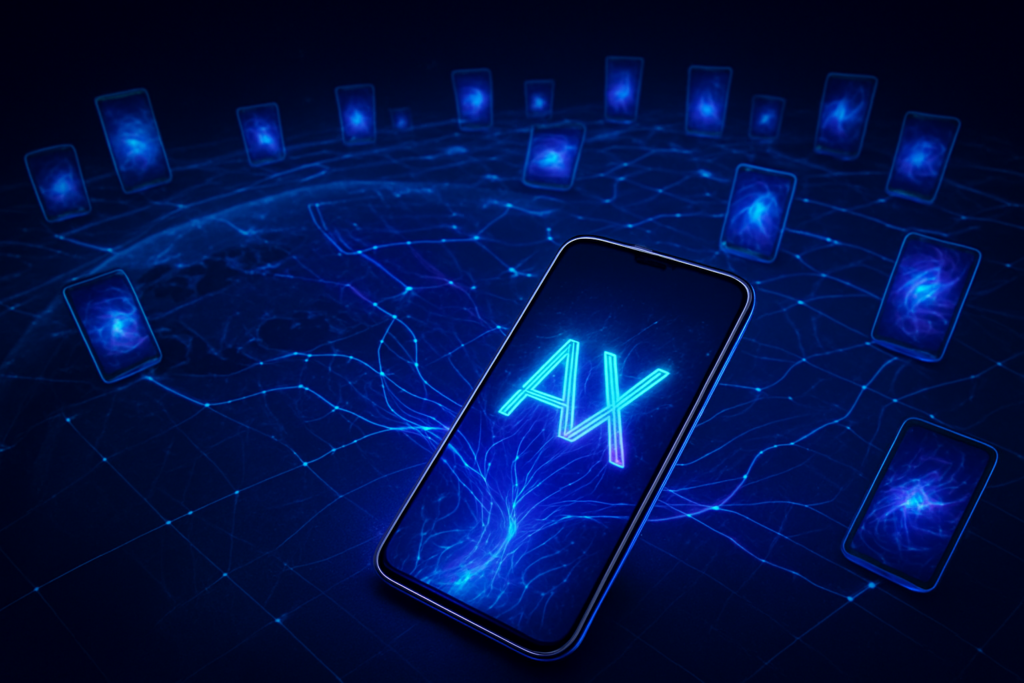
Samsung Electronics (KRX: 005930) has officially shifted the gears of the mobile industry into overdrive, announcing an ambitious roadmap to embed Google (NASDAQ: GOOGL) Gemini-powered artificial intelligence into 800 million devices by the end of 2026. This massive expansion, centered around what the company calls its "AX" (AI Transformation) vision, represents a definitive pivot from AI being a premium "opt-in" feature to it becoming the invisible, default operating layer for the entire Galaxy ecosystem.
The announcement, reaffirmed by T.M. Roh, President and Head of Mobile eXperience at Samsung, during a 2026 strategic briefing, signals a doubling of the company’s 2025 milestone of 400 million AI-enabled devices. By integrating advanced generative models across the Galaxy S, Z, and mid-range A series—as well as tablets and wearables—Samsung is betting that the future of mobile dominance lies not in hardware specs alone, but in the depth of a device's "ambient intelligence."
Technical Integration: From Features to a Default Layer
At the heart of Samsung’s AX vision is a sophisticated hybrid AI model that utilizes Google’s latest Gemini 3 architecture. Unlike the first-generation AI features of 2024, the 2026 suite moves toward "Agentic AI." This shift means the AI is no longer just a chatbot; it is a system-level agent capable of autonomous, multi-step actions. Leveraging the sheer power of 2nm silicon—specifically the Snapdragon 8 Gen 5 from Qualcomm (NASDAQ: QCOM) and Samsung’s own Exynos 2600—the new "Galaxy AI" can process complex requests like "Find the flight details in my emails and book a ride to the airport" without the user ever opening a specific app.
Key technical breakthroughs in the 2026 rollout include EdgeFusion, a generative imaging model co-developed with Nota AI that allows for near-instantaneous on-device photo editing. By using a highly compressed version of Stable Diffusion, users can remove objects, change lighting, or swap facial expressions in group shots via the "Best Face" feature in under one second. Furthermore, the introduction of the "Now Bar" on the lock screen uses AI to surface contextual widgets—such as live translation for an incoming call or real-time sports updates—based on the user’s location and habits, effectively making the UI proactive rather than reactive.
The AI research community has noted that Samsung’s "Local-First" approach is a significant technical achievement. By running Gemini Nano 3 locally on mid-range devices like the Galaxy A56, Samsung is bringing high-tier privacy and low latency to the masses. Industry experts suggest that the transition from cloud-dependent AI to high-performance on-device processing marks the beginning of the "Third Era" of mobile computing, where the operating system itself is rewritten around a large language model (LLM) core.
Industry Impact: A High-Stakes Duel for the AI Supercycle
Samsung’s aggressive 800-million-unit target has sent ripples through the tech sector, forcing competitors to accelerate their own AI roadmaps. The primary beneficiary of this move is Google (NASDAQ: GOOGL), whose Gemini models are now the foundational intelligence for the world’s largest fleet of mobile devices. This partnership has effectively sidelined smaller AI labs that lack the scale to compete with the Google-Samsung vertical integration.
The strategic advantage for Samsung lies in its ability to offer a unified AI experience across a vast hardware portfolio. While Apple (NASDAQ: AAPL) has seen success with its "Apple Intelligence" supercycle on the iPhone 17 and iPhone 16 Pro series, Samsung’s decision to bring "Awesome Intelligence" to its budget-friendly A-series devices creates a significant hurdle for Apple in emerging markets. In early 2026, the competitive battle has moved from "who has the best AI" to "who can make AI the most accessible."
However, this rapid scaling also presents a challenge for the broader Android ecosystem. As Samsung and Google deepen their tie-up, other OEMs like Xiaomi and Oppo have been forced to choose between building their own costly LLMs or becoming more dependent on the Google Gemini ecosystem. The current market dynamics suggest a "winner-takes-all" scenario for the software layers, even as hardware manufacturers scramble to secure the high-capacity DRAM required to run these models locally.
The Broader AI Landscape: Implications and Concerns
Samsung’s AX vision represents a milestone in the "normalization" of AI. Much like the transition from 3G to 4G, or the advent of the touchscreen, the embedding of AI as a default layer is reshaping human-computer interaction. The 800-million-device goal ensures that AI-assisted translation, real-time transcriptions, and generative editing become baseline expectations for consumers worldwide, rather than niche luxuries.
Yet, this massive rollout is not without its concerns. Privacy advocates have raised questions about the "ambient" nature of the AX vision. If AI is constantly running in the background to provide "proactive suggestions," how much data is being captured and where is the line between helpful and intrusive? Samsung has addressed this with its "Knox Matrix" security, which encrypts AI data on-device, but the psychological hurdle of a "listening and seeing" phone remains a point of contention for many.
Furthermore, the environmental impact of such a large-scale AI deployment cannot be ignored. While on-device processing is more energy-efficient than constant cloud pings, the sheer computational load of Gemini Nano 3 across 800 million units places a strain on battery longevity and requires more frequent hardware upgrades, potentially accelerating electronic waste. This is a sharp contrast to the sustainability goals many of these tech giants championed earlier in the decade.
Future Horizons: The Path to 1 Billion Devices
Looking toward the end of 2026 and into 2027, the focus of the AX vision is expected to shift from mobile phones to a fully integrated AI home. Samsung has already hinted at a goal of 1 billion AI-powered devices by 2028, encompassing Smart TVs, Bespoke appliances, and wearables like the Galaxy Ring. The potential applications are vast: a refrigerator that uses Gemini to suggest recipes based on what it "sees" inside, or a Galaxy Watch that utilizes "Agentic AI" to automatically schedule a doctor’s appointment if it detects a persistent irregular heart rhythm.
Experts predict that the next major challenge will be "Cross-Device Continuity." As users move between their AI-powered phones, tablets, and cars, the AI agent will need to maintain a "persistent memory" of the user's preferences and tasks without compromising security. The "Personal Intelligence" beta currently being tested by Google and Samsung is the first step toward this future, where the phone acts as a digital twin that truly understands the user’s life context.
Summary: A Defining Moment in AI History
Samsung’s commitment to bringing Gemini-powered AI to 800 million devices by the end of 2026 is a watershed moment for the technology industry. By rebranding the user experience as "AX," Samsung is moving beyond the gimmickry of early AI features and toward a world where artificial intelligence is as fundamental as the cellular signal itself. The success of this initiative will be measured not just by sales figures, but by how effectively these "agents" can actually simplify the lives of nearly a billion people.
As we move through 2026, the tech world will be watching closely to see if Samsung can maintain its lead over Apple’s increasingly LLM-centric Siri and whether the hardware can truly keep up with the demands of ever-evolving AI models. For now, the "AI Transformation" is no longer a vision—it is the reality of the mobile world.
This content is intended for informational purposes only and represents analysis of current AI developments.
TokenRing AI delivers enterprise-grade solutions for multi-agent AI workflow orchestration, AI-powered development tools, and seamless remote collaboration platforms.
For more information, visit https://www.tokenring.ai/.