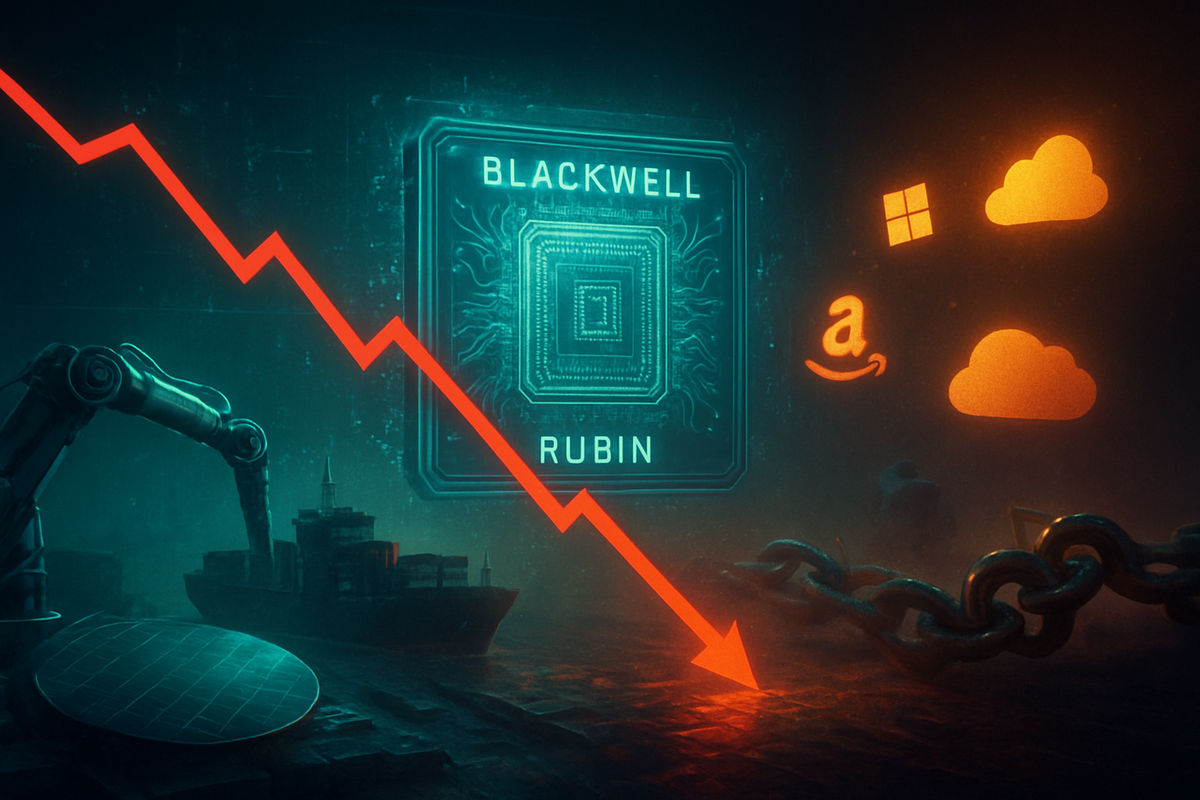
In a move that has sent shockwaves through global markets, Nvidia (NASDAQ: NVDA) saw its market capitalization crater by approximately $260 billion on February 26, 2026, marking the sharpest single-day decline for the AI juggernaut in nearly two years. The 5.6% plunge occurred just 24 hours after the company reported "blowout" fourth-quarter earnings that surpassed even the loftiest Wall Street expectations. This "sell-the-news" event has sparked a broader retreat across the semiconductor sector, leaving investors questioning whether the feverish pace of AI infrastructure spending has finally hit a ceiling of valuation fatigue.
The immediate implications are being felt far beyond Santa Clara. The tech-heavy Nasdaq-100 and the S&P 500 both retreated as Nvidia’s slide dragged down the broader indices, reflecting the company’s outsized influence on modern market mechanics. While the underlying financials remain historically strong, the market’s reaction suggests a fundamental shift in investor sentiment: the "construction phase" of the AI era is beginning to give way to a more skeptical era of "monetization and efficiency," where simply beating estimates is no longer enough to sustain record-high multiples.
The Paradox of Perfection: Anatomy of the February Plunge
The timeline leading to this week’s volatility began in late 2025. After Nvidia (NASDAQ: NVDA) reached a staggering $5 trillion market cap in October, the stock entered a period of consolidation, dropping nearly 10% in November as concerns regarding "AI bubble" dynamics resurfaced. However, expectations for the February 25, 2026, earnings call were sky-high. When the numbers finally dropped, they were objectively spectacular: record revenue of $68.1 billion—a 73% year-over-year increase—and a massive beat on the bottom line with an adjusted EPS of $1.62.
Despite this, the stock plummeted. Key stakeholders, including major institutional hedge funds, reportedly viewed the report as the pinnacle of the current cycle. Analysts noted that the "bar for positive surprises" had been set so high that even a significant "beat and raise" guidance of $78 billion for the next quarter failed to satisfy the market's hunger for exponential growth. The reaction was a classic liquidity event, where investors locked in gains from the 2025 rally, leading to a cascade of automated sell orders that hit the PHLX Semiconductor Index (SOX) for a 3% loss in tandem.
Winners and Losers in the "Great Rotation"
As the dust settles on Nvidia’s slide, the competitive landscape of the semiconductor industry is being redrawn. While Nvidia remains the king of the mountain, its competitors are finding openings. AMD (NASDAQ: AMD) has emerged as a significant beneficiary of the market’s desire for a "second source" of high-end silicon. AMD’s MI355X accelerators, which reportedly match Nvidia’s Blackwell performance at a 40% better "tokens-per-dollar" ratio, have recently secured major supply contracts with Meta (NASDAQ: META) and OpenAI.
On the other hand, traditional giants and supply chain partners are feeling the squeeze. Intel (NASDAQ: INTC), despite a strong 2025 recovery bolstered by its 18A process node and government foundry subsidies, saw its stock stall in sympathy with the sector-wide downturn. Meanwhile, Taiwan Semiconductor Manufacturing Co. (NYSE: TSM) and ASML (NASDAQ: ASML) are facing a double-edged sword: demand remains high, but Nvidia's volatility and TSMC's rumored 10% price hike for sub-5nm nodes are raising concerns about margin compression across the entire hardware stack. Interestingly, capital appears to be rotating into AI software firms like Palantir (NYSE: PLTR) and Salesforce (NYSE: CRM), as investors seek companies that can actually prove the ROI of the expensive chips they are buying.
Hardware Friction and the Shifting AI Landscape
The current slide is not just a result of market technicals; it reflects broader industry trends and emerging structural headwinds. The semiconductor market is currently grappling with "Hardware Friction"—a combination of critical shortages in High Bandwidth Memory (HBM4) and GDDR7, and a looming geopolitical shadow. Nvidia recently warned of a potential 25% U.S. import tariff as supply chains continue to migrate away from high-risk regions, a move that could add billions in costs to the Blackwell and future Vera Rubin architectures.
Historically, this moment mirrors the transition periods of the early 2000s, where the build-out of internet infrastructure (the "fiber optic boom") eventually cooled as focus shifted to the applications that ran on that infrastructure. Regulatory scrutiny is also intensifying, with global competition authorities investigating the "bundling" of AI software and hardware. As hyperscalers like Microsoft (NASDAQ: MSFT) and Google parent Alphabet (NASDAQ: GOOGL) continue to develop their own internal ASICs (like the TPU and Trainium), Nvidia's absolute dominance is being challenged by its own largest customers.
The Road Ahead: From Blackwell to Rubin
The short-term path for Nvidia and its peers will likely be defined by the transition to the newly unveiled "Vera Rubin" platform. While the Blackwell architecture remains the primary revenue driver, the industry is already looking toward the Rubin chips, which feature advanced HBM4 memory. The challenge for Nvidia will be managing this transition without cannibalizing its existing sales, especially as consumer-side Blackwell GPUs (the RTX 50 series) face mixed reviews regarding performance-per-watt regressions in certain ray-tracing workloads.
In the long term, the semiconductor industry must adapt to a "efficiency-first" model. The era of "growth at any cost" is being replaced by a focus on "power-optimized inference." Strategic pivots will be required; companies that can provide integrated liquid-cooling solutions or specialized AI networking will likely find new market opportunities. We may see a scenario where Nvidia’s growth stabilizes into a more "traditional" high-growth cyclical pattern, rather than the vertical ascent that defined 2024 and 2025.
Conclusion: A Healthy Correction or the End of an Era?
The recent slide in Nvidia shares serves as a potent reminder that even the most dominant market leaders are not immune to the laws of valuation gravity. The key takeaway for investors is that the AI trade has matured. The market is no longer rewarding the mere potential of AI; it is demanding sustained, profitable execution and a clear path toward software-driven ROI. While Nvidia’s fundamentals remain the envy of the corporate world, the "post-earnings plunge" suggests that much of its future success was already priced to perfection.
Moving forward, the semiconductor market is likely to remain volatile as it digests the massive CapEx of the last two years. Investors should keep a close watch on HBM4 supply chain stability, TSMC’s pricing power, and the upcoming "monetization" reports from the software sector. The "Great Rotation" out of pure hardware and into diversified AI applications may have only just begun. While the AI revolution is far from over, the era of easy gains in the chip sector may be entering its most challenging chapter yet.
This content is intended for informational purposes only and is not financial advice.