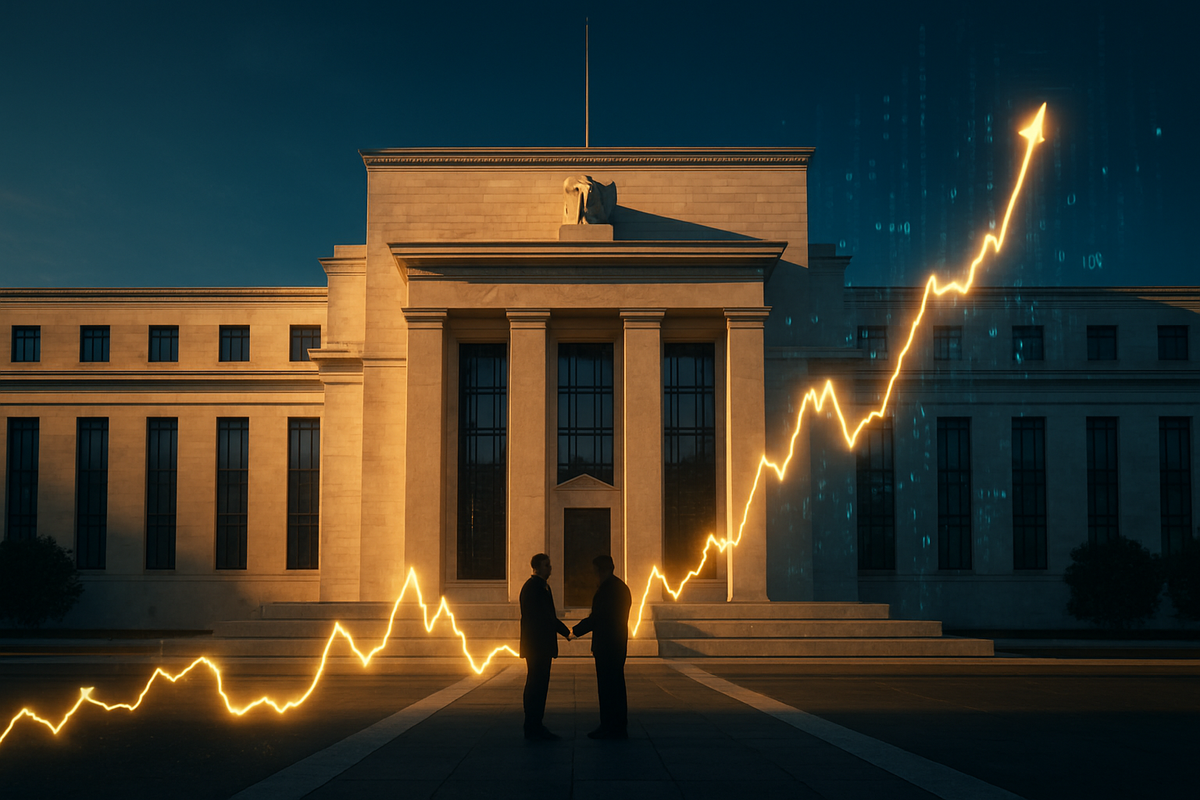
In a move that signals a seismic shift in American monetary policy, President Donald Trump has officially nominated former Federal Reserve Governor Kevin Warsh to succeed Jerome Powell as the Chair of the Federal Reserve. The announcement, made on January 30, 2026, marks the beginning of the end for the "Powell Era," a period defined by cautious data-dependency and a fiercely guarded independence that frequently put the central bank at odds with the White House.
The immediate implications are profound: Warsh’s arrival is expected to usher in a "regime change" characterized by aggressive deregulation, a smaller Fed footprint in financial markets, and a controversial new intellectual framework that links interest rate cuts to artificial intelligence-driven productivity. While the White House views Warsh as a visionary who can align the Fed with a pro-growth agenda, critics fear the nomination could compromise the central bank’s historic autonomy, potentially reigniting long-term inflationary pressures.
The Path to Nomination: A Friday Morning Bombshell
The nomination was made official via a statement from the President early Friday morning, following weeks of intense speculation and public friction between the administration and Chair Powell. In his announcement, the President described Warsh as a figure from "central casting" who possesses the "intellectual courage" to reform a central bank that he has repeatedly characterized as slow-moving and out of touch with modern economic realities. The move comes as Jerome Powell’s term is set to expire in May 2026, amid a backdrop of reported Department of Justice investigations into the incumbent Chair—a situation Powell’s allies have denounced as a political maneuver to force his exit.
Kevin Warsh, 55, is no stranger to the Fed’s marble halls. A former Morgan Stanley (NYSE: MS) executive, he served as the youngest Governor in the history of the Federal Reserve from 2006 to 2011. During the 2008 financial crisis, Warsh was a key lieutenant to then-Chair Ben Bernanke, acting as a critical bridge between the central bank and Wall Street. Since his departure, he has been a fellow at the Hoover Institution and a frequent critic of the Fed’s "mission creep," arguing that the bank has become too involved in social and environmental policy at the expense of its core mandate.
The market reaction to the news was swift and volatile. While U.S. equity futures initially dipped on concerns over Fed independence, the U.S. Dollar Index surged by 0.5% as investors priced in a more institutionalist approach to "sound money." However, the most dramatic movements occurred in the commodities and bond markets. Gold (COMEX: GC) prices plummeted nearly 5%, falling to approximately $5,132 an ounce, while Silver (COMEX: SI) tumbled 13% in a massive sell-off. In the bond market, long-term Treasury yields edged higher, reflecting a "sticky" inflation outlook despite the President’s demands for lower rates.
Winners and Losers: Wall Street Cheers, Silicon Valley Wary
The nomination has created a clear divide across corporate America, with the banking sector emerging as the primary beneficiary. Shares of JPMorgan Chase (NYSE: JPM) and Goldman Sachs (NYSE: GS) both trended higher following the news. Investors are betting that Warsh will lead a significant rollback of the "Basel III Endgame" capital requirements, which have long been a thorn in the side of major lenders. Analysts at major firms suggest that a Warsh-led Fed would likely favor "tailored" regulation, potentially freeing up billions in capital for banks to return to shareholders through buybacks and increased dividends.
Conversely, the high-growth technology sector and the real estate market faced immediate headwinds. Nvidia (NASDAQ: NVDA), Apple (NASDAQ: AAPL), and Microsoft (NASDAQ: MSFT) all saw their stock prices move into the red as the market digested the potential for a "steeper" yield curve. While Warsh has expressed a willingness to cut short-term rates, his long-standing criticism of the Fed’s bloated $6.5 trillion balance sheet suggests he may accelerate Quantitative Tightening (QT). A reduction in the Fed’s liquidity could keep long-term borrowing costs high, a direct threat to the rich valuation multiples of tech giants.
The real estate sector, represented by giants like Prologis (NYSE: PLD), also reacted with caution. Warsh’s historical skepticism toward the Fed’s holdings of mortgage-backed securities (MBS) suggests that the central bank may step back as a primary buyer in the housing market. This could keep mortgage rates elevated even if the federal funds rate begins to fall, further cooling a housing market that has already struggled under the weight of high financing costs throughout late 2025.
Historical Significance: Redefining Independence in the AI Age
Warsh’s nomination represents a fundamental challenge to the "data-dependent" framework that has guided the Fed for over a decade. He has long advocated for a more forward-looking approach, criticizing the current board for being "backward-looking" and overly reliant on lagging economic indicators. This shift mirrors historical precedents like the appointment of Paul Volcker in 1979, who broke from the consensus of his time to tackle stagflation through unconventional means. However, unlike Volcker, Warsh must balance his "inflation hawk" reputation with a President who has been vocally demanding lower interest rates.
The "intellectual bridge" Warsh has built to satisfy both camps is centered on artificial intelligence. He has recently argued that the "AI-induced productivity boom" allows the U.S. economy to grow at a faster clip without triggering a wage-price spiral. By this logic, the Fed can afford to lower interest rates because the structural capacity of the economy has expanded. This "AI Productivity" thesis is likely to be a central theme of his confirmation hearings, as it provides a theoretical justification for a more accommodative stance that still aligns with his "sound money" principles.
Furthermore, Warsh is expected to pursue a "narrower" mandate for the Fed. He has been a vocal critic of the bank's involvement in climate-related financial disclosures and other "social" initiatives. His tenure would likely see a return to a 1990s-style focus on price stability and financial regulation, a move that would please Republican lawmakers but draw fire from progressives who believe the Fed should play a broader role in managing systemic risks, including those posed by a changing climate.
The Road Ahead: Confirmation and Policy Pivots
The next immediate hurdle for Warsh is the Senate confirmation process. While Republicans hold a majority, the hearings are expected to be contentious. Democrats are likely to grill Warsh on his ties to the White House and whether he can truly act as an independent arbiter of the economy. The "Warsh Rule"—his preference for a smaller balance sheet—will also be under the microscope, as lawmakers from both parties worry about the potential for market instability if the Fed withdraws its support for the Treasury market too abruptly.
In the short term, the market will be watching for any "lame duck" moves from the outgoing Powell Fed. There is significant speculation that Powell may attempt to cement certain regulatory measures or maintain a restrictive stance to protect the bank's credibility before his departure. Once Warsh takes the gavel, the primary focus will shift to his "Plan for the Balance Sheet." If he moves to aggressively sell off assets, we could see a period of heightened volatility in both the bond and equity markets as the private sector is forced to absorb more debt.
Long-term, the Warsh nomination could redefine the relationship between the Executive Branch and the Federal Reserve for a generation. If he successfully coordinates with Treasury Secretary Scott Bessent to lower rates while maintaining price stability through productivity gains, it could validate a new "Trumpian" school of economic thought. However, if inflation re-accelerates under his watch, the experiment could be seen as a cautionary tale of the risks inherent in politicizing the world’s most powerful financial institution.
Wrap-Up: What Investors Should Watch
The nomination of Kevin Warsh as the next Federal Reserve Chair is more than just a personnel change; it is an ideological pivot that will reverberate through every corner of the global economy. For the first time in years, the "Fed Put"—the idea that the central bank will always step in to save the markets—is being questioned in favor of a more disciplined, market-driven approach to liquidity.
Investors should keep a close eye on three key indicators in the coming months:
- The 10-Year Treasury Yield: This will be the ultimate "truth serum" for Warsh’s credibility. If yields rise sharply, it indicates that the market doesn't buy his "AI-productivity" defense against inflation.
- Bank Earnings: Look for guidance from firms like JPMorgan Chase (NYSE: JPM) regarding capital return plans. If they begin to bake in a Basel III rollback, it signals high confidence in Warsh’s regulatory pivot.
- Senate Hearing Rhetoric: Pay attention to how Warsh describes his "independence." Any sign of total alignment with the White House could trigger a "risk-off" environment for international investors.
As we move toward the transition in May 2026, the financial world is entering unchartered territory. Whether Kevin Warsh becomes the "greatest Chair in history" or a symbol of central bank overreach remains to be seen, but one thing is certain: the era of "business as usual" at the Fed is over.
This content is intended for informational purposes only and is not financial advice.