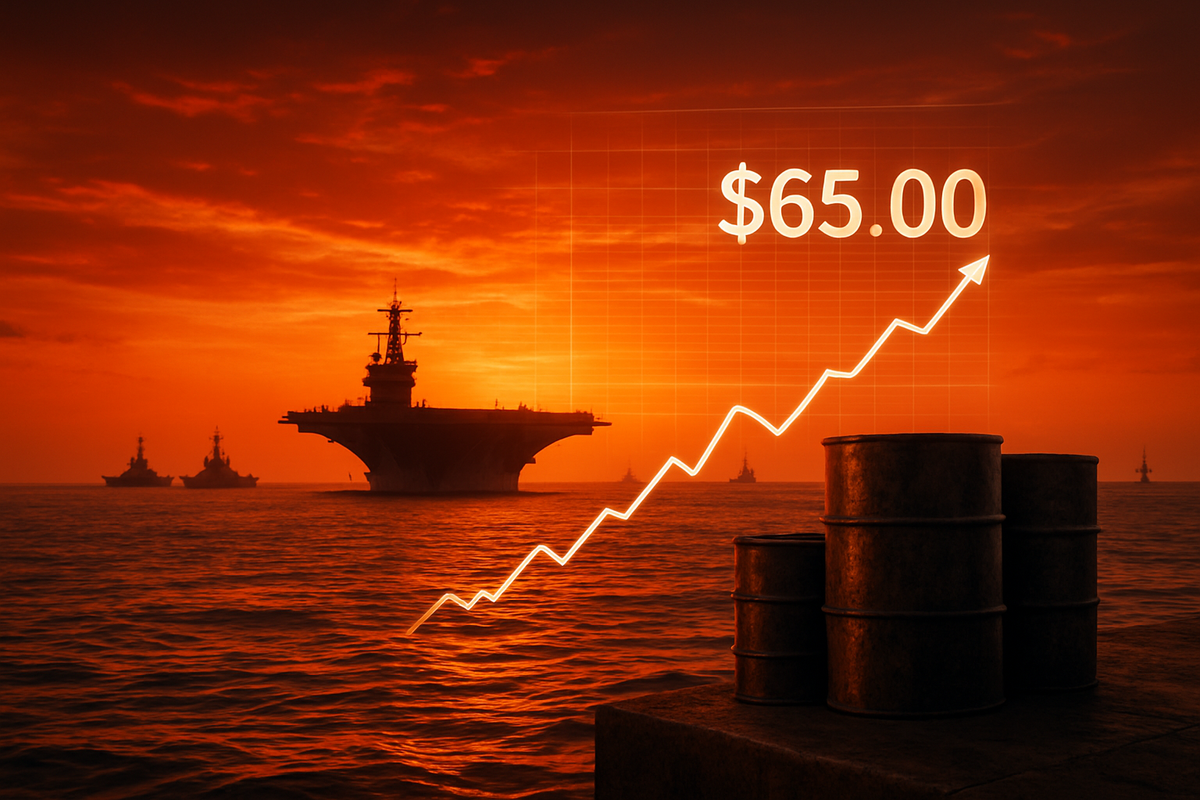
In a month characterized by high-stakes brinkmanship and a dramatic reshuffling of global energy maps, West Texas Intermediate (WTI) crude oil has found a precarious footing, stabilizing at the $65 per barrel threshold as of late January 2026. This stabilization comes after a volatile 15% rally throughout the month, a surge fueled by a potent cocktail of renewed Middle Eastern hostilities and a stunning geopolitical intervention in South America. For the global markets, $65 represents a "Goldilocks" zone—high enough to sustain the ambitious capital expenditure of U.S. shale giants, yet low enough to prevent an all-out inflationary spiral in a fragile global economy.
The immediate implications of this price floor are twofold: it provides a margin of safety for domestic producers while signaling that the "geopolitical risk premium" is back with a vengeance. Traders are currently pricing in a $3 to $4 premium per barrel, reflecting the very real possibility of a supply shock should the verbal sparring between Washington and Tehran escalate into a kinetic conflict. As the world watches the Persian Gulf, the energy sector is bracing for a year where the price of a barrel is determined as much by naval maneuvers as it is by supply and demand fundamentals.
The Road to $65: A Timeline of Escalation
The journey to $65 crude began in late 2025, a period where WTI languished in the mid-$50s due to cooling global demand and record-breaking U.S. production. However, the narrative shifted abruptly in early January 2026. The primary catalyst was the deployment of "The Armada," a massive U.S. naval strike group led by the aircraft carrier USS Abraham Lincoln, toward the Persian Gulf. This move, ordered by the second Trump administration, was framed as a response to Iran’s continued refusal to dismantle its nuclear program and a brutal internal crackdown on domestic dissent.
By mid-January, the tension reached a fever pitch. In response to the U.S. naval buildup, Tehran announced joint maritime drills with Russia and China in the Strait of Hormuz, a critical chokepoint through which 20% of the world’s seaborne oil passes. The threat of a blockade sent shockwaves through the futures markets, ending the bear run of 2025. Adding further complexity to the global supply chain was the January 3rd U.S. military operation in Venezuela, which resulted in the capture of President Nicolás Maduro. While the move was intended to eventually unlock Venezuelan reserves, the immediate aftermath has been regional instability, further tightening the global "perpetual crisis" sentiment that has kept oil prices buoyant.
Initial market reactions have been a mix of tactical hedging and cautious optimism. While the physical supply of oil remains sufficient for now, the "fear factor" has created a floor for prices. Analysts note that the current $65 level reflects a market that is waiting for the next shoe to drop—either a diplomatic de-escalation that could send prices back to $60, or a tactical strike that could catapult WTI toward the $90 mark almost overnight.
Industry Titans: Navigating the Geopolitical Maze
In this environment of high-stakes diplomacy and $65 oil, Chevron Corporation (NYSE: CVX) has emerged as a clear frontrunner. Reporting its Q4 2025 earnings today, January 30, 2026, Chevron posted a beat with earnings of $1.52 per share, surpassing the analyst consensus of $1.44. The company has been a primary beneficiary of the U.S. intervention in Venezuela; with a long-standing presence in the country, Chevron is uniquely positioned to ramp up production as the political landscape shifts. The company further signaled its confidence by announcing a 4% dividend increase, demonstrating that even at $65 oil, its cash-flow machine remains robust.
Conversely, Exxon Mobil Corporation (NYSE: XOM) is taking a more diversified approach to the current crisis. While the company continues to break production records in the Permian Basin, it is looking toward the March 2026 startup of its Golden Pass LNG project in Texas. This joint venture with QatarEnergy serves as a strategic hedge; if Middle Eastern tensions flare and oil prices spike, the global demand for U.S. liquefied natural gas (LNG) is expected to skyrocket. However, Exxon has faced some political headwinds, as CEO Darren Woods has recently sparred with the White House over the long-term investability of newly "liberated" territories like Venezuela, insisting on deeper legal reforms before committing massive new capital.
While the "Supermajors" are thriving, the losers in this scenario are the smaller, high-debt shale players and the heavy industrial consumers. Companies like Occidental Petroleum (NYSE: OXY), which are heavily leveraged toward domestic production, face the challenge of rising service costs that often accompany a $65+ oil environment. Furthermore, the transportation and airline sectors are beginning to feel the pinch of the 15% price hike in January, with fuel surcharges potentially threatening the nascent recovery in global travel.
A New Era of Energy Security
The current stabilization of oil prices fits into a much broader trend: the return of "Energy Security" as the dominant theme of the decade. Throughout the early 2020s, the industry's focus was largely on the energy transition and decarbonization. However, the events of 2025 and early 2026 have shifted the spotlight back to the military reliability of supply. The U.S. has effectively become the world’s "swing producer," a role traditionally held by Saudi Arabia, as domestic production hits levels that allow Washington to use energy as a primary tool of foreign policy.
This shift has significant regulatory and policy implications. The current administration’s aggressive stance in the Persian Gulf and South America suggests a move toward a "Pax Americana" in energy markets, where U.S. military might is used to ensure the flow of oil while simultaneously squeezing rivals like Iran. This mirrors historical precedents from the late 20th century, but with a modern twist: the U.S. is now doing so as a net exporter rather than a vulnerable importer. The ripple effects are being felt by European and Asian partners, who are increasingly looking to long-term contracts with U.S. firms to insulate themselves from the volatility of the Middle East.
The Horizon: What Comes Next?
In the short term, all eyes remain on the Strait of Hormuz. If Iran follows through on threats to disrupt shipping, the $65 floor will vanish, replaced by a vertical climb toward $100. However, if the U.S. naval presence succeeds in deterring a blockade, the market may see a "sell-on-news" event where prices retreat as the risk premium evaporates. The upcoming startup of Exxon’s Golden Pass project in March will be a critical milestone, potentially easing some of the global energy anxiety by providing a non-Middle Eastern source of fuel for European and Asian markets.
Strategically, oil companies are likely to continue their "barbell" approach: maximizing short-term output from high-yield assets like the Permian Basin while investing in LNG and carbon capture as long-term hedges. The challenge for the market will be managing the "perpetual crisis" sentiment. If prices stay at $65 or higher for the remainder of 2026, we can expect a renewed focus on domestic drilling permits and a potential clash between environmental regulations and the urgent need for national energy independence.
Closing Thoughts: The 2026 Market Outlook
The stabilization of WTI at $65 per barrel marks a turning point in the post-pandemic energy era. It reflects a market that has learned to live with chronic geopolitical instability, pricing in risk without succumbing to panic. For investors, the takeaway is clear: the energy sector has decoupled from the purely economic cycles of the past and is now a central theater of global geopolitics.
Moving forward, the market's health will depend on the delicate balance of U.S. production levels and the success of the administration’s "Armada" diplomacy. Investors should closely watch the Q1 2026 earnings reports and any shifts in the Iranian nuclear standoff. While $65 provides a comfortable cushion for the giants like Chevron (NYSE: CVX) and ExxonMobil (NYSE: XOM), the volatility of the past month serves as a stark reminder that in the world of oil, peace is often just a temporary state between crises.
This content is intended for informational purposes only and is not financial advice.