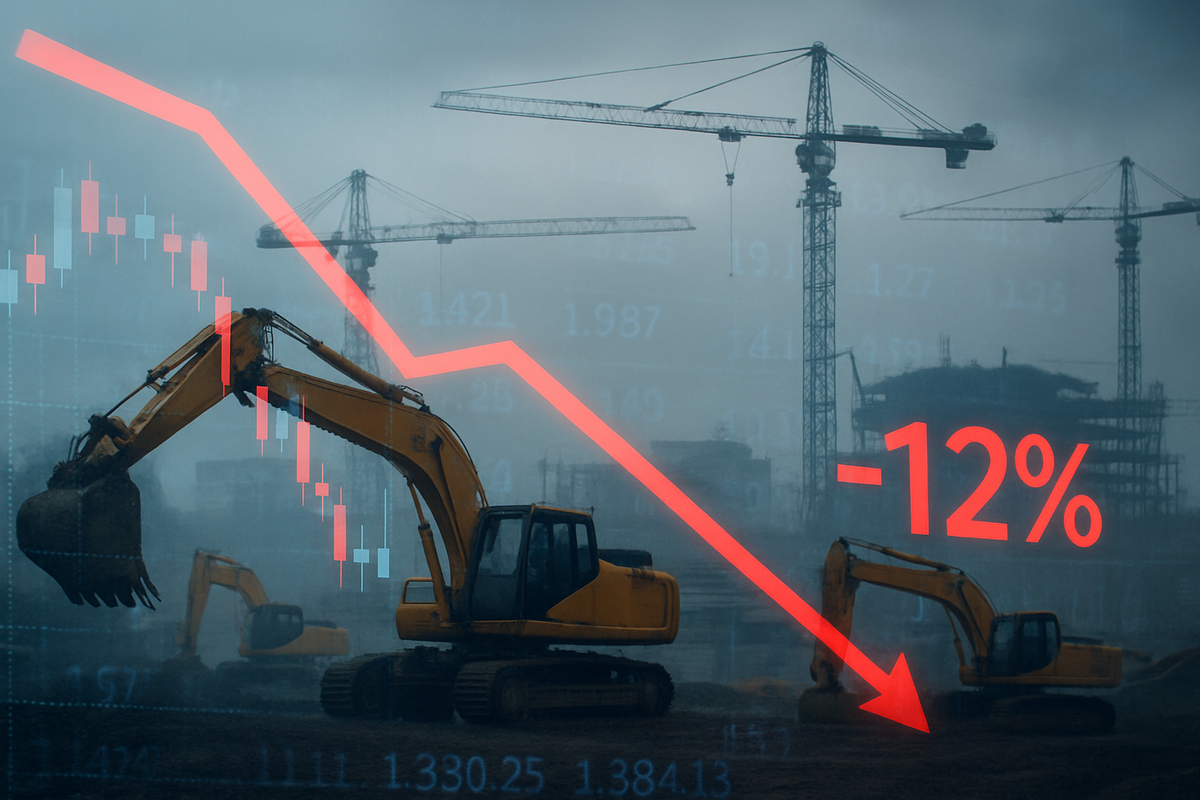
The industrial sector faced a harsh reality check this week as United Rentals (NYSE: URI), the world’s largest equipment rental company, saw its shares dive by nearly 13% following the release of its fourth-quarter earnings and a surprisingly cautious revenue forecast for 2026. Despite coming off a record-breaking 2025, the company’s conservative stance on the upcoming year has ignited fears that the post-pandemic construction boom may finally be hitting a structural ceiling.
The sell-off, which erased billions in market capitalization on Friday, January 30, 2026, came as investors grappled with a rare miss on both the top and bottom lines. While United Rentals remains a dominant force in the North American market, the market's reaction suggests that "good enough" is no longer sufficient for a company that has seen its valuation swell over the past two years. The 12.8% slide represents one of the sharpest single-day declines for the stock in recent history, signaling a potential pivot in investor sentiment toward the broader industrials category.
A "Conservative" Guidance Shakes Investor Confidence
The volatility began late on January 28, when United Rentals reported an adjusted earnings per share (EPS) of $11.09 for the fourth quarter of 2025—falling short of the $11.80 consensus estimate. Total revenue for the quarter reached $4.21 billion, missing the projected $4.24 billion. While these misses were modest, it was the forward-looking guidance that truly rattled the street. CEO Matthew Flannery projected 2026 revenue to land between $16.8 billion and $17.3 billion, implying a growth rate as low as 2.8% at the bottom end.
The timeline of the drop was swift. Following the earnings call on January 29, several analysts downgraded the stock, citing margin compression and a "sluggish" industrial economy. By the morning of January 30, the stock opened significantly lower and continued to slide throughout the trading session. Investors were particularly concerned about rising delivery costs and the "normalization" of the used equipment market, which had previously provided a lucrative tailwind for URI.
Key stakeholders, including institutional investors who had ridden URI’s record-setting 2025 gains, appeared to be in a "sell the news" mode. Flannery attempted to soothe nerves by highlighting the company's resilience in "mega-projects" like data centers and infrastructure. However, the market focused on the slowing "local" business, which often serves as the canary in the coal mine for regional economic health. To counter the narrative, URI’s board authorized a massive $5 billion share repurchase program, but even that was not enough to stem the bleeding on Friday.
Winners and Losers in a Re-calibrating Market
The primary "loser" in this event is undoubtedly United Rentals (NYSE: URI), but the ripple effects are being felt across the rental landscape. Herc Holdings (NYSE: HRI), the third-largest player in the space, saw its shares trade lower in sympathy, though it has remained more resilient in recent months following its strategic acquisition of H&E Equipment Services. Herc’s ability to maintain its own guidance late last year now looks like a potential competitive advantage as URI recalibrates.
Conversely, some analysts suggest that specialty equipment providers could emerge as relative winners. As URI noted a 9.2% growth in its specialty segment—pumps, power, and HVAC—companies that focus exclusively on these high-margin, mission-critical niches may attract capital fleeing the more commoditized general rental market. Additionally, as URI slows its capital expenditure for new fleet additions, equipment manufacturers like Caterpillar (NYSE: CAT) and Deere & Company (NYSE: DE) could face downward pressure on sales volumes in the short term.
The most intriguing "winner" might be Sunbelt Rentals, owned by Ashtead Group (LSE: AHT). Sunbelt is currently preparing for a highly anticipated New York Stock Exchange listing scheduled for March 2, 2026. The current pullback in URI’s valuation could provide a more "attractive" entry point for Sunbelt’s debut, allowing the company to price its IPO against a more realistic market backdrop rather than at the height of a speculative bubble.
Macroeconomic Headwinds and the End of the "Easy" Growth Era
This event fits into a broader trend of industrial deceleration that has been quietly building since mid-2025. For years, United Rentals and its peers benefited from a "perfect storm" of high demand, limited equipment supply, and massive federal infrastructure spending. However, the 2026 guidance suggests that these tailwinds are fading. Inflationary pressures on labor and logistics, combined with "tariff-related uncertainty" mentioned by analysts, are beginning to bite into the operating margins of heavy industry.
The shift toward "mega-projects" is a significant structural change. While large-scale semiconductor plants and data centers provide a steady floor for revenue, they require massive capital commitments and have longer lead times than the high-velocity local construction projects that URI traditionally relied on. This move toward a "bifurcated" market—where large projects thrive while local business cools—is a trend that competitors like Herc and Sunbelt are also navigating.
Historically, URI has been seen as a proxy for the U.S. economy. A 12% drop on conservative guidance is reminiscent of the mid-cycle slowdowns seen in 2015 and 2018. In those instances, the company eventually recovered by aggressively cutting costs and focusing on "cold-start" specialty locations. The policy implication here is that the industrial sector may be signaling to the Federal Reserve that the economy is finally cooling enough to warrant a more dovish stance on interest rates later in 2026.
What Comes Next: Strategic Pivots and Market Opportunities
In the short term, United Rentals will likely double down on its $5 billion share repurchase program to support the stock price and signal confidence to the market. Investors will be looking for "cost discipline" in the Q1 2026 report to see if management can protect margins despite slower revenue growth. If URI can successfully integrate more "specialty" locations, which offer higher margins and less cyclicality, it may be able to offset the sluggishness in its general rental fleet.
Long-term, the focus will remain on the execution of the "mega-project" strategy. The industry is watching to see if the surge in AI-driven data center construction and the transition to green energy infrastructure can truly replace the volume lost from a cooling residential and commercial real estate market. Potential scenarios include a period of consolidation, where URI uses its strong balance sheet to acquire smaller, specialized regional players that are struggling with the same margin pressures.
The Bottom Line for Investors
The sudden 12% drop in United Rentals serves as a stark reminder that even industry leaders are not immune to the gravity of macroeconomic cycles. The key takeaway is that the "rental-comotion" that drove shares to record highs in 2024 and 2025 has reached a stage of normalization. While URI remains fundamentally strong with record annual revenues, the market is now pricing in a period of slower, more deliberate growth.
As we move forward into 2026, investors should closely watch the Sunbelt (Ashtead) NYSE listing in March, as it will provide a fresh valuation benchmark for the entire sector. The ability of United Rentals to navigate "tariff-related" cost spikes and maintain its dividend growth will be the primary indicators of its health. For now, the industrial bellwether has sounded a note of caution that the market would be wise to heed.
This content is intended for informational purposes only and is not financial advice.