In a pivotal moment for the electric vehicle pioneer, Tesla, Inc. (NASDAQ: TSLA) reported fourth-quarter 2025 earnings that defied pessimistic forecasts, triggering a relief rally across the technology and automotive sectors. Despite posting its first annual revenue contraction in company history, Tesla delivered a significant beat on adjusted earnings per share and, more critically, a dramatic recovery in profit margins. The results, released on January 28, 2026, have shifted the investor narrative from a struggling car manufacturer to an aggressive "physical AI" and robotics powerhouse.
The market response has been swift and decisive. Tesla’s stock, which had been languishing under the weight of declining delivery volumes and the expiration of federal EV tax credits, rebounded nearly 4% in the sessions following the report. As of January 30, 2026, shares are consolidating these gains as investors digest a strategic "hard pivot" that includes the sunsetting of legacy models and a massive capital commitment to autonomous transport and humanoid robotics.
A Surprise Bottom-Line Beat Amidst Revenue Headwinds
The fourth quarter of 2025 was a period of stark contrasts for the Austin-based giant. Tesla reported adjusted earnings per share (EPS) of $0.50, comfortably clearing the Wall Street consensus of $0.44 to $0.45. This earnings beat came despite a 3.1% year-over-year decline in total revenue, which landed at $24.90 billion. The revenue dip was largely driven by a 16% slide in vehicle deliveries, which fell to 418,227 units for the quarter. However, the "star of the show" was the GAAP gross margin, which surged to 20.1%—the highest level in over eight quarters.
This margin recovery was no accident. Throughout late 2025, Tesla aggressively pursued manufacturing efficiencies and benefited from a more stable supply chain for battery materials. The surge in profitability was also bolstered by the record performance of Tesla’s Energy Storage segment, which deployed 14.2 GWh in the quarter alone. This diversification away from pure automotive sales provided a necessary buffer as the core vehicle market faced cooling demand and the aforementioned loss of U.S. consumer tax incentives.
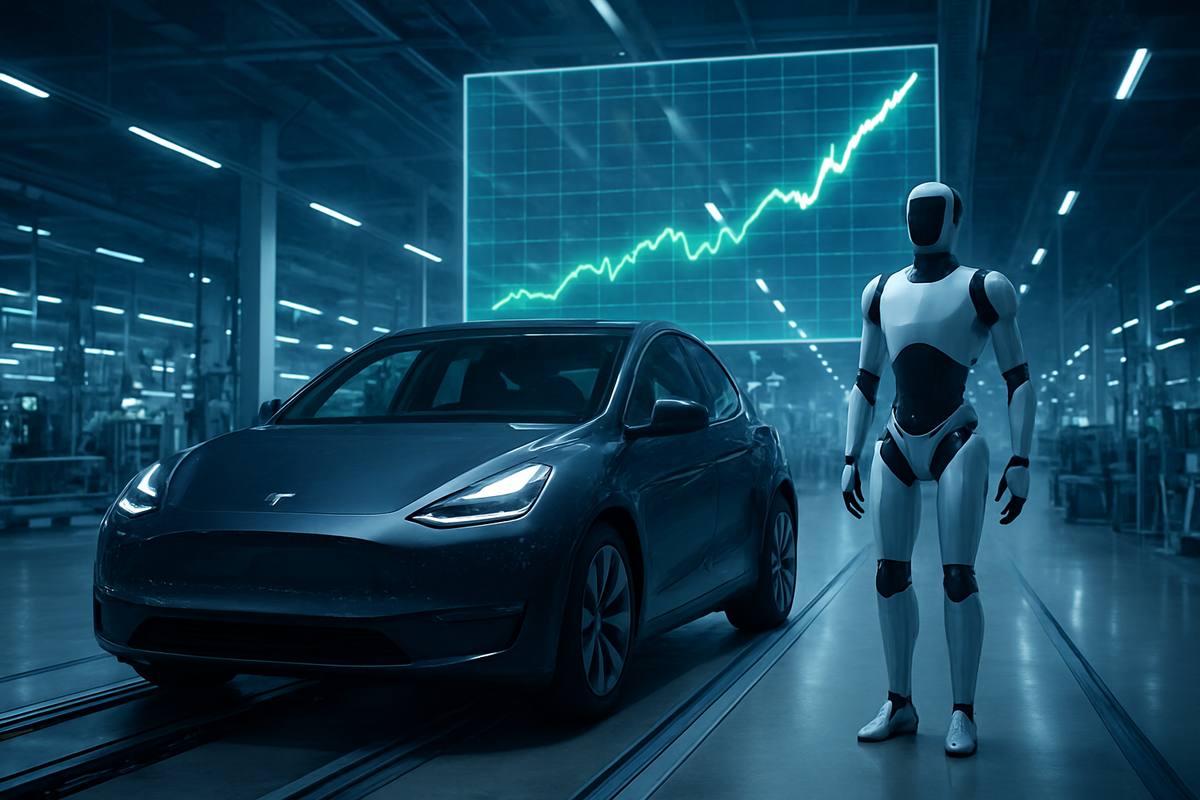
During the earnings call, CEO Elon Musk stunned observers by announcing the "honorable discharge" of the Model S and Model X programs. These flagship vehicles, which pioneered the modern EV era, will be discontinued to free up factory space for the production of the Optimus humanoid robot and the upcoming "Cybercab." This decision signals a ruthless prioritization of future-state technology over legacy hardware, a move that initially rattled traditionalist analysts but ultimately fueled the stock’s rebound as growth-oriented investors doubled down.
Initial industry reactions were a mix of awe and skepticism. While some analysts questioned the wisdom of abandoning the high-end luxury sedan market, the broader market focused on the stabilized net income of $840 million and the robust free cash flow of $1.4 billion. The report suggests that even in a "down year" for deliveries, Tesla’s ability to extract profit through software subscriptions and energy solutions remains unparalleled in the EV space.
Evaluating the Landscape: Winners and Losers
Tesla’s successful margin defense puts immense pressure on direct competitors. Luxury EV makers like Lucid Group, Inc. (NASDAQ: LCID) and Rivian Automotive, Inc. (NASDAQ: RIVN) may find themselves in a precarious position. If Tesla can maintain 20% margins while cutting costs and pivoting to AI, competitors still struggling with negative gross margins will find it increasingly difficult to attract the capital needed for their own autonomous transitions. Tesla’s "efficiency first" approach serves as a warning that the "price war" of 2024 and 2025 has left the incumbent leader leaner and more dangerous.
On the winning side of this event are AI infrastructure providers and battery material specialists. With Tesla projecting capital expenditures to exceed $20 billion in 2026, suppliers like Nvidia (NASDAQ: NVDA), which provides the hardware for Tesla’s Dojo supercomputer and FSD training clusters, stand to benefit from sustained high-level demand. Furthermore, the record deployment of the Megapack and Powerwall suggests that the utility-scale storage market is decoupled from the automotive slump, benefiting Tesla’s own energy division and its battery partners.
Conversely, the traditional "Big Three" Detroit automakers—General Motors (NYSE: GM) and Ford Motor Company (NYSE: F)—face a renewed threat. While they have recently scaled back their EV ambitions to focus on hybrids, Tesla’s pivot toward a fully autonomous "Cybercab" fleet by April 2026 threatens to leapfrog their current technology stacks entirely. The market is now rewarding Tesla for its AI potential, a valuation premium that remains elusive for traditional manufacturers.
The Physical AI Pivot: A Broader Industry Shift
Tesla’s latest results are a microcosm of a broader shift in the tech industry: the transition from digital AI to "physical AI." For years, the market focused on Large Language Models (LLMs) and chatbots. Tesla’s Q4 2025 report marks the moment when the market began to seriously price in the value of AI in the physical world—robotics and autonomous transit. By reaching 1.1 million active Full Self-Driving (FSD) subscribers and transitioning to a subscription-only model, Tesla has effectively turned its fleet into a high-margin recurring revenue engine.
This event mirrors historical pivots by other tech giants, such as Apple’s shift from hardware-centric sales to a services-heavy model in the late 2010s. Just as Apple used the iPhone as a trojan horse for the App Store and iCloud, Tesla is using its vehicle fleet as a foundation for FSD and its energy ecosystem. The "first annual revenue decline" for Tesla is being viewed by long-term bulls not as a sign of decay, but as a necessary "reset" before the next exponential growth curve driven by robotics.
However, regulatory hurdles remain the primary "ripple effect" to watch. As Tesla scales its robotaxi fleet in Austin and San Francisco, federal and state regulators are under increasing pressure to standardize autonomous vehicle (AV) safety protocols. The success or failure of Tesla’s April 2026 Cybercab launch will likely dictate the regulatory landscape for the entire industry for the next decade.
What Lies Ahead: The Road to April 2026
The short-term outlook for Tesla is focused on execution. The company must now prove it can successfully transition its Fremont and Giga Texas production lines from Model S/X to the Optimus robot without significant downtime. Any delays in the production ramp of the humanoid robot could dampen the current enthusiasm. Strategically, the company is also expected to seek further partnerships or "licensing" deals for its FSD software, which Musk hinted could be a major revenue catalyst in late 2026.
Long-term, the central question is whether the "Cybercab" can achieve the mass-market scale needed to replace the revenue lost from the declining Model 3 and Model Y delivery growth. Tesla is essentially betting the company on the idea that the cost-per-mile of an autonomous taxi will be so low that traditional car ownership becomes obsolete. This is a high-stakes gamble that requires not just technological perfection, but a fundamental shift in consumer behavior.
Potential scenarios range from a "Golden Age of Robotics," where Tesla dominates the global transport-as-a-service market, to a "Regulatory Standoff," where safety concerns and legal challenges keep the Cybercab grounded. For now, the market is pricing in a cautiously optimistic middle ground, fueled by the recent margin recovery.
A New Chapter for the EV Leader
Tesla’s Q4 2025 earnings report will likely be remembered as the moment the company officially outgrew its "automaker" label. By beating profit expectations in the face of falling vehicle sales, Tesla demonstrated a level of fiscal resilience that its competitors lack. The 20.1% gross margin is a testament to the company's manufacturing prowess, while the discontinuation of legacy models marks a bold commitment to an AI-first future.
Moving forward, the market will be less interested in quarterly delivery "beats" and more focused on the development of the Optimus robot and the reliability of FSD version 13 and beyond. The stock's rebound suggests that the "Elon Musk discount"—the volatility often associated with the CEO’s public persona—has been temporarily offset by the tangible progress in the company’s high-margin segments.
Investors should watch for three key metrics in the coming months: the stabilization of Model Y delivery volumes, the rate of FSD subscription growth, and any early production milestones for the Optimus robot. As 2026 begins, Tesla is no longer just a car company; it is a laboratory for the future of labor and transportation.
This content is intended for informational purposes only and is not financial advice.