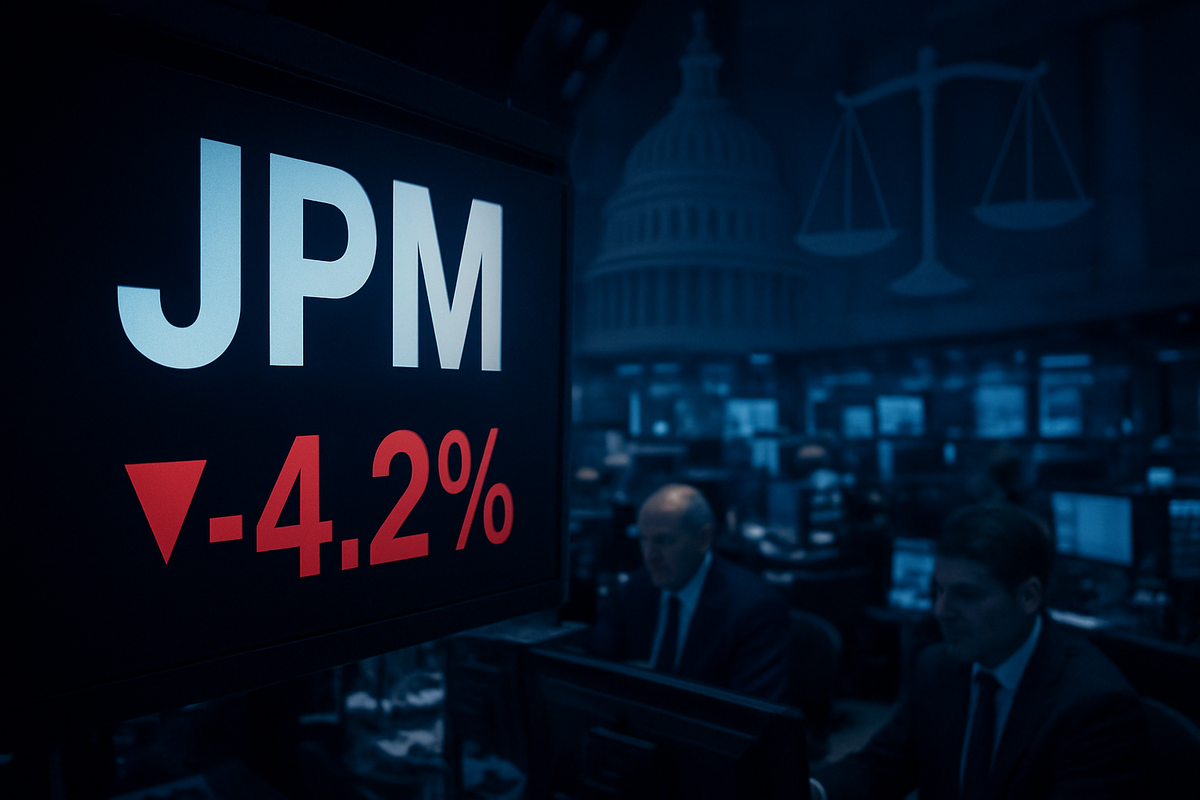
JPMorgan Chase (NYSE: JPM) officially opened the fourth-quarter earnings season on January 13, 2026, delivering a set of results that sent a chill through the financial sector. Despite reporting robust headline revenue and a significant beat on adjusted earnings per share, the banking giant saw its stock price tumble by 4.2% in a single trading session. The decline, the sharpest daily drop for the firm in months, was fueled by an unexpected "expense shock" and a massive $2.2 billion reserve build, signaling that even the nation’s largest lender is not immune to a hardening regulatory environment and shifting consumer credit risks.
The market reaction to JPMorgan’s report served as a stark warning for the broader financial industry. Investors, who had been positioning for a "Goldilocks" scenario of high interest rates and low defaults, were instead met with management’s cautious guidance for 2026. This sentiment quickly spread, dragging down peer institutions and raising questions about the sustainability of the banking sector's recent rally. As the industry grapples with new regulatory proposals and a potential cap on consumer lending fees, JPMorgan's mixed performance has set a somber tone for the weeks of earnings reports to come.
Expense Volatility and the Apple Card Integration
The primary catalyst for the 4.2% slide in JPMorgan's shares was the disclosure of significantly higher-than-expected operating expenses. For the fourth quarter of 2025, the bank reported that total managed revenue reached $46.8 billion, a 7% increase year-over-year. However, this growth was overshadowed by a "forward purchase commitment" reserve of $2.2 billion related to the acquisition of the Apple Card portfolio from Goldman Sachs (NYSE: GS). This accounting requirement forced JPMorgan to set aside billions in provisions before even collecting its first dollar of interest from the new customers, a move that caught many analysts off guard.
The timeline leading up to this moment has been defined by a consolidation of consumer finance power. Over the past year, JPMorgan has aggressively expanded its footprint, but the Q4 report revealed the hidden costs of such scale. On the earnings call, management warned that 2026 expenses would likely hit $96 billion, driven by technology investments and the higher cost of servicing a massive, diversified loan book. While the bank’s net income stood at a formidable $13.0 billion—or an adjusted $5.23 per share—the market focused almost exclusively on the $103 billion Net Interest Income (NII) guidance for 2026, which many viewed as overly conservative given the current interest rate trajectory.
Initial market reactions were swift and unforgiving. Within the first hour of trading on January 13, JPM shares plummeted as institutional investors recalibrated their models to account for higher "expense creep." The bank’s CET1 capital ratio remained strong at 14.5%, but the specter of rising G-SIB (Globally Systemically Important Bank) surcharges—slated to rise to 5.0% for the firm—suggested that the pace of share buybacks might slow significantly in the coming year.
Winners and Losers in a Rebounding Market
While JPMorgan bore the brunt of the initial sell-off, the ripple effects created a bifurcated landscape across Wall Street. Citigroup (NYSE: C) and Bank of America (NYSE: BAC) were both dragged lower in the immediate aftermath, falling 3.5% and 2.8% respectively, as investors feared similar reserve builds for their own credit card portfolios. Citigroup, in particular, was identified as a potential "loser" due to its high exposure to retail credit cards, making it vulnerable to the same regulatory pressures voiced by JPMorgan’s leadership.
Conversely, the "pure-play" investment banks emerged as the clear winners as the week progressed. Just two days after JPMorgan’s report, Morgan Stanley (NYSE: MS) and Goldman Sachs reported blowout numbers that partially redeemed the sector. Morgan Stanley saw its stock climb 5.8% after reporting a 47% surge in investment banking fees, while Goldman Sachs rose 4.6% on the back of record equity trading revenue. These results suggested that while "Main Street" banking is facing expense and regulatory hurdles, "Wall Street" dealmaking is entering a renaissance.
Smaller regional players also found themselves in a difficult position. Wells Fargo (NYSE: WFC) saw a 3.1% decline following JPMorgan's report, as the market began to price in higher regulatory compliance costs for all large-cap banks. The diverging fortunes of these institutions highlight a shift in investor preference toward firms with high fee-based income, such as wealth management and M&A advisory, over those heavily reliant on net interest margins and some consumer lending.
Regulatory Headwinds and the 10% Cap Proposal
The mixed results come at a time of intense friction between the banking industry and federal regulators. CEO Jamie Dimon used the earnings platform to voice strong opposition to a new proposal signaled by the Trump administration: a 10% cap on credit card interest rates (APRs). Dimon warned that such a policy would "fundamentally alter the economics of consumer lending" and could force banks to restrict credit access for millions of lower-income Americans. This regulatory threat has become a major overhang for the sector, adding a layer of political risk that had been largely absent during the 2024-2025 period.
Furthermore, the finalization of the "Basel III Endgame" capital standards continues to weigh on the industry. Although the finalized rules were less punitive than the initial drafts proposed in 2023, the requirement for higher capital buffers remains a drag on Return on Equity (ROE). For JPMorgan, the increase in the G-SIB surcharge to 5.0% represents a permanent hurdle to capital efficiency. This fits into a broader industry trend where "too big to fail" institutions are being asked to hold more "rainy day" capital, even as they are encouraged to provide the liquidity necessary to fuel economic growth.
The situation mirrors the post-2008 regulatory environment, but with a modern twist. In 2026, the focus has shifted from solvency to "fairness" in consumer fees, with regulators targeting everything from "junk fees" to high-interest revolving debt. This regulatory pivot is forcing banks to seek out more stable, non-interest revenue streams, such as the AI-driven data center financing and infrastructure debt that have recently become high-margin opportunities for the largest firms.
The Path Toward 2027: Strategic Pivots Required
Looking ahead, the banking sector faces a period of mandatory adaptation. In the short term, JPMorgan and its peers will likely focus on aggressive cost-cutting measures to offset the "expense shock" revealed this quarter. We may see a slowdown in new branch openings and a more disciplined approach to technology spending as firms prioritize protecting their bottom lines. The strategic acquisition of the Apple Card portfolio suggests that JPMorgan is still willing to play offense, but the $2.2 billion reserve build serves as a reminder that inorganic growth now carries a higher upfront cost.
Market opportunities are likely to emerge in the "shadow banking" or private credit sectors. As traditional banks pull back on riskier consumer lending due to the proposed 10% interest rate cap, non-bank lenders may step in to fill the void, albeit at higher costs to the borrower. For investors, the "long-term" play may reside in banks that have successfully diversified into wealth management and technology-driven services. Morgan Stanley's record $9.3 trillion in client assets provides a blueprint for the type of stable, fee-based business model that can weather regulatory volatility.
In the coming months, the primary scenario to watch is the legislative fate of the credit card interest rate cap. If the proposal gains traction in Congress, it could trigger a massive re-rating of the entire banking sector. Conversely, if the industry successfully lobbies for a more moderate "tiering" of rates, the current sell-off in JPMorgan and its peers may eventually be viewed as a significant buying opportunity for those betting on a resilient American consumer.
A New Chapter of Caution
JPMorgan Chase’s Q4 2025 earnings report has effectively ended the era of "easy wins" for the financial sector. The 4.2% drop in its share price serves as a definitive signal that the market is no longer satisfied with top-line growth alone; it is now demanding expense discipline and regulatory foresight. The combination of high integration costs for the Apple Card and the looming threat of price caps on consumer debt has replaced the previous optimism with a necessary dose of realism.
Moving forward, the significance of this event lies in its role as a "sector reset." Investors should closely monitor the upcoming reports from regional banks to see if the "expense shock" is a systemic issue or unique to the giants of Wall Street. The key takeaways for the coming months are clear: capital efficiency is king, and regulatory resiliency is the new benchmark for success.
As we navigate the first half of 2026, the financial sector will remain in a state of high sensitivity. While the "M&A renaissance" provides a silver lining for investment banks, the bread-and-butter business of consumer lending faces its most significant challenge in over a decade. For the public and investors alike, the message from 270 Park Avenue is loud and clear: the landscape has shifted, and the road ahead will require a much more careful hand.
This content is intended for informational purposes only and is not financial advice.