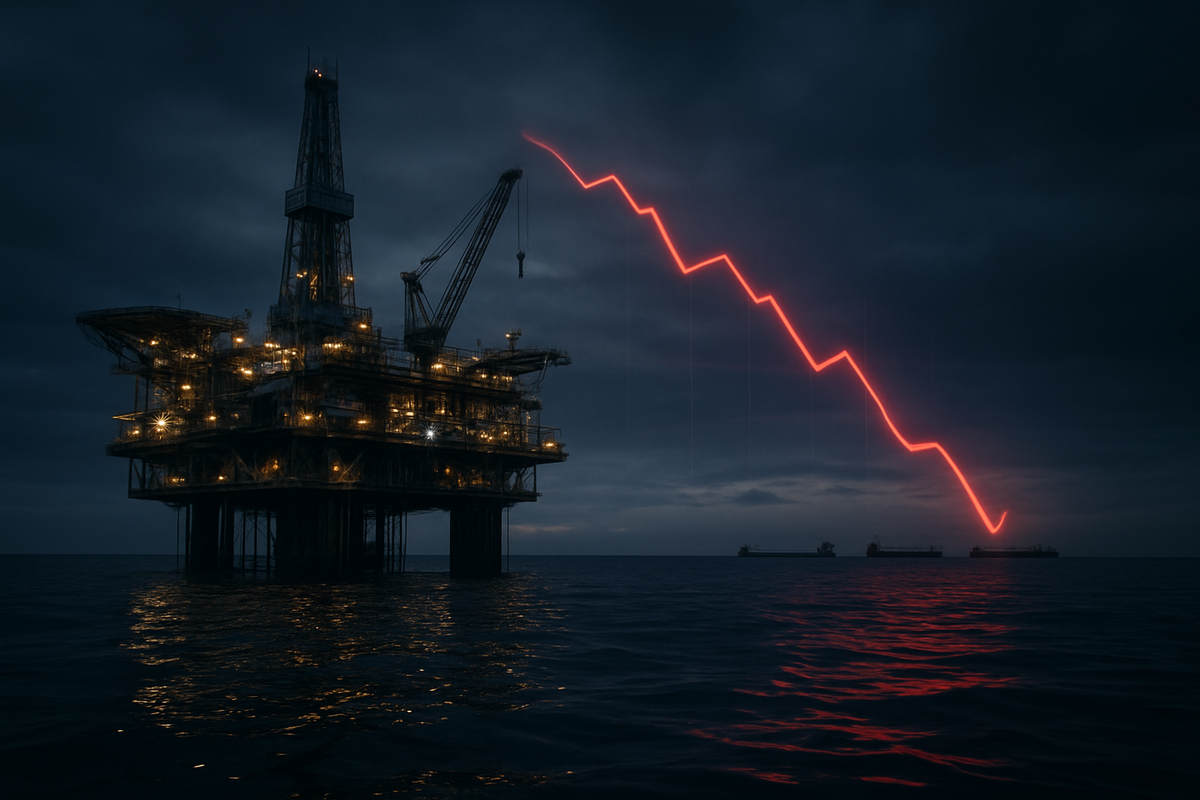
The global energy sector has entered 2026 facing a dual crisis of structural oversupply and sudden geopolitical upheaval. Despite a dramatic start to the year marked by the capture of Venezuelan President Nicolás Maduro by U.S. forces on January 3, crude oil prices have struggled to maintain any upward momentum. As of mid-January, Brent crude is languishing between $55 and $60 per barrel, representing a nearly 20% decline from 2025 averages, as a looming "super-glut" of supply outweighs the temporary risk premiums of political instability.
The immediate implications for the market are stark: energy stocks are decoupling from traditional geopolitical triggers. While news of regime change in Caracas initially sent shockwaves through trading floors, the reality of a massive global surplus—estimated by the International Energy Agency (IEA) to reach 3.84 million barrels per day (b/d) this year—has quickly reasserted itself as the dominant narrative. For major oil producers and their investors, the focus has shifted from "where is the next barrel coming from?" to "how can we survive in a sub-$60 world?"
A Surplus of Supply and a Deficit of Certainty
The current market malaise is the culmination of a multi-year surge in production from non-OPEC+ nations and a cooling of demand in major economies. Throughout 2025, record output from the United States, Brazil, and Guyana saturated the market, creating a buffer that has proven remarkably resilient. By early January 2026, global oil inventories had climbed to their highest levels since the 2020 pandemic, leaving little room for prices to rise even as headlines signaled potential disruptions in South America.
The capture of Nicolás Maduro on January 3, 2026, initially acted as a catalyst for volatility. In the hours following the announcement, energy stocks spiked as traders speculated on a total collapse of Venezuelan exports or a rapid reintegration of the country into the Western energy sphere. However, the rally was short-lived. Industry analysts at Wood Mackenzie and Kpler quickly noted that Venezuela’s "broken" infrastructure would require at least 18 months of intensive capital investment before any significant new production could reach the market. By January 14, the "geopolitical risk premium" has largely evaporated, replaced by fears that a reformed Venezuela might eventually add even more supply to an already drowning market.
In response to these pressures, the OPEC+ alliance has moved into a defensive crouch. In late 2025, the group decided to pause all planned production increases through the first quarter of 2026. Voluntary cuts totaling 1.65 million b/d have been extended through the end of the year, yet the market remains unimpressed. The next ministerial meeting, scheduled for June 7, 2026, is now viewed by analysts as a critical crossroads where the group may be forced to choose between deeper cuts or a price-war strategy to reclaim market share from high-cost producers.
Corporate Impact: Navigating the Bear Market
The downward pressure on prices has created a challenging environment for the "Supermajors," though the impact has been uneven. Chevron (NYSE: CVX) emerged as the most volatile stock of the month. Given its existing joint ventures in Venezuela and its long-standing history in the region, Chevron’s shares surged 5.5% on the news of Maduro’s capture. However, that gain was erased by a 4.2% slide a week later as the market realized that the "rebuilding phase" for Venezuelan assets would be a multi-billion dollar drain on capital with no immediate return on investment.
ExxonMobil (NYSE: XOM) has fared slightly better, relying on its massive Permian Basin operations and its "Cowboy Connector" pipeline to maintain logistical efficiency. While XOM shares saw a modest 2.5% bump in early January, the company is now focusing on defensive strategies. Analysts expect Exxon to report adjusted earnings of $1.66 per share for the final quarter of 2025—a solid figure that nonetheless reflects the reality of lower crude realizations. The company’s focus has shifted toward high-margin projects in the Permian and Guyana to offset the softening price environment.
Meanwhile, Shell (NYSE: SHEL) is grappling with a different set of challenges. Trading near £26.96 on the London Stock Exchange, the company recently flagged a difficult fourth quarter for its Chemicals and Products division. The global supply glut has not only hit upstream crude prices but has also compressed margins in the refining and petrochemical sectors. To support its valuation in a falling market, Shell is currently executing an aggressive share buyback program through the end of January 2026, a move seen by many as a necessary hedge against declining investor sentiment in the broader energy sector.
Wider Significance: The End of the Post-Pandemic Era
The 2026 supply glut marks a significant turning point in the global energy transition. For the past five years, the industry has been defined by supply-side constraints and a post-pandemic demand surge. Today, that dynamic has flipped. The IEA’s forecast of a 3.84 million b/d surplus suggests that the "peak demand" narrative is finally gaining structural momentum, even if the absolute peak has not yet been reached. The slowdown is particularly evident in China, where the rapid adoption of electric vehicles and a shift toward petrochemicals over transportation fuels have fundamentally altered demand patterns.
Furthermore, the plateauing of U.S. shale production is changing the "swing producer" dynamic. After reaching a record 13.6 million b/d in 2025, U.S. output is projected to remain flat at roughly 13.5 million b/d in 2026. This stagnation is not due to a lack of resources but to a strict adherence to capital discipline. Producers in mature basins like the Bakken and Eagle Ford are facing breakeven costs in the $50–$55 range; with WTI prices hovering near those levels, there is no economic incentive to drill. This shift effectively hands the keys of market management back to OPEC+, though the group's ability to control prices is being tested by the sheer volume of non-OPEC barrels from Guyana and Brazil.
The Road Ahead: Potential Scenarios
Looking forward to the remainder of 2026, the energy sector faces two primary paths. The first is a "controlled landing," where OPEC+ successfully manages the phase-out of its voluntary cuts without crashing the price floor. This would require exceptional discipline and likely a further extension of current cuts into 2027. If successful, Brent could stabilize in the low $60s, allowing well-capitalized firms like ExxonMobil and Chevron to continue their dividend and buyback programs.
The second, more volatile scenario is a "market share war." If OPEC+ members become frustrated with the loss of revenue and the continued growth of non-OPEC production, they may choose to "open the taps" to flush out high-cost producers—including some U.S. shale operators. While this would be catastrophic for short-term stock prices, it is a tactic the group has used historically to reset the market. Investors should keep a close eye on the June 2026 OPEC+ meeting for any signals of this strategic pivot.
Summary and Investor Outlook
The first weeks of 2026 have proven that even the most significant geopolitical events cannot hide the fundamental reality of a saturated oil market. The capture of Nicolás Maduro provided a temporary distraction, but the long-term challenge for the energy sector remains a massive supply surplus and slowing demand growth. For investors, the takeaway is clear: the era of easy gains driven by supply scarcity is over.
In the coming months, market participants should watch for three key indicators: the pace of infrastructure assessments in a post-Maduro Venezuela, the discipline of U.S. shale producers as they approach their breakeven points, and any shifts in rhetoric from the Saudi-led OPEC+ coalition. While the major energy stocks offer robust balance sheets and attractive yields, their performance in 2026 will be defined by their ability to maintain efficiency in a low-price environment.
This content is intended for informational purposes only and is not financial advice