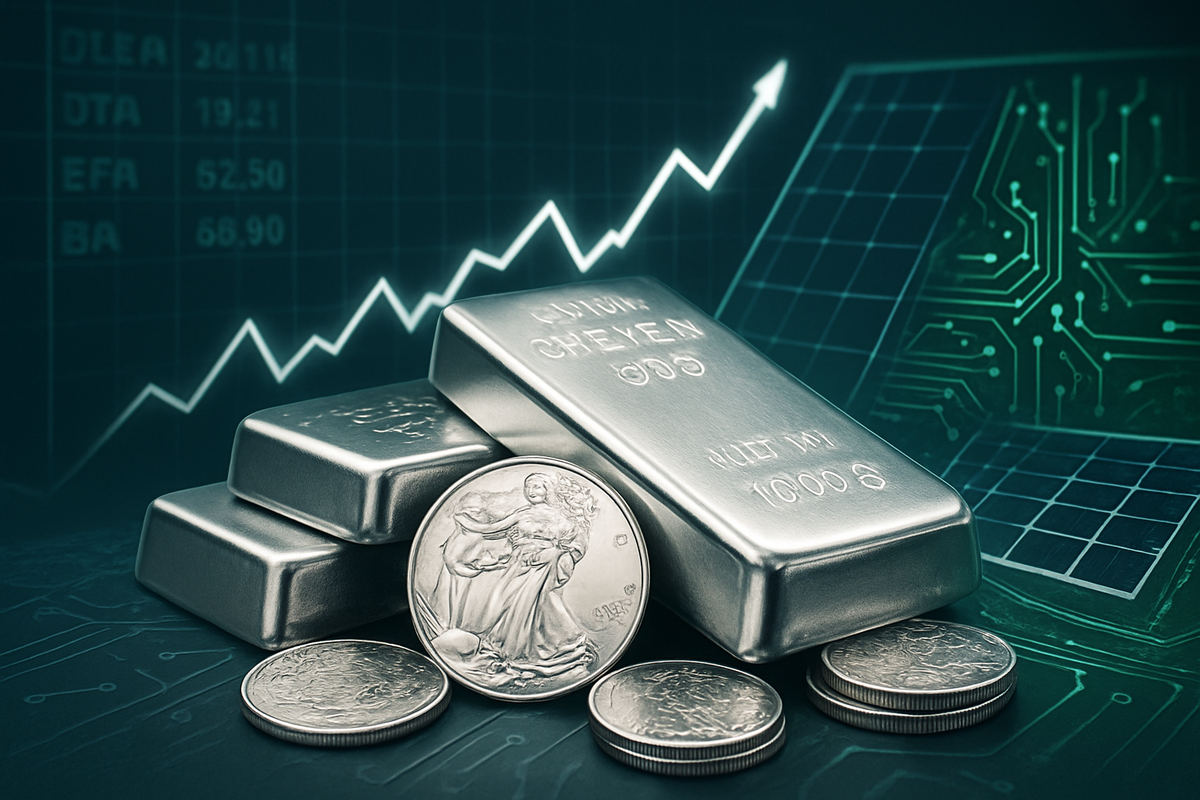
Silver has captivated global financial markets throughout 2025, experiencing an extraordinary surge to historic highs that saw its price more than double year-to-date. The white metal, often overshadowed by gold, touched an all-time record of nearly $59 per troy ounce in early December, fueled by a potent mix of tightening supply, burgeoning industrial demand from green technologies, and widespread expectations of U.S. Federal Reserve interest rate cuts. This monumental rally, however, has recently witnessed a slight step back from these dizzying peaks, with prices consolidating around the mid-$50s as of December 2, 2025, prompting market participants to scrutinize the underlying dynamics at play.
The immediate implications of this surge are far-reaching. For investors, silver has transitioned from a traditionally volatile asset to a "multibagger" performer, commanding significant attention as both a safe-haven and a critical industrial commodity. Conversely, industries heavily reliant on silver, particularly those at the forefront of the green energy transition, are grappling with unprecedented input costs, sparking urgent conversations about material substitution and supply chain resilience. The market's current phase of consolidation suggests a period of reflection after an aggressive ascent, but the fundamental drivers hint at a sustained bullish narrative for the foreseeable future.
Unpacking the Rally: A Timeline of Silver's Historic 2025
Silver's journey to historic highs in 2025 has been nothing short of spectacular, characterized by consistent upward momentum punctuated by significant milestones. The year began with silver trading around $30 per ounce, building on a robust performance in late 2024. By early September 2025, the metal had comfortably breached the $40 mark, driven by escalating industrial demand and growing anticipation of a dovish shift from the U.S. Federal Reserve.
The rally intensified dramatically in October, with silver smashing through the $50 barrier and hitting a then-record high above $54 per ounce on October 17. The momentum carried into late November, nearing $58 per ounce, with a notable event on November 28 where a CME Group (COMEX) trading outage, caused by a cooling system failure, contributed to a single-session advance of approximately $3, pushing spot prices to a new record of $55.66 per ounce. The crescendo arrived on December 1, when silver jumped 3.8% to US$58.57, briefly touching a historic peak of US$58.83. On December 2, 2025, silver reached an all-time high of $58.85 per troy ounce before experiencing a pullback of over 1% to $57 per ounce due to profit-taking after a six-session rally.
Key stakeholders have reacted with a mix of excitement and apprehension. Silver miners and streaming companies are reaping substantial benefits, with increased profitability and enhanced prospects for expansion. Investors, from large institutional funds to a powerful decentralized force of global retail participants, have poured into the market, driving demand for physical bullion and Exchange-Traded Funds (ETFs) like the iShares Silver Trust (NYSEARCA: SLV). Conversely, industrial users, particularly in the solar and electronics sectors, are facing significant cost pressures, with limited immediate options for substitution. The U.S. government's addition of silver to the Critical Minerals List in 2025 has also added a geopolitical layer, influencing supply flows and potentially encouraging domestic mining.
Corporate Fortunes: Winners and Losers in the Silver Boom
The unprecedented surge in silver prices has created a clear bifurcation in corporate fortunes, enriching companies involved in silver extraction and streaming while posing significant cost challenges for industries reliant on the metal.
Among the clear beneficiaries are silver mining companies. Firms like First Majestic Silver Corp. (NYSE: AG) have reported monumental improvements in operating and free cash flow, with nearly doubled silver output year-over-year in Q3 2025. Their stock performance has seen significant jumps, with the company benefiting from operational leverage. Similarly, Pan American Silver Corp. (NASDAQ: PAAS) has experienced an "explosive" rally, reaching a 52-week high of $45.97 on November 28, 2025, driven by improved market conditions and strategic acquisitions. Fresnillo PLC (LSE: FRES), a major silver producer, is also benefiting directly from higher commodity prices, maintaining its position as a benchmark for operational resilience. Andean Silver Ltd (ASX: ASL), an ASX-listed miner, has outpaced the All Ordinaries Index with a staggering 161.9% rise in 2025 due to both rising prices and exploration successes.
Silver streaming companies like Wheaton Precious Metals Corp. (NYSE: WPM) are also significant winners. Their business model, which involves providing upfront capital to miners in exchange for the right to purchase silver at fixed, low prices, allows for substantial margin expansion during periods of rising silver prices, minimizing direct mining risks. Wheaton has seen a 10% share price uptick in 2025, underscoring the effectiveness of its royalty agreements. Other companies with significant silver exposure, such as Hecla Mining (NYSE: HL), are also poised to benefit from the sustained high prices.
On the other side of the coin are industries and companies heavily reliant on silver as a key input material. Solar panel manufacturers, including giants like First Solar, Inc. (NASDAQ: FSLR) and JinkoSolar Holding Co., Ltd. (NYSE: JKS), are facing immense cost pressures. The solar industry is the largest industrial consumer of silver, and with prices soaring, silver now accounts for a significant portion of solar module production costs, threatening profitability and accelerating efforts in "thrifting" (reducing silver content) and exploring alternatives like copper and graphene. Similarly, electronics manufacturers such as Apple Inc. (NASDAQ: AAPL) and Samsung Electronics Co., Ltd. (KRX: 005930), which use silver in semiconductors, circuit boards, and mobile devices, are seeing rising material costs. Electric Vehicle (EV) manufacturers like Tesla, Inc. (NASDAQ: TSLA) also face increased costs, as EVs utilize more silver than traditional vehicles. Finally, jewelry retailers and manufacturers, including Signet Jewelers (NYSE: SIG), are grappling with escalating costs of goods sold and potential declines in sales volume as they struggle to pass on the full price increases to consumers.
Wider Significance: Silver's Role in a Changing World
Silver's current rally transcends mere market speculation; it represents a profound shift in the metal's economic significance, deeply intertwined with broader industry trends, geopolitical dynamics, and historical precedents. The most critical aspect of this surge is its connection to the global green technology revolution. Silver is an indispensable component in solar photovoltaics, electric vehicles, 5G technology, and various advanced electronics. The rapid expansion of these sectors has created an insatiable and inelastic demand for silver, making it a strategic commodity for decarbonization and technological advancement. This sustained industrial appetite, now accounting for roughly half of total silver supply, distinguishes the current rally from past speculative bubbles.
The ripple effects are widespread. For competitors in the precious metals space, silver's outperformance has significantly narrowed the gold-silver ratio, indicating a strengthening relative value and a broader market recognition of silver's dual utility. Other industrial metals, such as platinum and copper, have also seen gains, but silver's percentage increase has been more pronounced. For partners—the industries consuming silver—the surge forces accelerated innovation. While "thrifting" efforts to reduce silver content are underway, widespread material substitution remains challenging due to silver's unique properties, leaving these sectors vulnerable to price volatility and supply chain disruptions.
Regulatory and policy implications are also coming to the fore. The U.S. government's inclusion of silver in its Critical Minerals List in 2025 is a significant development, leading to front-loaded shipments to the U.S. and potentially paving the way for tariffs or quotas. This policy decision highlights silver's strategic importance and could encourage domestic mining within the U.S. Furthermore, global green policies and energy transition mandates implicitly support increased silver utilization, while expectations of U.S. Federal Reserve interest rate cuts are providing a supportive macroeconomic backdrop by making non-yielding assets more attractive.
Historically, silver has seen dramatic rallies, notably in 1980 (driven by the Hunt brothers' attempt to corner the market) and 2011 (following the 2008 financial crisis). While these past surges were largely speculative or inflation-driven, the current rally is fundamentally underpinned by a persistent structural supply deficit and robust, inelastic industrial demand. This makes the current market dynamics potentially more sustainable, positioning silver less as a pure monetary asset and more as a critical industrial input with a resilient price floor.
What Comes Next: Navigating Silver's Future Trajectory
As silver steps back from its immediate record highs, the market enters a crucial phase of assessment and anticipation. The short-term outlook suggests continued volatility, with potential for further profit-taking and consolidation around current levels. However, the overarching sentiment remains bullish, largely due to the enduring supply-demand imbalance and the supportive macroeconomic environment. Analysts anticipate that silver could resume its upward trajectory, with some forecasts suggesting a range of $50-$65 per ounce in the near term, and more aggressive predictions pointing towards $75-$100 by late 2025 or early 2026. The timing and extent of the Federal Reserve's anticipated interest rate cuts will be a critical short-term catalyst, as lower rates typically weaken the dollar and enhance the appeal of precious metals.
In the long term, silver's prospects appear exceptionally strong, driven by its indispensable role in the global green energy transition. The demand from solar PV, electric vehicles, and advanced electronics is a secular trend that is expected to intensify, while mine supply continues to struggle to keep pace. This structural deficit is projected to persist for the remainder of the decade, leading to dwindling above-ground inventories. This fundamental imbalance, coupled with silver's traditional safe-haven appeal amid ongoing geopolitical uncertainties and inflation concerns, forms a robust foundation for sustained price appreciation. Some long-term projections even venture into the triple-digit range, with predictions of $100-$400 per ounce by 2030-2036 under aggressive scenarios of intensifying shortages or currency crises.
Market participants will need to adapt strategically. For silver miners, the high prices present an opportunity for increased investment in exploration and expansion, though the long lead times for new projects mean supply response will be gradual. Industrial users, facing elevated costs, must accelerate efforts in "thrifting" and research into alternative materials, even as technological challenges persist. Investors, meanwhile, should brace for continued volatility but recognize silver's potential as a hedge against inflation and a beneficiary of the green transition, considering diversification through physical silver, ETFs, or mining stocks. Governments and policymakers will also continue to grapple with the implications of silver's strategic importance, potentially influencing trade policies and resource management.
Wrap-up: Silver's Enduring Significance in a New Era
Silver's remarkable surge to historic highs in 2025 underscores a fundamental re-evaluation of its market position. No longer merely "poor man's gold," silver has cemented its status as an indispensable industrial metal, critical to the global transition towards a greener, more digitized future. The confluence of persistent supply deficits, burgeoning demand from clean energy technologies, and a supportive macroeconomic environment has created a powerful bullish narrative that is unlikely to dissipate quickly. While the recent pullback reflects natural profit-taking and technical cooling, it does not diminish the underlying strength of the market.
Moving forward, the silver market is poised for continued strength, albeit with its characteristic volatility. The lasting impact of this rally will likely be a higher baseline for silver prices in the years to come, reflecting its elevated strategic importance. This shift signals a new era for silver, where its industrial utility plays an increasingly dominant role in price discovery alongside its traditional monetary appeal.
Investors should remain vigilant, closely monitoring key indicators such as the U.S. Federal Reserve's monetary policy decisions, global industrial demand trends (especially in solar and EV sectors), and developments in mine supply and above-ground inventories. The performance of the U.S. dollar and broader geopolitical stability will also continue to influence silver's safe-haven appeal. While the ride may be bumpy, the fundamental drivers suggest that silver's journey to greater significance is far from over, offering both opportunities and challenges for a dynamic global market.
This content is intended for informational purposes only and is not financial advice