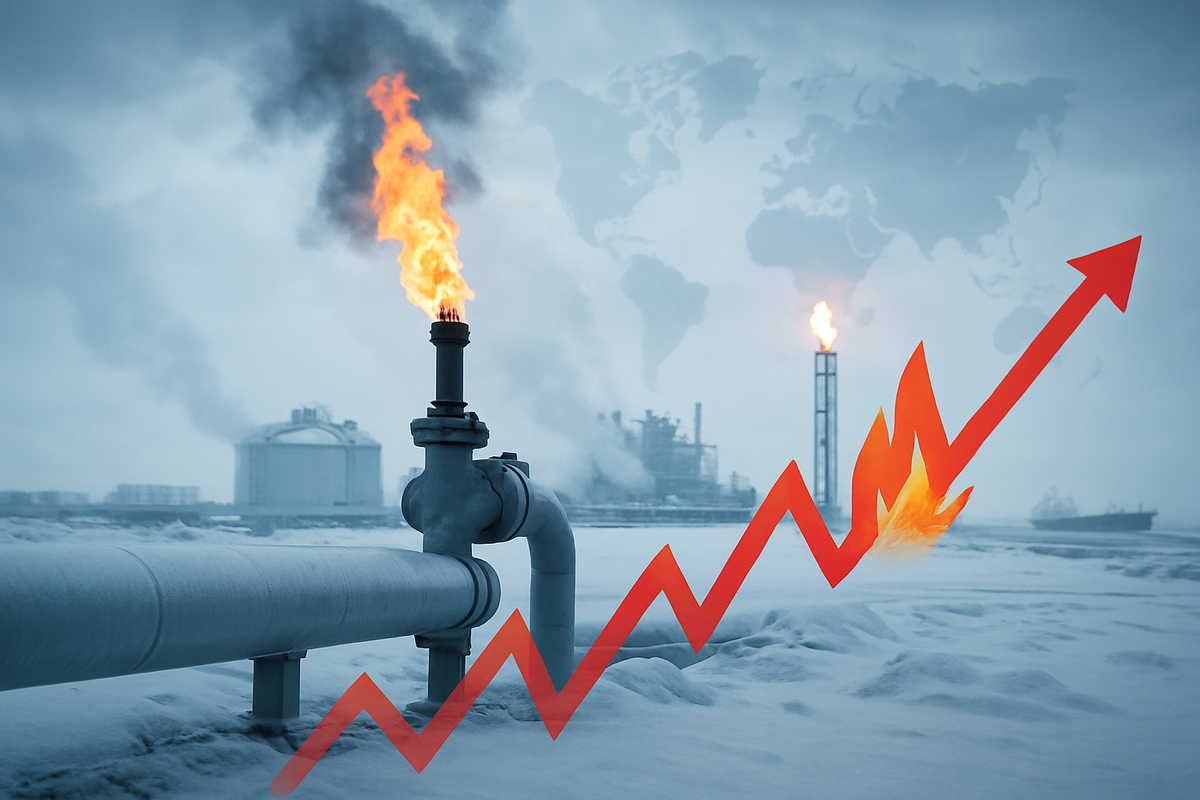
New York, NY – December 2, 2025 – The natural gas market is experiencing a significant upheaval as colder weather forecasts sweep across major consuming regions and robust export demand continues to tighten supplies. U.S. natural gas futures have surged to nearly three-year highs, signaling increased heating costs for consumers and a dynamic shift in market fundamentals. This sharp upward movement, observed as of early December 2025, is creating both opportunities and challenges across the energy landscape.
The immediate implications are palpable: residential and commercial heating costs are set to rise as wintry conditions intensify across the Midwest and East. Market volatility is also a key feature, with prices swinging in response to evolving weather models. Despite record-high U.S. dry gas production and above-average storage levels, the relentless demand from liquefied natural gas (LNG) exports, which hit a record 10.7 million tons in November, is creating a tighter supply-demand balance, leading to recent storage withdrawals and fueling the price rally.
Detailed Coverage: A Confluence of Factors Ignites the Market
The current surge in natural gas prices is the culmination of a year-long trajectory marked by increasing demand and evolving supply dynamics. U.S. natural gas futures (Henry Hub) have broken above the $4.80 per million British thermal units (MMBtu) mark, extending a November rally that saw prices climb over 15%. On December 1, 2025, the Henry Hub spot price stood at $4.81/MMBtu, representing a nearly 50% increase year-over-year. Some regional spot prices, like NGI's Southern Natural price index, even soared to an average of $5.280/MMBtu on the same day.
The timeline leading to this moment began in Q4 2024 with a price hike driven by robust demand, geopolitical tensions, and rising LNG shipment costs. Early 2025 saw cold temperatures across the U.S. and Europe, leading to substantial inventory withdrawals. By April 2025, both U.S. and European storage levels were lower than anticipated, setting the stage for increased demand during the refill season. Persistent high global demand throughout 2025, projected to increase by 1.6% to 1.7%, further solidified the bullish trend. The situation intensified in November 2025 with record U.S. LNG exports exceeding 15 billion cubic feet per day (Bcf/d) and early winter conditions prompting significant storage withdrawals. As of December 2, 2025, intense cold is expected across the Northeast and Great Lakes from December 3-7, with U.S. feed gas to operational LNG export terminals projected to exceed 19 Bcf/d.
Key players and stakeholders include major U.S. producers and exporters like Cheniere Energy (NYSE: LNG), which plays a crucial role in the country's dominant LNG export position. Consumers in North America, Europe, and Asia are driving demand, with U.S. residential gas bills seeing an 11.7% year-over-year increase. Government agencies such as the U.S. Energy Information Administration (EIA) provide critical market data and forecasts, while various investment funds and analysts actively monitor the volatile market. Geopolitical factors, including the potential cessation of Russian pipeline gas transit via Ukraine in 2025, also contribute significantly to market dynamics.
Initial market reactions are largely bullish in the U.S., with analysts suggesting a "Buy" rating for natural gas (NG=F) through Q1 2026. However, in stark contrast, European natural gas futures (Dutch TTF) have fallen, reaching under €27.8/MWh at the start of December, due to perceptions of ample supply and moderate demand, leading some investment funds to bet on a price fall—a move some analysts warn carries "considerable risk."
Companies Navigating the Volatile Current
The surge in natural gas prices creates a clear divide between "winners" and "losers" in the public market, impacting their operations, profitability, and stock performance.
Winners: Companies focused on natural gas exploration, production, and particularly export, are poised for significant gains. EQT Corporation (NYSE: EQT), the largest natural gas producer in the U.S., stands to benefit directly from higher commodity prices. With approximately 90% of its production being dry natural gas, increased prices translate directly into higher revenue and expanded profit margins. EQT's earnings grew by 466.6% over the past year, showcasing its sensitivity to market movements. Similarly, Cheniere Energy (NYSE: LNG), the largest U.S. LNG producer, is a prime beneficiary. As global natural gas prices surge, demand for U.S. LNG exports increases, boosting Cheniere's sales volumes and potentially contract pricing. The expansion of U.S. LNG export terminals, with Cheniere at the forefront, strengthens its long-term outlook.
Losers: Industries that rely heavily on natural gas as a fuel or feedstock face significant cost pressures. Chemical companies, for instance, use natural gas both for energy and as a crucial raw material. Dow Chemical (NYSE: DOW) is an energy-intensive company that uses natural gas and natural gas liquids. A price surge means higher fuel costs for operations and more expensive raw materials, leading to compressed profit margins. In past crises, Dow experienced billions in increased costs and even closed U.S. plants, shifting production overseas. Fertilizer companies, for whom natural gas is a fundamental raw material for nitrogen-based products, also face severe headwinds. CF Industries Holdings (NYSE: CF), a major nitrogen fertilizer producer, has seen its production expenses jump by 27% due to gas price increases in the past, leading to missed earnings forecasts and plant closures.
Utility companies that operate natural gas-fired power plants, like Duke Energy (NYSE: DUK), also face higher fuel costs. While these costs are often passed on to consumers through higher electricity bills, there can be regulatory lags and public pressure, potentially impacting their perceived stability. Lastly, energy-intensive metal production companies, such as Alcoa Corporation (NYSE: AA), a major aluminum producer, are highly vulnerable. Aluminum smelting requires substantial electricity, with natural gas prices inflating power costs. Alcoa faced significant production curtailments in Europe in 2022 due to soaring natural gas prices, directly impacting its revenue and profitability.
Wider Significance: A Global Commodity in Transition
The current natural gas price surge is not an isolated event but rather a symptom of deeper, interconnected trends shaping the global energy landscape. The most prominent trend is the undeniable ascendance of LNG, transforming natural gas into a truly global commodity. This enhances energy security for importing nations by diversifying supply but also links regional markets more closely, making them vulnerable to global shocks. Global LNG demand is projected to rise by approximately 60% by 2040, driven by economic growth in Asia and the increasing energy demands of artificial intelligence.
This event also plays a complex role in the broader energy transition. Higher natural gas costs can make utility-scale solar and wind projects, especially with battery storage, more economically attractive, potentially accelerating renewable energy investments. However, historical precedents show that natural gas price spikes can sometimes lead to a temporary resurgence in coal use, increasing carbon emissions. Geopolitical influences remain paramount, with the anticipated phasing out of Russian gas imports by Europe at the end of 2025 being a major driver of increased LNG demand. The U.S. also imposed a 10% tariff on Canadian gas in March 2025, tightening supply in certain North American regions.
Ripple effects are felt across the economy. The electricity sector sees increased generation costs, affecting utilities and consumers. Energy-intensive industrial consumers, particularly in Europe and Asia, face compressed profit margins, with some like Dow Inc. accelerating their search for cheaper natural gas. The improved competitiveness of renewables due to higher gas prices acts as a catalyst for investment, though rising raw material costs, influenced by energy prices, could also impact development. Robust global demand for LNG is reshaping international trade relationships, strengthening U.S. trade balances as it becomes a critical supplier to Europe and Asia.
Regulatory and policy implications are also emerging. Governments may need to offer consumer aid to cope with higher bills. Regulations aimed at market stability and emissions reduction, such as the EU's methane emissions tracking, are influencing sourcing decisions. In the U.S., debate continues over LNG export policies due to concerns about domestic price hikes. Historically, natural gas markets have seen similar volatility, such as the 2000-2001 and 2005 surges, often driven by cold weather, strong demand, and supply constraints. These past events underscore that sustained price surges can lead to manufacturing cost increases, supply chain disruptions, and inflationary pressures, often prompting regulatory intervention.
What Comes Next: Navigating a Dynamic Future
The natural gas market is poised for a dynamic period stretching from December 2025 into 2026 and beyond, characterized by a complex interplay of increasing demand, expanding supply, and persistent geopolitical and weather-related uncertainties.
In the short-term (December 2025 - 2026), market balances are expected to tighten, leading to potentially higher prices. The U.S. Henry Hub spot price is projected to average around $3.90/MMBtu over the winter season, possibly peaking at $4.25/MMBtu in January 2026. This upward pressure is largely due to robust LNG export growth, which is expected to increase by an additional 10% in 2026, following a 25% rise in 2025. New LNG projects in the U.S., Canada, and Qatar are set to boost global LNG supply by 7% in 2026, which may ease fundamentals later in the year but will continue to support demand growth. Geopolitical tensions, particularly in the Middle East, will remain a source of volatility, and cold weather forecasts for key U.S. consuming regions will continue to drive heating demand.
In the long-term (Beyond 2026), while short-term prices are elevated, some forecasts suggest a potential moderation as increased production, especially from the Permian Basin and Haynesville Shale, comes online. However, other projections anticipate Henry Hub prices reaching $5.40/Mcf by 2030 and $6.55/Mcf by 2040. Natural gas is increasingly viewed as a strategic "bridge fuel" in the energy transition, providing reliability and flexibility to complement intermittent renewables. Its role in power generation, industrial processes, and heating, coupled with surging demand from data centers, ensures its continued importance.
Strategic pivots will be crucial for market participants. Companies involved in LNG will prioritize expanding export infrastructure, with facilities like Plaquemines LNG and Golden Pass LNG coming online. Technological advancements, including AI and data analytics, will optimize operations. To align with decarbonization goals, the industry will invest in carbon capture, utilization, and storage (CCUS) and hydrogen blending. Producers may exercise disciplined capital allocation, potentially holding off on hedging 2026 production to capture higher prices. Commercial businesses will need to review energy strategies, considering fixed-rate contracts or on-site power generation. Industry consolidation is also expected to continue, leading to fewer, more integrated players.
Market opportunities include the robust global demand for LNG, the surging power needs of AI data centers, and expansion into CCS and hydrogen. Midstream infrastructure operators are also poised for higher throughput. Challenges include geopolitical and macroeconomic uncertainties, policy shifts regarding carbon pricing and methane emissions, and potential infrastructure delays. A significant wave of new LNG supply could also lead to global oversupply, potentially weakening prices in 2026.
Potential scenarios include tighter market balances and elevated prices in the near term, increased global LNG competition as new supply comes online, and the continued positioning of natural gas as a "bridge fuel" in decarbonization efforts. Industry consolidation and efficiency will likely persist, with price volatility remaining heavily influenced by weather and geopolitical developments.
Comprehensive Wrap-up: Navigating a New Era of Natural Gas
As of December 2, 2025, the natural gas market is navigating a new era defined by its globalized nature, increased volatility, and pivotal role in the ongoing energy transition. The recent price surges, driven by a potent mix of colder weather forecasts, record-breaking LNG exports, and underlying geopolitical tensions, underscore the market's sensitivity and its far-reaching implications.
Key Takeaways: The natural gas market has transformed into a truly global commodity, with U.S. LNG exports playing a dominant role. Prices have seen a significant year-over-year increase, directly impacting consumer heating costs and industrial expenses. While U.S. production remains robust, it is increasingly channeled to meet international demand, creating a tighter domestic balance. The interplay between weather, storage levels, and geopolitical events will continue to dictate short-term price movements.
Market Assessment Moving Forward: The market is poised for continued dynamism. While a significant wave of new LNG export capacity is expected to come online in 2026, potentially easing global fundamentals, strong demand from Asia and Europe will likely maintain upward pressure on prices. U.S. Henry Hub prices are projected to remain elevated through the winter season and into 2026. The long-term outlook sees natural gas as a critical "bridge fuel," necessitating investments in low-carbon technologies like CCUS and hydrogen blending to ensure its sustained relevance.
Significance and Lasting Impact: The most significant lasting impact is the irreversible globalization of natural gas. This offers enhanced energy security but also means greater interconnectedness and vulnerability to global shocks. Persistent price volatility will continue to affect household budgets and industrial profitability, while also influencing the pace of the energy transition by making renewables more competitive. The economic strain on consumers and energy-intensive industries remains a critical concern.
What Investors Should Watch For: In the coming months, investors should closely monitor several key indicators. Weather forecasts for major consuming regions will be paramount for short-term price swings. The timing and successful ramp-up of new LNG export facilities (e.g., Plaquemines LNG, Golden Pass LNG) will be crucial for supply dynamics. Geopolitical developments, particularly in Eastern Europe and the Middle East, will continue to introduce market uncertainty. Weekly storage reports in the U.S. and Europe will offer insights into supply-demand balances. Investors should also track capital discipline versus production response from E&P companies, the global economic outlook, and Asian demand dynamics, especially from China and India. Finally, observe the pace of renewable energy deployment and any shifts in coal-to-gas switching that could impact demand. The market will remain dynamic, and while a more balanced environment may emerge, "injections of volatility" will persist.
This content is intended for informational purposes only and is not financial advice