As of January 23, 2026, Tesla, Inc. (NASDAQ: TSLA) stands at a crossroads that few could have predicted just eighteen months ago. Once viewed strictly as a high-growth electric vehicle (EV) manufacturer, the company has spent the last year aggressively rebranding itself as an artificial intelligence and robotics conglomerate. This transformation was ignited by the pivotal Q3 2024 earnings report, which saw a surprising expansion in automotive margins and a record-breaking performance in the energy sector.
Today, Tesla is no longer just fighting for market share in the sedan and SUV segments; it is vying for dominance in autonomous transport, humanoid robotics, and distributed energy storage. With a market capitalization hovering around $1.4 trillion, the "Elon Musk premium" remains as contentious as ever, as the company balances maturing automotive hardware with the speculative upside of its "unsupervised" Full Self-Driving (FSD) and Optimus initiatives.
Historical Background
Founded in 2003 by Martin Eberhard and Marc Tarpenning, with Elon Musk joining shortly thereafter as the lead investor, Tesla's journey has been defined by "production hell" and radical pivots. The 2008 release of the Roadster proved that EVs could be aspirational. However, it was the Model S (2012) and the mass-market Model 3 (2017) that truly disrupted the global automotive industry.
The company's history is characterized by a "master plan" approach: start with low-volume, high-price vehicles to fund high-volume, lower-priced offerings. Over the last decade, Tesla scaled from a niche California automaker to a global titan with "Gigafactories" in Nevada, New York, Shanghai, Berlin, and Texas. The late 2010s saw the company teetering on the edge of bankruptcy during the Model 3 ramp, only to emerge as the world's most valuable automaker by 2020. The 2021-2023 period saw rapid expansion, but by 2024, the narrative shifted from growth at all costs to efficiency, cost reduction, and the pursuit of general AI.
Business Model
Tesla’s business model is vertically integrated to a degree rarely seen in modern manufacturing. It generates revenue through three primary segments:
- Automotive: The core revenue driver, encompassing the sale and lease of the Model 3, Y, S, X, and Cybertruck. This includes regulatory credits sold to other manufacturers—a high-margin "pure profit" stream that has historically propped up earnings.
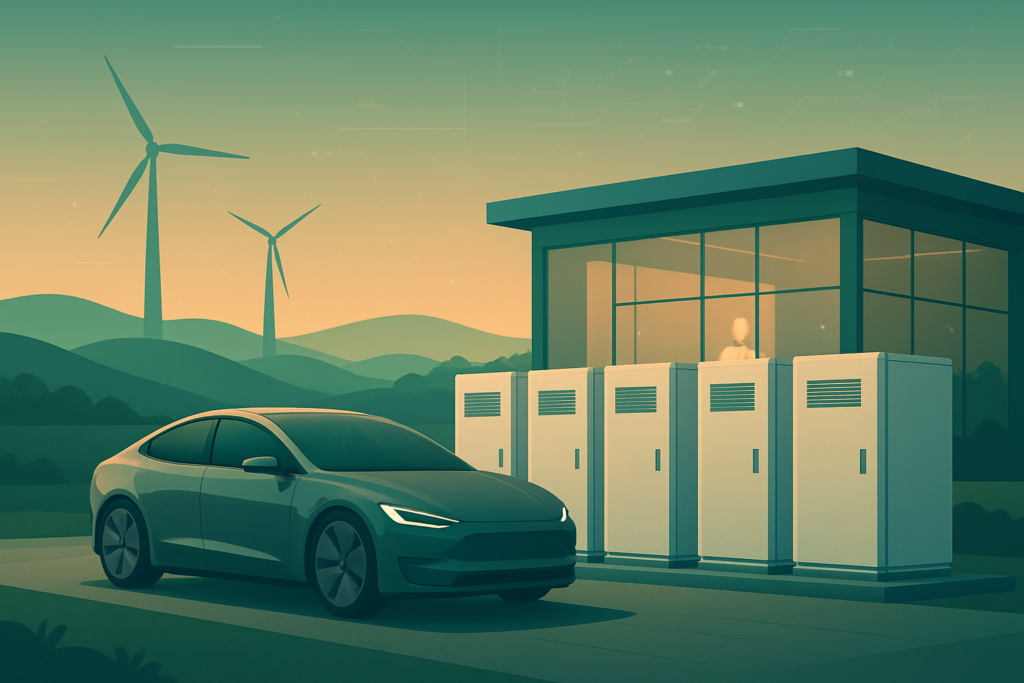
- Energy Generation and Storage: This segment has become the company’s most consistent growth engine. It involves the production and installation of the Powerwall (residential), Megapack (utility-scale), and solar products.
- Services and Other: This includes FSD software subscriptions, Supercharger network access, insurance, and vehicle service. This segment is critical for Tesla’s long-term goal of shifting toward a high-margin software-as-a-service (SaaS) model.
By owning its sales channels (direct-to-consumer) and much of its supply chain, Tesla captures margins that traditional OEMs often lose to dealerships and third-party suppliers.
Stock Performance Overview
Tesla's stock remains one of the most volatile large-cap equities in the world.
- 1-Year Performance: Over the past twelve months (Jan 2025 – Jan 2026), TSLA has seen a gain of approximately 7%, though this masks a roller-coaster ride that saw the stock dip to $320 in early 2025 before peaking at $485 in late December 2025.
- 5-Year Performance: Investors who held since early 2021 have seen a roughly 100% gain, though the path was marred by the 2022 tech wreck and 2024's "valuation reset."
- 10-Year Performance: TSLA has been a legendary performer, returning over 1,500% to long-term shareholders who navigated the various production crises and controversies.
The current trading range of $430–$450 reflects a market that has priced in the success of the automotive business but remains skeptical of the multi-trillion-dollar valuations Musk attributes to Robotaxis and Optimus.
Financial Performance
The Q3 2024 earnings report served as a financial "restoration" for Tesla. Following a period of declining margins due to aggressive price cuts, Tesla reported an automotive gross margin (ex-credits) of 17.1%. This was achieved through a relentless focus on lowering the "cost per vehicle," which hit a record low of approximately $35,100.
In the most recent 2025 fiscal year, Tesla showed:
- Revenue Growth: While automotive revenue slowed to single digits in mid-2025, the Energy segment grew by over 50% year-over-year, achieving gross margins of 30.5%.
- Debt and Cash Flow: Tesla maintains a fortress-like balance sheet with over $30 billion in cash and negligible debt. Free cash flow remains positive, though heavily reinvested into AI compute (Dojo and Nvidia H100/H200 clusters).
- Valuation: Trading at a forward P/E ratio of approximately 75x, Tesla remains significantly more expensive than rivals like Toyota (NYSE: TM) or BYD (OTC: BYDDF), reflecting its status as an "AI play" rather than a traditional car company.
Leadership and Management
Elon Musk remains the singular face of Tesla. While his focus is split between SpaceX, X (formerly Twitter), and xAI, his influence on Tesla’s engineering culture is undeniable. However, the management team has seen significant turnover. The 2024 departure of Drew Baglino (SVP Powertrain) was viewed as a blow to the "engineering soul" of the company.
By early 2026, the leadership has transitioned. The new guard consists largely of AI and software engineers rather than automotive manufacturing veterans. This reflects Musk’s directive that Tesla is "not an auto company" but a "robotics and AI company." Governance remains a concern for institutional investors, particularly regarding Musk’s controversial compensation packages and his board's perceived lack of independence.
Products, Services, and Innovations
Tesla’s current lineup is spearheaded by the Model Y, which remains the world’s best-selling vehicle. The Cybertruck has moved past its initial production hurdles, achieving a run rate of 125,000 units by mid-2025, though its high price point ($50k-$100k) has limited it to a premium-niche role.
The true innovation pipeline is focused on:
- Robotaxi (Cybercab): Launched as a pilot in Austin in June 2025, this dedicated autonomous vehicle has no steering wheel.
- Full Self-Driving (FSD): Now in version 13.x, FSD has moved to "end-to-end neural networks," significantly improving its ability to handle complex urban environments.
- Optimus: Approximately 1,000 Optimus bots are currently deployed in Tesla's own factories, performing simple battery sorting and logistics tasks. This is the "alpha test" for what Musk claims will be a multi-billion unit market.
Competitive Landscape
The competitive landscape in 2026 is bifurcated. In China, BYD (OTC: BYDDF) has surpassed Tesla in total EV volume, offering a wider range of affordable models. In the West, traditional OEMs like Ford (NYSE: F) and General Motors (NYSE: GM) have significantly scaled back their EV ambitions, focusing instead on hybrids, which has ironically allowed Tesla to regain market share in the pure-EV space.
Tesla’s primary competitive edge is its Supercharger network—now the industry standard (NACS) in North America—and its massive data moat for training AI models. Rivals struggle to match Tesla’s software integration and its ultra-low manufacturing costs.
Industry and Market Trends
The "EV Winter" of 2024 gave way to a "Hybrid Spring" in 2025, but Tesla resisted the hybrid trend, betting entirely on the transition to autonomy. Macro drivers include the continued fall in battery metal prices (Lithium, Nickel), which has benefited Tesla’s margins. However, the cyclical nature of high-interest rates in the U.S. continues to put pressure on monthly car payments, forcing Tesla to offer aggressive financing incentives (as low as 0.99% APR) throughout 2025 to sustain volume.
Risks and Challenges
Tesla faces several existential and operational risks:
- Execution Risk: The valuation is tied to FSD and Optimus. If full autonomy is not achieved within the next 24 months, a massive valuation reset is likely.
- Regulatory Scrutiny: The NHTSA continues to investigate FSD-related accidents. In January 2026, a high-profile case regarding "unsupervised" mode has created a legal bottleneck for the Robotaxi rollout.
- Key Person Risk: Musk’s involvement in politics and other ventures creates a distraction risk and potential brand erosion among certain demographics.
- Chinese Geopolitics: Tesla’s dependence on Giga Shanghai makes it vulnerable to escalating trade tensions between Washington and Beijing.
Opportunities and Catalysts
- The $25,000 EV: Rumors of a "Model 2" or "Model Q" have evolved into the "Model 3/Y Standard" variants, but a dedicated sub-$30k platform remains the holy grail for global volume.
- Licensing FSD: Tesla is in late-stage talks with a major legacy automaker (rumored to be a Japanese or German OEM) to license its FSD software, which would create a high-margin recurring revenue stream.
- Energy Arbitrage: As more Megapacks are deployed, Tesla is beginning to act as a distributed utility, selling software to manage grid stability.
Investor Sentiment and Analyst Coverage
Wall Street remains deeply divided.
- Bulls: Analysts like Dan Ives (Wedbush) maintain price targets in the $600 range, arguing that Tesla is an "AI and Robotics play" that should not be valued on P/E multiples but on "sum-of-the-parts" for its software and energy businesses.
- Bears: Traditional analysts, such as those at JP Morgan, maintain targets as low as $150, citing the slow-down in vehicle delivery growth (which saw its first-ever annual decline in 2025) and the "unrealistic" timeline for Optimus commercialization.
Retail sentiment remains high, with a loyal "X-based" investor community that views every dip as a buying opportunity.
Regulatory, Policy, and Geopolitical Factors
The regulatory landscape in early 2026 is dominated by the Inflation Reduction Act (IRA). Tesla remains the primary beneficiary of battery production credits in the U.S. However, new "Foreign Entity of Concern" (FEOC) rules have complicated its supply chain for Chinese-sourced materials.
In Europe, the imposition of tariffs on Chinese-made EVs (including those from Giga Shanghai) has forced Tesla to shift more production to Giga Berlin. Geopolitically, Tesla is walking a tightrope between its massive manufacturing footprint in China and its reliance on U.S. government subsidies and defense-adjacent AI development.
Conclusion
Tesla enters 2026 as a company in the middle of a high-stakes metamorphosis. The Q3 2024 margin expansion proved that the automotive core is still healthy and capable of generating the cash flow needed to fund Elon Musk’s grander visions. However, the "Great Pivot" to AI and robotics has fundamentally changed the investment thesis.
Investors must now decide if they are buying a car company that is slightly overvalued or a robotics company that is vastly undervalued. The success of the Austin Robotaxi pilot and the ability to bring a truly affordable EV to market will be the defining themes of the coming year. While the risks are substantial, Tesla’s ability to defy the skeptics—and its own past—remains its most enduring characteristic.
This content is intended for informational purposes only and is not financial advice.