Experts at the U.S. Department of Energy’s (DOE) Argonne National Laboratory and other national laboratories are looking more closely at passive safety systems, which will be used prevalently in the next generation of nuclear power plants. Passive safety systems rely on natural processes, such as gravity and circulation, to cool or safely shut down reactors without active power sources or human intervention. Their novel technologies may also present a soft underside to insider threats and saboteurs. New reactor designs must be tested and approved before they are licensed for construction. This makes it important to know what would cause these systems to not work. What could bad guys do to make things break?
This press release features multimedia. View the full release here: https://www.businesswire.com/news/home/20260128214771/en/
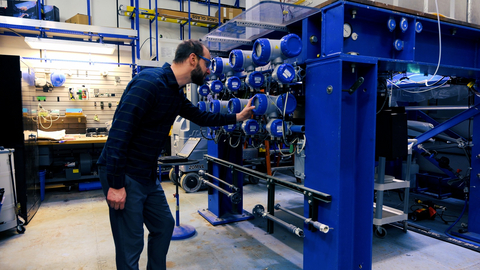
Good guy Darius Lisowski, Argonne’s group manager of reactor safety testing and analysis, takes time to play "bad guy" in order to thwart those who would interfere with safe nuclear reactor operations. (Image by Argonne National Laboratory.)
A roundtable of researchers from national laboratories brainstormed bad acts that a saboteur might try. What if someone left open an access hatch that should be closed? Or deliberately plugged a pathway to prevent cooling fluid from going where it needed to go?
List in hand, they then looked closely at how likely and how impactful such acts would be.
As expected, they found that nuclear power plants are extremely safe by design. There is controlled access. Multiple alarms signal quickly when something isn’t in good operating condition, or an event poses a risk to the plant and its workers. Nuclear reactors with passive safety systems operate as they should even if they lose power or no operator is present. This means creating havoc is hard to do.
Hard, but not impossible.
The researchers took the most likely sabotage scenarios to Argonne’s Natural Convection Shutdown Heat Removal Test Facility (NSTF) and tried to do their worst. They left that hatch open. They blocked that cooling fluid’s path. They pressed the softest, weakest points to see where new designs might bruise.
The overarching goal was to identify risks, inform better design and inspire better planning. In this way, the researchers help the nuclear energy industry avoid small oversights that might turn into large hazards.
“By using redundancy, focusing on the most severe threats, and meeting strict design tests, we can make sure passive safety features are robust,” said Darius Lisowski, group manager of reactor safety testing and analysis at Argonne’s NSTF. “Design improvements will happen early, before the next generation of reactors goes into operation.”
This work was supported by the DOE’s National Nuclear Security Administration and the International Nuclear Security for Advanced Reactors (INSTAR) Program.
View source version on businesswire.com: https://www.businesswire.com/news/home/20260128214771/en/
Contacts
Christopher J. Kramer
Head of External Communications
Argonne National Laboratory
Office: 630.252.5580
Email: media@anl.gov