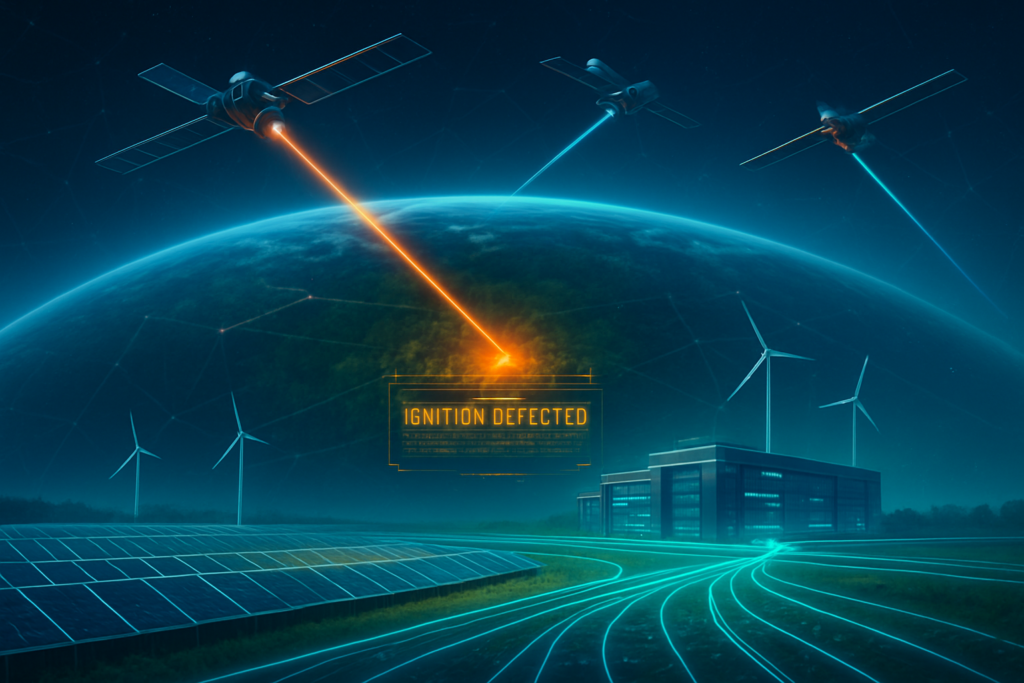
As of early 2026, the global conversation surrounding artificial intelligence has shifted from theoretical risks to practical, planetary-scale interventions. While the massive energy requirements of AI data centers have long been a point of contention, the technology is now proving to be its own best solution. In a landmark series of developments, AI is being deployed at the forefront of climate action, most notably through high-resolution wildfire prediction and the sophisticated optimization of renewable energy grids designed to meet the tech industry’s skyrocketing power demands.
This duality—AI as both a significant consumer of resources and a primary tool for environmental preservation—marks a turning point in the climate crisis. By integrating satellite data with advanced foundation models, tech giants and startups are now able to detect fires the size of a classroom from space and manage electrical grids with a level of precision that was impossible just two years ago. These innovations are not merely experimental; they are being integrated into the core infrastructure of the world's largest companies to ensure that the AI revolution does not come at the cost of the Earth's stability.
Precision from Orbit: The New Frontier of Wildfire Prediction
The technical landscape of wildfire mitigation has been transformed by the launch of specialized AI-enabled satellite constellations. Leading the charge is Alphabet Inc. (NASDAQ: GOOGL), which, through its Google Research division and the Earth Fire Alliance, successfully deployed the first FireSat satellite in March 2025. Unlike previous generations of weather satellites that could only identify fires once they reached the size of a football field, FireSat utilizes custom infrared sensors and on-board AI processing to detect hotspots as small as 5×5 meters. As of January 2026, the constellation is expanding toward a 50-satellite array, providing global updates every 20 minutes and allowing fire authorities to intervene before a small ignition becomes a catastrophic conflagration.
Complementing this detection capability is the Aurora foundation model, released by Microsoft Corp. (NASDAQ: MSFT) in late 2025. Aurora is a massive AI model trained on over a million hours of Earth system data, capable of simulating wildfire spread with unprecedented speed. While traditional numerical weather models often take hours to process terrain and atmospheric variables, Aurora can predict a fire’s path up to 5,000 times faster. This allows emergency responders to run thousands of "what-if" scenarios in seconds, accounting for shifting wind patterns and moisture levels in real-time. This shift from reactive monitoring to predictive simulation represents a fundamental change in how humanity manages one of the most destructive symptoms of climate change.
The Rise of "Energy Parks" and AI-Driven Grid Stabilization
The industry’s response to the power-hungry nature of AI has led to a strategic pivot toward vertical energy integration. In early 2026, Google finalized a $4.75 billion acquisition of renewable energy developer Intersect Power, signaling the birth of the "Energy Park" era. These parks are industrial campuses where hyperscale data centers are co-located with gigawatts of solar, wind, and battery storage. By using AI to balance energy production and consumption "behind-the-meter," companies can bypass the aging public grid and its notorious interconnection delays. This ensures that the massive compute power required for AI training is matched by dedicated, carbon-free energy sources in real-time.
Meanwhile, Amazon.com, Inc. (NASDAQ: AMZN) has focused on "baseload-first" strategies, utilizing AI to optimize the safety and deployment of Small Modular Reactors (SMRs). In collaboration with the Idaho National Laboratory, AWS is deploying AI-driven dynamic line rating (DLR) technology. This system uses real-time weather data and AI sensors to monitor the physical capacity of transmission lines, allowing for up to 30% more renewable energy to be transmitted over existing wires. This optimization is crucial for tech giants who are no longer just passive consumers of electricity but are now acting as active grid stabilizers, using AI to "throttle" non-urgent data workloads during peak demand to prevent local blackouts.
Balancing the Scales: The Wider Significance of AI in Climate Action
The integration of AI into climate strategy addresses the "Jevons Paradox"—the idea that as a resource becomes more efficient to use, its total consumption increases. While NVIDIA Corporation (NASDAQ: NVDA) continues to push the limits of hardware efficiency, the sheer scale of AI deployment could have outweighed these gains if not for the concurrent breakthroughs in grid management. By acting as a "virtual power plant," AI-managed data centers are proving that large-scale compute can actually support grid resilience rather than just straining it. This marks a significant milestone in the AI landscape, where the technology's societal value is being measured by its ability to solve the very problems its growth might otherwise exacerbate.
However, this reliance on AI for environmental safety brings new concerns. Critics point to the "black box" nature of some predictive models and the risk of over-reliance on automated systems for critical infrastructure. If a wildfire prediction model fails to account for a rare atmospheric anomaly, the consequences could be dire. Furthermore, the concentration of energy resources by tech giants—exemplified by the acquisition of entire renewable energy developers—raises questions about energy equity and whether the public grid will be left with less reliable, non-optimized infrastructure while "Energy Parks" thrive.
Looking Ahead: Autonomous Suppression and Global Integration
The near-term future of AI in climate action points toward even greater autonomy. Experts predict the next phase will involve the integration of AI wildfire detection with autonomous fire-suppression drones. These "first responder" swarms could be dispatched automatically by satellite triggers to drop retardant on small ignitions minutes after they are detected, potentially ending the era of "mega-fires" altogether. In the energy sector, we expect to see the "Energy Park" model exported globally, with AI agents from different corporations communicating to balance international power grids during extreme weather events.
The long-term challenge remains the standardization of data. For AI to truly master global climate prediction, there must be a seamless exchange of data between private satellite operators, government agencies, and utility providers. While the open-sourcing of models like Microsoft’s Aurora is a step in the right direction, the geopolitical implications of "climate intelligence" will likely become a major topic of debate in the coming years. As AI becomes the primary architect of our climate response, the transparency and governance of these systems will be as important as their technical accuracy.
A New Era of Environmental Stewardship
The developments of 2025 and early 2026 have demonstrated that AI is not merely a tool for productivity or entertainment, but an essential component of 21st-century environmental stewardship. From the 5×5 meter detection capabilities of FireSat to the trillion-parameter simulations of the Aurora model, the technology is providing a level of visibility and control over the natural world that was previously the stuff of science fiction. The shift toward self-sustaining "Energy Parks" and AI-optimized grids shows that the tech industry is taking accountability for its footprint by reinventing the very infrastructure of power.
As we move forward, the success of these initiatives will be measured by the fires that never started and the grids that never failed. The convergence of AI and climate action is perhaps the most significant chapter in the history of the technology thus far, proving that the path to a sustainable future may well be paved with silicon. In the coming months, keep a close watch on the deployment of SMRs and the expansion of satellite-to-drone suppression networks as the next indicators of this high-stakes technological evolution.
This content is intended for informational purposes only and represents analysis of current AI developments.
TokenRing AI delivers enterprise-grade solutions for multi-agent AI workflow orchestration, AI-powered development tools, and seamless remote collaboration platforms.
For more information, visit https://www.tokenring.ai/.