As of early 2026, the landscape of artificial intelligence has been fundamentally reshaped by a single architectural leap: the NVIDIA Blackwell platform. When NVIDIA (NASDAQ: NVDA) first unveiled the Blackwell B200 GPU, it was described not merely as a chip, but as the "engine of the new industrial revolution." Today, with Blackwell clusters powering the world’s most advanced frontier models—including the recently debuted Llama 5 and GPT-5—the industry recognizes this architecture as the definitive milestone that transitioned generative AI from a burgeoning trend into a permanent, high-performance infrastructure for the global economy.
The immediate significance of Blackwell lay in its unprecedented scale. By shattering the physical limits of single-die semiconductor manufacturing, NVIDIA provided the "compute oxygen" required for the next generation of Mixture-of-Experts (MoE) models. This development effectively ended the era of "compute scarcity" for the world's largest tech giants, enabling a shift in focus from simply training models to deploying agentic AI systems at a scale that was previously thought to be a decade away.
A Technical Masterpiece: The 208-Billion Transistor Milestone
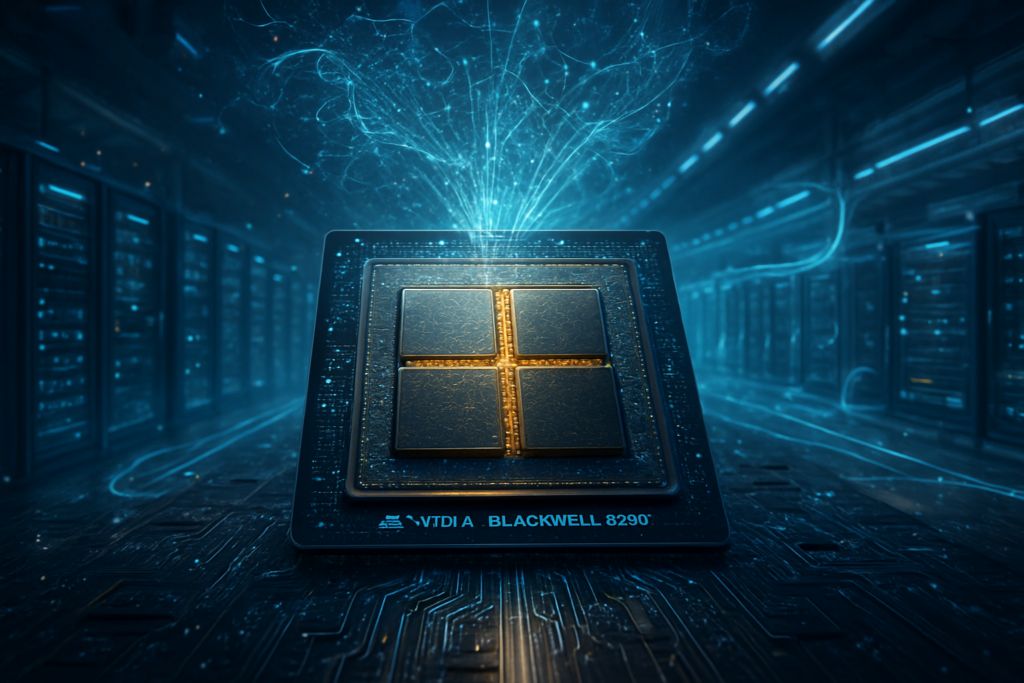
At the heart of the Blackwell architecture sits the B200 GPU, a marvel of engineering that features a staggering 208 billion transistors. To achieve this density, NVIDIA moved away from the monolithic design of the previous Hopper H100 and adopted a sophisticated multi-die (chiplet) architecture. Fabricated on a custom-built TSMC (NYSE: TSM) 4NP process, the B200 consists of two primary dies connected by a 10 terabytes-per-second (TB/s) ultra-low-latency chip-to-chip interconnect. This design allows the two dies to function as a single, unified GPU, providing seamless performance for developers without the software complexities typically associated with multi-chip modules.
The technical specifications of the B200 represent a quantum leap over its predecessors. It is equipped with 192GB of HBM3e memory, delivering 8 TB/s of bandwidth, which is essential for feeding the massive data requirements of trillion-parameter models. Perhaps the most significant innovation is the second-generation Transformer Engine, which introduced support for FP4 (4-bit floating point) precision. By doubling the throughput of FP8, the B200 can achieve up to 20 petaflops of sparse AI compute. This efficiency has proven critical for real-time inference, where the B200 offers up to 15x the performance of the H100, effectively collapsing the cost of generating high-quality AI tokens.
Initial reactions from the AI research community were centered on the "NVLink 5" interconnect, which provides 1.8 TB/s of bidirectional bandwidth per GPU. This allowed for the creation of the GB200 NVL72—a liquid-cooled rack-scale system that acts as a single 72-GPU giant. Industry experts noted that while the previous Hopper architecture was a "GPU for a server," Blackwell was a "GPU for a data center." This shift necessitated a total overhaul of data center cooling and power delivery, as the B200’s power envelope can reach 1,200W, making liquid cooling a standard requirement for high-density AI deployments in 2026.
The Trillion-Dollar CapEx Race and Market Dominance
The arrival of Blackwell accelerated a massive capital expenditure (CapEx) cycle among the "Big Four" hyperscalers. Microsoft (NASDAQ: MSFT), Meta (NASDAQ: META), Alphabet (NASDAQ: GOOGL), and Amazon (NASDAQ: AMZN) have each projected annual CapEx spending exceeding $100 billion as they race to build "AI Factories" based on the Blackwell and the newly-announced Rubin architectures. For these companies, Blackwell isn't just a purchase; it is a strategic moat. Those who secured early allocations of the B200 were able to iterate on their foundational models months ahead of competitors, leading to a widening gap between the "compute-rich" and the "compute-poor."
While NVIDIA maintains an estimated 90% share of the data center GPU market, Blackwell’s dominance has forced competitors to pivot. AMD (NASDAQ: AMD) has successfully positioned its Instinct MI350 and MI455X series as the primary alternative, particularly for companies seeking higher memory capacity for specialized inference. Meanwhile, Intel (NASDAQ: INTC) has struggled to keep pace at the high end, focusing instead on mid-tier enterprise AI with its Gaudi 3 line. The "Blackwell era" has also intensified the development of custom silicon; Google’s TPU v7p and Amazon’s Trainium 3 are now widely used for internal workloads to mitigate the "NVIDIA tax," though Blackwell remains the gold standard for third-party cloud developers.
The strategic advantage of Blackwell extends into the supply chain. The massive demand for HBM3e and the transition to HBM4 have created a windfall for memory giants like SK Hynix (KRX: 000660), Samsung (KRX: 005930), and Micron (NASDAQ: MU). NVIDIA’s ability to orchestrate this complex supply chain—from TSMC’s advanced packaging to the liquid-cooling components provided by specialized vendors—has solidified its position as the central nervous system of the AI industry.
The Broader Significance: From Chips to "AI Factories"
Blackwell represents a fundamental shift in the broader AI landscape: the transition from individual chips to "system-level" scaling. In the past, AI progress was often bottlenecked by the performance of a single processor. With Blackwell, the unit of compute has shifted to the rack and the data center. This "AI Factory" concept—where thousands of GPUs operate as a single, coherent machine—has enabled the training of models with vastly improved reasoning capabilities, moving us closer to Artificial General Intelligence (AGI).
However, this progress has not come without concerns. The energy requirements of Blackwell clusters have placed immense strain on global power grids. In early 2026, the primary bottleneck for AI expansion is no longer the availability of chips, but the availability of electricity. This has sparked a new wave of investment in modular nuclear reactors (SMRs) and renewable energy to power the massive data centers required for Blackwell NVL72 deployments. Additionally, the high cost of Blackwell systems has raised concerns about "AI Centralization," where only a handful of nations and corporations can afford the infrastructure necessary to develop frontier AI.
Comparatively, Blackwell is to the 2020s what the mainframe was to the 1960s or the cloud was to the 2010s. It is the foundational layer upon which a new economy is being built. The architecture has also empowered "Sovereign AI" initiatives, with nations like Saudi Arabia and the UAE investing billions to build their own Blackwell-powered domestic compute clouds, ensuring they are not solely dependent on Western technology providers.
Future Developments: The Road to Rubin and Agentic AI
As we look toward the remainder of 2026, the focus is already shifting to NVIDIA’s next act: the Rubin (R100) architecture. Announced at CES 2026, Rubin is expected to feature 336 billion transistors and utilize the first generation of HBM4 memory. While Blackwell was about "Scaling," Rubin is expected to be about "Reasoning." Experts predict that the transition to Rubin will enable "Agentic AI" systems that can operate autonomously for weeks at a time, performing complex multi-step tasks across various digital and physical environments.
Near-term developments will likely focus on the "Blackwell Ultra" (B300) refresh, which is currently being deployed to bridge the gap until Rubin reaches volume production. This refresh increases memory capacity to 288GB, further reducing the cost of inference for massive models. The challenges ahead remain significant, particularly in the realm of interconnects; as clusters grow to 100,000+ GPUs, the industry must solve the "tail latency" issues that can slow down training at such immense scales.
A Legacy of Transformation
NVIDIA’s Blackwell architecture will be remembered as the catalyst that turned the promise of generative AI into a global reality. By delivering a 208-billion transistor powerhouse that redefined the limits of semiconductor design, NVIDIA provided the hardware foundation for the most capable AI models in history. The B200 was the moment the industry stopped talking about "AI potential" and started building "AI infrastructure."
The significance of this development in AI history cannot be overstated. It marked the successful transition to multi-die GPU architectures and the widespread adoption of liquid cooling in the data center. As we move into the Rubin era, the legacy of Blackwell remains visible in every AI-generated insight, every autonomous agent, and every "AI Factory" currently humming across the globe. For the coming months, the industry will be watching the ramp-up of Rubin, but the "Blackwell Epoch" has already left an indelible mark on the world.
This content is intended for informational purposes only and represents analysis of current AI developments.
TokenRing AI delivers enterprise-grade solutions for multi-agent AI workflow orchestration, AI-powered development tools, and seamless remote collaboration platforms.
For more information, visit https://www.tokenring.ai/.