In a move that signals a fundamental shift in the architecture of artificial intelligence, Marvell Technology (NASDAQ: MRVL) has announced the definitive acquisition of Celestial AI, a leader in optical interconnect technology. The deal, valued at up to $5.5 billion, represents the most significant attempt to date to replace traditional copper-based electrical signals with light-based photonic communication within the data center. By integrating Celestial AI’s "Photonic Fabric" into its portfolio, Marvell is positioning itself at the center of the industry’s desperate push to solve the "memory wall"—the bottleneck where the speed of processors outpaces the ability to move data from memory.
The acquisition comes at a critical juncture for the semiconductor industry. As of January 22, 2026, the demand for massive AI models has pushed existing hardware to its physical limits. Traditional electrical interconnects, which rely on copper traces to move data between GPUs and High-Bandwidth Memory (HBM), are struggling with heat, power consumption, and physical distance constraints. Marvell’s absorption of Celestial AI, combined with its recent $540 million purchase of XConn Technologies, suggests that the future of AI scaling will not be built on faster electrons, but on the seamless integration of silicon photonics and memory disaggregation.
The Photonic Fabric: Technical Mastery Over the Memory Bottleneck
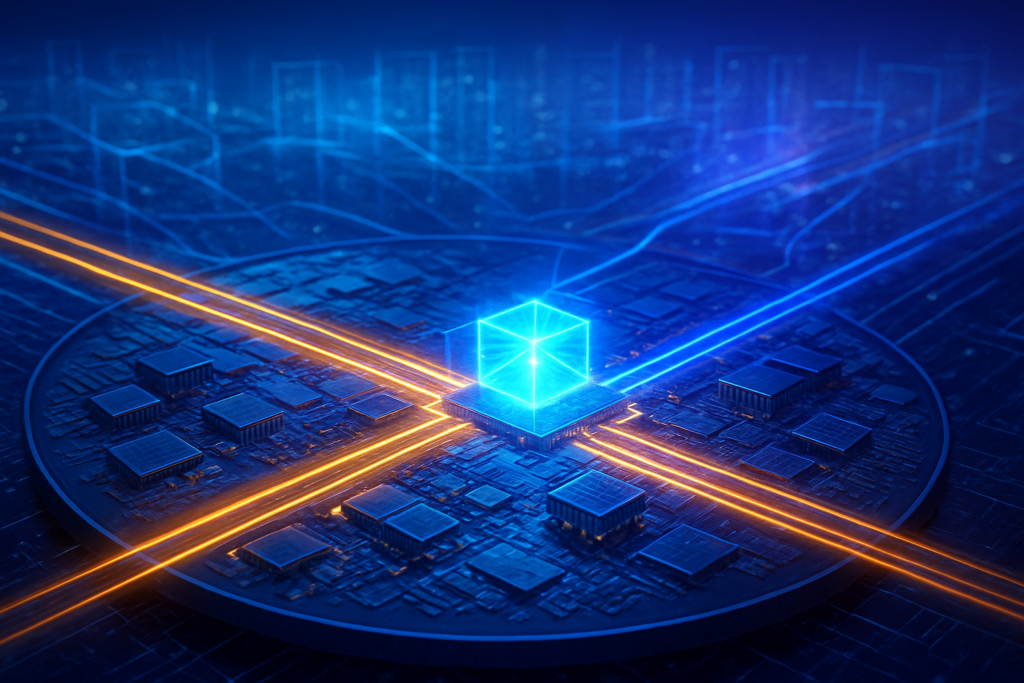
The centerpiece of this acquisition is Celestial AI’s proprietary Photonic Fabric , an optical interconnect platform that achieves what was previously thought impossible: 3D-stacked optical I/O directly on the compute die. Unlike traditional silicon photonics that use temperature-sensitive ring modulators, Celestial AI utilizes Electro-Absorption Modulators (EAMs). These components are remarkably thermally stable, allowing photonic chiplets to be co-packaged alongside high-power AI accelerators (XPUs) that can generate several kilowatts of heat. This technical leap allows for a 10x increase in bandwidth density, with first-generation chiplets delivering a staggering 16 terabits per second (Tbps) of throughput.
Perhaps the most disruptive aspect of the Photonic Fabric is its "DSP-free" analog-equalized linear-drive architecture. By eliminating the need for complex Digital Signal Processors (DSPs) to clean up electrical signals, the system reduces power consumption by an estimated 4 to 5 times compared to copper-based solutions. This efficiency enables a new architectural paradigm known as memory disaggregation. In this setup, High-Bandwidth Memory (HBM) no longer needs to be soldered within millimeters of the processor. Marvell’s roadmap now includes "Photonic Fabric Appliances" (PFAs) capable of pooling up to 32 terabytes of HBM3E or HBM4 memory, accessible to hundreds of XPUs across a distance of up to 50 meters with nanosecond-class latency.
The industry reaction has been one of cautious optimism followed by rapid alignment. Experts in the AI research community note that moving I/O from the "beachfront" (the edges) of a chip to the center of the die via 3D stacking frees up valuable perimeter space for even more HBM stacks. This effectively triples the on-chip memory capacity available to the processor. "We are moving from a world where we build bigger chips to a world where we build bigger systems connected by light," noted one lead architect at a major hyperscaler. The design win announced by Celestial AI just prior to the acquisition closure confirms that at least one Tier-1 cloud provider is already integrating this technology into its 2027 silicon roadmap.
Reshaping the Competitive Landscape: Marvell, Broadcom, and the UALink War
The acquisition sets up a titanic clash between Marvell (NASDAQ: MRVL) and Broadcom (NASDAQ: AVGO). While Broadcom has dominated the networking space with its Tomahawk and Jericho switch series, it has doubled down on "Scale-Up Ethernet" (SUE) and its "Davisson" 102.4 Tbps switch as the primary solution for AI clusters. Broadcom’s strategy emphasizes the maturity and reliability of Ethernet. In contrast, Marvell is betting on a more radical architectural shift. By combining Celestial AI’s optical physical layer with XConn’s CXL (Compute Express Link) and PCIe switching logic, Marvell is providing the "plumbing" for the newly finalized Ultra Accelerator Link (UALink) 1.0 specification.
This puts Marvell in direct competition with NVIDIA (NASDAQ: NVDA). Currently, NVIDIA’s proprietary NVLink is the gold standard for high-speed GPU-to-GPU communication, but it remains a "walled garden." The UALink Consortium, which includes heavyweights like Advanced Micro Devices (NASDAQ: AMD), Intel (NASDAQ: INTC), Meta Platforms (NASDAQ: META), and Microsoft (NASDAQ: MSFT), is positioning Marvell’s new photonic capabilities as the "open" alternative to NVLink. For hyperscalers like Alphabet (NASDAQ: GOOGL) and Amazon (NASDAQ: AMZN), Marvell’s technology offers a path to build massive, multi-rack AI clusters that aren't beholden to NVIDIA’s full-stack pricing and hardware constraints.
The market positioning here is strategic: Broadcom is the incumbent of "reliable connectivity," while Marvell is positioning itself as the architect of the "optical future." The acquisition of Celestial AI effectively gives Marvell a two-year lead in the commercialization of 3D-stacked optical I/O. If Marvell can successfully integrate these photonic chiplets into the UALink ecosystem by 2027, it could potentially displace Broadcom in the highest-performance tiers of the AI data center, especially as power delivery to traditional copper-based switches becomes an insurmountable engineering hurdle.
A Post-Moore’s Law Reality: The Significance of Optical Scaling
Beyond the corporate maneuvering, this breakthrough represents a pivotal moment in the broader AI landscape. We are witnessing the twilight of Moore’s Law as defined by transistor density, and the dawn of a new era defined by "system-level scaling." As AI models like GPT-5 and its successors demand trillions of parameters, the energy required to move data between a processor and its memory has become the primary limit on intelligence. Marvell’s move to light-based interconnects addresses the energy crisis of the data center head-on, offering a way to keep scaling AI performance without requiring a dedicated nuclear power plant for every new cluster.
Comparisons are already being made to previous milestones like the introduction of HBM or the first multi-chip module (MCM) designs. However, the shift to photons is arguably more fundamental. It represents the first time the "memory wall" has been physically dismantled rather than just temporarily bypassed. By allowing for "any-to-any" memory access across a fabric of light, researchers can begin to design AI architectures that are not constrained by the physical size of a single silicon wafer. This could lead to more efficient "sparse" AI models that leverage massive memory pools more effectively than the dense, compute-heavy models of today.
However, concerns remain regarding the manufacturability and yield of 3D-stacked optical components. Integrating laser sources and modulators onto silicon at scale is a feat of extreme precision. Critics also point out that while the latency is "nanosecond-class," it is still higher than local on-chip SRAM. The industry will need to develop new software and compilers capable of managing these massive, disaggregated memory pools—a task that companies like Cisco (NASDAQ: CSCO) and HP Enterprise (NYSE: HPE) are already beginning to address through new software-defined networking standards.
The Road Ahead: 2026 and Beyond
In the near term, expect to see the first silicon "tape-outs" featuring Celestial AI’s technology by the end of 2026, with early-access samples reaching major cloud providers in early 2027. The immediate application will be "Memory Expansion Modules"—pluggable units that allow a single AI server to access terabytes of external memory at local speeds. Looking further out, the 2028-2029 timeframe will likely see the rise of the "Optical Rack," where the entire data center rack functions as a single, giant computer, with hundreds of GPUs sharing a unified memory space over a photonic backplane.
The challenges ahead are largely related to the ecosystem. For Marvell to succeed, the UALink standard must gain universal adoption among chipmakers like Samsung (KRX: 005930) and SK Hynix, who will need to produce "optical-ready" HBM modules. Furthermore, the industry must solve the "laser problem"—deciding whether to integrate the light source directly into the chip (higher efficiency) or use external laser sources (higher reliability and easier replacement). Experts predict that the move toward external, field-replaceable laser modules will win out in the first generation to ensure data center uptime.
Final Thoughts: A Luminous Horizon for AI
The acquisition of Celestial AI by Marvell is more than just a business transaction; it is a declaration that the era of the "all-electrical" data center is coming to an end. As we look back from the perspective of early 2026, this event may well be remembered as the moment the industry finally broke the memory wall, paving the way for the next order of magnitude in artificial intelligence development.
The long-term impact will be measured in the democratization of high-end AI compute. By providing an open, optical alternative to proprietary fabrics, Marvell is ensuring that the race for AGI remains a multi-player competition rather than a single-company monopoly. In the coming weeks, keep a close eye on the closing of the deal and any subsequent announcements from the UALink Consortium. The first successful demonstration of a 32TB photonic memory pool will be the signal that the age of light-speed computing has truly arrived.
This content is intended for informational purposes only and represents analysis of current AI developments.
TokenRing AI delivers enterprise-grade solutions for multi-agent AI workflow orchestration, AI-powered development tools, and seamless remote collaboration platforms.
For more information, visit https://www.tokenring.ai/.
Authored by: Expert Technology Journalist for TokenRing AI
Current Date: January 22, 2026
Note: Public companies mentioned include Marvell Technology (NASDAQ: MRVL), NVIDIA (NASDAQ: NVDA), Broadcom (NASDAQ: AVGO), Advanced Micro Devices (NASDAQ: AMD), Intel (NASDAQ: INTC), Meta Platforms (NASDAQ: META), Microsoft (NASDAQ: MSFT), Alphabet (NASDAQ: GOOGL), Amazon (NASDAQ: AMZN), Cisco (NASDAQ: CSCO), HP Enterprise (NYSE: HPE), and Samsung (KRX: 005930).