In a series of candid remarks delivered between the late 2025 earnings cycle and the recent 2026 World Economic Forum in Davos, Microsoft (NASDAQ: MSFT) CEO Satya Nadella has signaled a fundamental shift in the artificial intelligence arms race. The era of the "chip shortage" has officially ended, replaced by a much more physical and daunting obstacle: the "Energy Wall." Nadella warned that the primary bottlenecks for AI scaling are no longer the availability of high-end silicon, but the skyrocketing costs of electricity and the lack of advanced liquid cooling infrastructure required to keep next-generation data centers from melting down.
The significance of these comments cannot be overstated. For the past three years, the tech industry has focused almost exclusively on securing NVIDIA (NASDAQ: NVDA) H100 and Blackwell GPUs. However, Nadella’s admission that Microsoft currently holds a vast inventory of unutilized chips—simply because there isn't enough power to plug them in—marks a pivot from digital constraints to the limitations of 20th-century physical infrastructure. As the industry moves toward trillion-parameter models, the struggle for dominance has moved from the laboratory to the power grid.
From Silicon Shortage to the "Warm Shell" Crisis
Nadella’s technical diagnosis of the current AI landscape centers on the concept of the "warm shell"—a data center building that is fully permitted, connected to a high-voltage grid, and equipped with the specialized thermal management systems needed for modern compute densities. During a recent appearance on the BG2 Podcast, Nadella noted that Microsoft’s biggest challenge is no longer compute glut, but the "linear world" of utility permitting and power plant construction. While software can be iterated in weeks and chips can be fabricated in months, building a new substation or a high-voltage transmission line can take a decade.
To circumvent these physical limits, Microsoft has begun a massive architectural overhaul of its global data center fleet. At the heart of this transition is the newly unveiled "Fairwater" architecture. Unlike traditional cloud data centers designed for 10-15 kW racks, Fairwater is built to support a staggering 140 kW per rack. This 10x increase in power density is necessitated by the latest AI chips, which generate heat far beyond the capabilities of traditional air-conditioning systems.
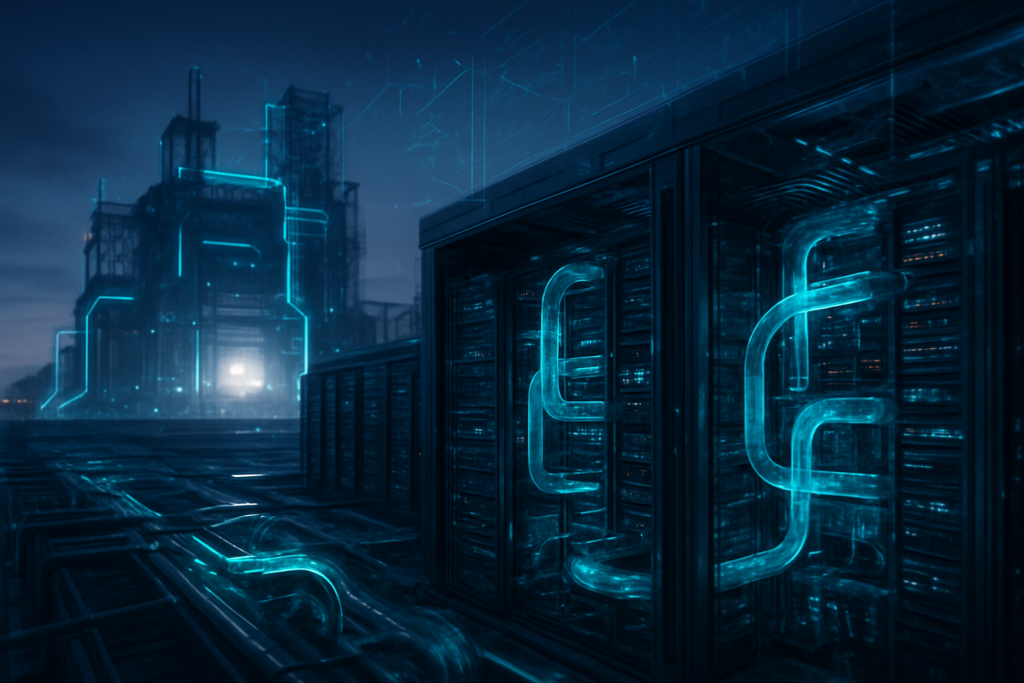
To manage this thermal load, Microsoft is moving toward standardized, closed-loop liquid cooling. This system utilizes direct-to-chip microfluidics—a technology co-developed with Corintis that etches cooling channels directly onto the silicon. This approach reduces peak operating temperatures by as much as 65% while operating as a "zero-water" system. Once the initial coolant is loaded, the system recirculates indefinitely, addressing both the energy bottleneck and the growing public scrutiny over data center water consumption.
The Competitive Shift: Vertical Integration or Gridlock
This infrastructure bottleneck has forced a strategic recalibration among the "Big Five" hyperscalers. While Microsoft is doubling down on "Fairwater," its rivals are pursuing their own paths to energy independence. Alphabet (NASDAQ: GOOGL), for instance, recently closed a $4.75 billion acquisition of Intersect Power, allowing it to bypass the public grid by co-locating data centers directly with its own solar and battery farms. Meanwhile, Amazon (NASDAQ: AMZN) has pivoted toward a "nuclear renaissance," committing hundreds of millions of dollars to Small Modular Reactors (SMRs) through partnerships with X-energy.
The competitive advantage in 2026 is no longer held by the company with the best model, but by the company that can actually power it. This shift favors legacy giants with the capital to fund multi-billion dollar grid upgrades. Microsoft’s "Community-First AI Infrastructure" initiative is a direct response to this, where the company effectively acts as a private utility, funding local substations and grid modernizations to secure the "social license" to operate.
Startups and smaller AI labs face a growing disadvantage. While a boutique lab might raise the funds to buy a cluster of Blackwell chips, they lack the leverage to negotiate for 500 megawatts of power from local utilities. We are seeing a "land grab" for energized real estate, where the valuation of a data center site is now determined more by its proximity to a high-voltage line than by its proximity to a fiber-optic hub.
Redefining the AI Landscape: The Energy-GDP Correlation
Nadella’s comments fit into a broader trend where AI is increasingly viewed through the lens of national security and energy policy. At Davos 2026, Nadella argued that future GDP growth would be directly correlated to a nation’s energy costs associated with AI. If the "energy wall" remains unbreached, the cost of running an AI query could become prohibitively expensive, potentially stalling the much-hyped "AI-led productivity boom."
The environmental implications are also coming to a head. The shift to liquid cooling is not just a technical necessity but a political one. By moving to closed-loop systems, Microsoft and Meta (NASDAQ: META) are attempting to mitigate the "water wall"—the local pushback against data centers that consume millions of gallons of water in drought-prone regions. However, the sheer electrical demand remains. Estimates suggest that by 2030, AI could consume upwards of 4% of total global electricity, a figure that has prompted some experts to compare the current AI infrastructure build-out to the expansion of the interstate highway system or the electrification of the rural South.
The Road Ahead: Fusion, Fission, and Efficiency
Looking toward late 2026 and 2027, the industry is betting on radical new energy sources to break the bottleneck. Microsoft has already signed a power purchase agreement with Helion Energy for fusion power, a move that was once seen as science fiction but is now viewed as a strategic necessity. In the near term, we expect to see more "behind-the-meter" deployments where data centers are built on the sites of retired coal or nuclear plants, utilizing existing transmission infrastructure to shave years off deployment timelines.
On the cooling front, the next frontier is "immersion cooling," where entire server racks are submerged in non-conductive dielectric fluid. While Microsoft’s current Fairwater design uses direct-to-chip liquid cooling, industry experts predict that the 200 kW racks of the late 2020s will require full immersion. This will necessitate an even deeper partnership with cooling specialized firms like LG Electronics (KRX:066570), which recently signed a multi-billion dollar deal to supply Microsoft’s global cooling stack.
Summary: The Physical Reality of Intelligence
Satya Nadella’s recent warnings serve as a reality check for an industry that has long lived in the realm of virtual bits and bytes. The realization that thousands of world-class GPUs are sitting idle in warehouses for lack of a "warm shell" is a sobering milestone in AI history. It signals that the easy gains from software optimization are being met by the hard realities of thermodynamics and aging electrical grids.
As we move deeper into 2026, the key metrics to watch will not be benchmark scores or parameter counts, but "megawatts under management" and "coolant efficiency ratios." The companies that successfully bridge the gap between AI's infinite digital potential and the Earth's finite physical resources will be the ones that define the next decade of technology.
This content is intended for informational purposes only and represents analysis of current AI developments.
TokenRing AI delivers enterprise-grade solutions for multi-agent AI workflow orchestration, AI-powered development tools, and seamless remote collaboration platforms.
For more information, visit https://www.tokenring.ai/.