In a move that signals the arrival of the "Bio-Computing" era, NVIDIA (NASDAQ: NVDA) and Eli Lilly (NYSE: LLY) have officially launched a landmark $1 billion AI co-innovation lab. Announced during the J.P. Morgan Healthcare Conference in January 2026, the five-year partnership represents a massive bet on the convergence of generative AI and life sciences. By co-locating biological experts with elite AI researchers in South San Francisco, the two giants aim to dismantle the traditional, decade-long drug discovery timeline and replace it with a continuous, autonomous loop of digital design and physical experimentation.
The significance of this development cannot be overstated. While AI has been used in pharma for years, this lab represents the first time a major technology provider and a pharmaceutical titan have deeply integrated their intellectual property and infrastructure to build "Physical AI"—systems capable of not just predicting biology, but interacting with it autonomously. This initiative is designed to transition drug discovery from a process of serendipity and trial-and-error to a predictable engineering discipline, potentially saving billions in research costs and bringing life-saving treatments to market at unprecedented speeds.
The Dawn of Vera Rubin and the 'Lab-in-the-Loop'
At the heart of the new lab lies NVIDIA’s newly minted Vera Rubin architecture, the high-performance successor to the Blackwell platform. Specifically engineered for the massive scaling requirements of frontier biological models, the Vera Rubin chips provide the exascale compute necessary to train "Biological Foundation Models" that understand the trillions of parameters governing protein folding, RNA structure, and molecular synthesis. Unlike previous iterations of hardware, the Vera Rubin architecture features specialized accelerators for "Physical AI," allowing for real-time processing of sensor data from robotic lab equipment and complex chemical simulations simultaneously.
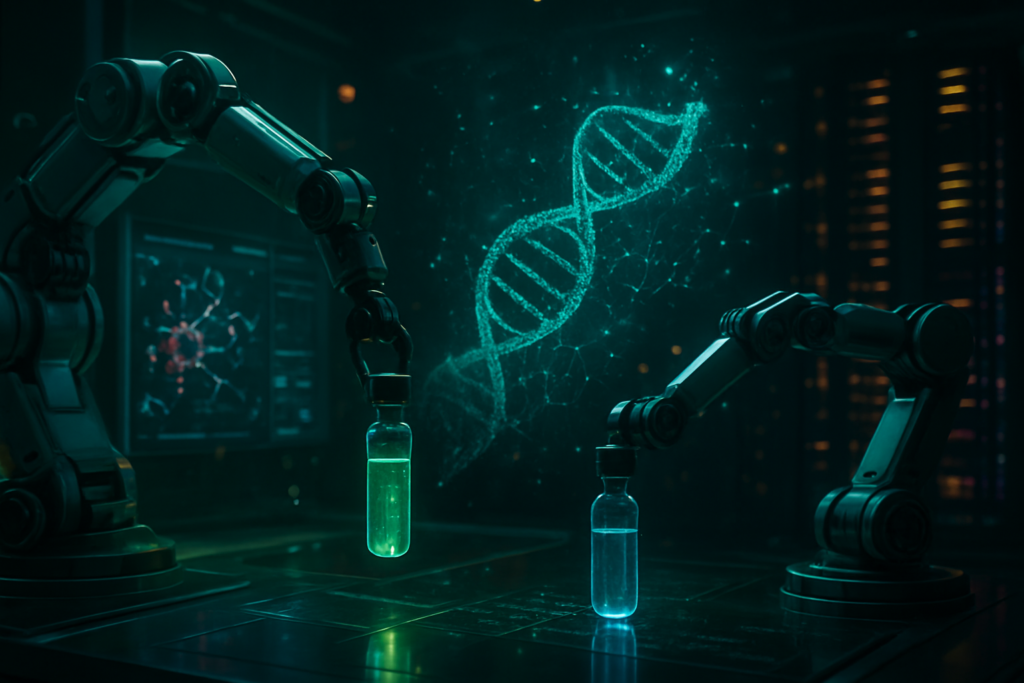
The lab utilizes an advanced version of NVIDIA’s BioNeMo platform to power what researchers call a "lab-in-the-loop" (or agentic wet lab) system. In this workflow, AI models don't just suggest molecules; they command autonomous robotic arms to synthesize them. Using a new reasoning model dubbed ReaSyn v2, the AI ensures that any designed compound is chemically viable for physical production. Once synthesized, the physical results—how the molecule binds to a target or its toxicity levels—are immediately fed back into the foundation models via high-speed sensors, allowing the AI to "learn" from its real-world failures and successes in a matter of hours rather than months.
This approach differs fundamentally from previous "In Silico" methods, which often suffered from a "reality gap" where computer-designed drugs failed when introduced to a physical environment. By integrating the NVIDIA Omniverse for digital twins of the laboratory itself, the team can simulate physical experiments millions of times to optimize conditions before a single drop of reagent is used. This closed-loop system is expected to increase research throughput by 100-fold, shifting the focus from individual drug candidates to a broader exploration of the entire "biological space."
A Strategic Power Play in the Trillion-Dollar Pharma Market
The partnership places NVIDIA and Eli Lilly in a dominant position within their respective industries. For NVIDIA, this is a strategic pivot from being a mere supplier of GPUs to a co-owner of the innovation process. By embedding the Vera Rubin architecture into the very fabric of drug discovery, NVIDIA is creating a high-moat ecosystem that is difficult for competitors like Advanced Micro Devices (NASDAQ: AMD) or Intel (NASDAQ: INTC) to penetrate. This "AI Factory" model proves that the future of tech giants lies in specialized vertical integration rather than general-purpose cloud compute.
For Eli Lilly, the $1 billion investment is a defensive and offensive masterstroke. Having already seen massive success with its obesity and diabetes treatments, Lilly is now using its capital to build an unassailable lead in AI-driven R&D. While competitors like Pfizer (NYSE: PFE) and Roche have made similar AI investments, the depth of the Lilly-NVIDIA integration—specifically the use of Physical AI and the Vera Rubin architecture—sets a new bar. Analysts suggest that this collaboration could eventually lead to "clinical trials in a box," where much of the early-stage safety testing is handled by AI agents before a single human patient is enrolled.
The disruption extends beyond Big Pharma to AI startups and biotech firms. Many smaller companies that relied on providing niche AI services to pharma may find themselves squeezed by the sheer scale of the Lilly-NVIDIA "AI Factory." However, the move also validates the sector, likely triggering a wave of similar joint ventures as other pharmaceutical companies rush to secure their own high-performance compute clusters and proprietary foundation models to avoid being left behind in the "Bio-Computing" race.
The Physical AI Paradigm Shift
This collaboration is a flagship example of the broader trend toward "Physical AI"—the shift of artificial intelligence from digital screens into the physical world. While Large Language Models (LLMs) changed how we interact with text, Biological Foundation Models are changing how we interact with the building blocks of life. This fits into a broader global trend where AI is increasingly being used to solve hard-science problems, such as fusion energy, climate modeling, and materials science. By mastering the "language" of biology, NVIDIA and Lilly are essentially creating a compiler for the human body.
The broader significance also touches on the "Valley of Death" in pharmaceuticals—the high failure rate between laboratory discovery and clinical success. By using AI to predict toxicity and efficacy with high fidelity before human trials, this lab could significantly reduce the cost of medicine. However, this progress brings potential concerns regarding the "dual-use" nature of such powerful technology. The same models that design life-saving proteins could, in theory, be used to design harmful pathogens, necessitating a new framework for AI bio-safety and regulatory oversight that is currently being debated in Washington and Brussels.
Compared to previous AI milestones, such as AlphaFold’s protein-structure predictions, the Lilly-NVIDIA lab represents the transition from understanding biology to engineering it. If AlphaFold was the map, the Vera Rubin-powered "AI Factory" is the vehicle. We are moving away from a world where we discover drugs by chance and toward a world where we manufacture them by design, marking perhaps the most significant leap in medical science since the discovery of penicillin.
The Road Ahead: RNA and Beyond
Looking toward the near term, the South San Francisco facility is slated to become fully operational by late March 2026. The initial focus will likely be on high-demand areas such as RNA structure prediction and neurodegenerative diseases. Experts predict that within the next 24 months, the lab will produce its first "AI-native" drug candidate—one that was conceived, synthesized, and validated entirely within the autonomous Physical AI loop. We can also expect to see the Vera Rubin architecture being used to create "Digital Twins" of human organs, allowing for personalized drug simulations tailored to an individual’s genetic makeup.
The long-term challenges remain formidable. Data quality remains the "garbage in, garbage out" hurdle for biological AI; even with $1 billion in funding, the AI is only as good as the biological data provided by Lilly’s centuries of research. Furthermore, regulatory bodies like the FDA will need to evolve to handle "AI-designed" molecules, potentially requiring new protocols for how these drugs are vetted. Despite these hurdles, the momentum is undeniable. Experts believe the success of this lab will serve as the blueprint for the next generation of industrial AI applications across all sectors of the economy.
A Historic Milestone for AI and Humanity
The launch of the NVIDIA and Eli Lilly co-innovation lab is more than just a business deal; it is a historic milestone that marks the definitive end of the purely digital AI era. By investing $1 billion into the fusion of the Vera Rubin architecture and biological foundation models, these companies are laying the groundwork for a future where disease could be treated as a code error to be fixed rather than an inevitability. The shift to Physical AI represents a maturation of the technology, moving it from the realm of chatbots to the vanguard of human health.
As we move into 2026, the tech and medical worlds will be watching the South San Francisco facility closely. The key takeaways from this development are clear: compute is the new oil, biology is the new code, and those who can bridge the gap between the two will define the next century of progress. The long-term impact on global health, longevity, and the economy could be staggering. For now, the industry awaits the first results from the "AI Factory," as the world watches the code of life get rewritten in real-time.
This content is intended for informational purposes only and represents analysis of current AI developments.
TokenRing AI delivers enterprise-grade solutions for multi-agent AI workflow orchestration, AI-powered development tools, and seamless remote collaboration platforms.
For more information, visit https://www.tokenring.ai/.