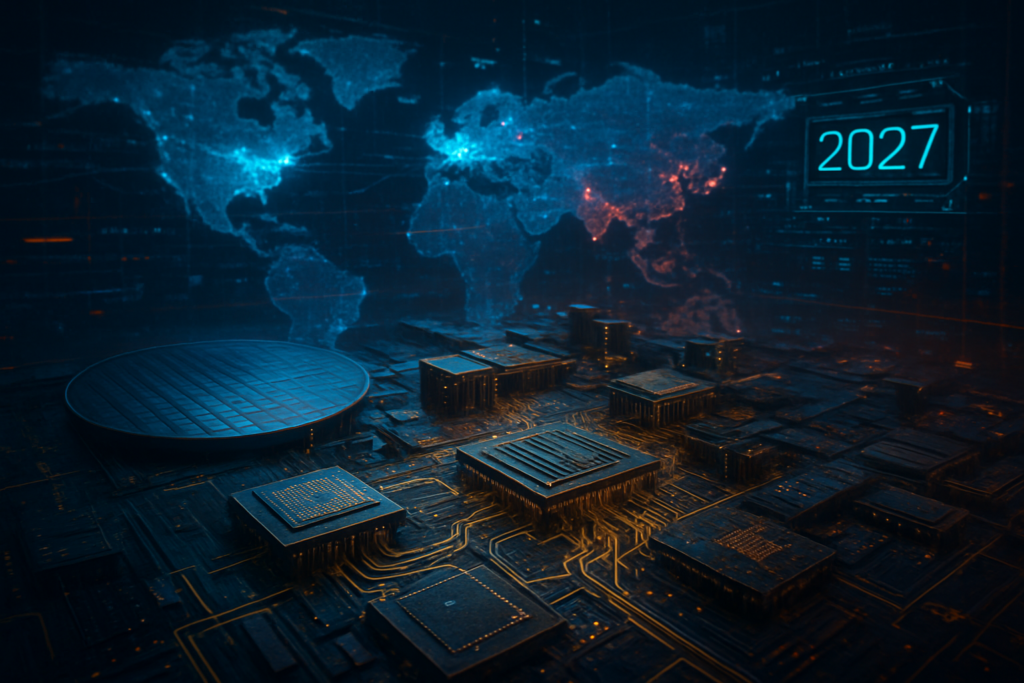
In a significant recalibration of global trade policy, the Trump administration has officially announced a new round of Section 301 tariffs targeting Chinese semiconductor imports, specifically focusing on "legacy" and older-generation chips. However, recognizing the fragile state of global electronics manufacturing, the administration has implemented a strategic delay, pushing the enforcement of these new duties to June 23, 2027. This 18-month "reproach period" is designed to act as a pressure valve for U.S. manufacturers, providing them with a critical window to de-risk their supply chains while the White House maintains a powerful bargaining chip in ongoing negotiations with Beijing over rare earth metal exports.
The announcement, which follows a year-long investigation into China’s state-subsidized dominance of mature-node semiconductor markets, marks a pivotal moment in the "Silicon War." By delaying the implementation, the administration aims to avoid the immediate inflationary shocks that would hit the automotive, medical device, and consumer electronics sectors—industries that remain heavily dependent on Chinese-made foundational chips. As of December 31, 2025, this move is being viewed by industry analysts as a high-stakes gamble: a "strategic pause" that bets on the rapid expansion of domestic fabrication capacity before the 2027 deadline arrives.
The Legacy Chip Lockdown: Technical Specifics and the 2027 Timeline
The new tariffs specifically target "legacy" semiconductors—chips built on 28-nanometer (nm) process nodes and larger. While these are not the cutting-edge processors found in the latest smartphones, they are the "workhorses" of the modern economy, controlling everything from power management in electric vehicles to the sensors in industrial robotics. The Trump administration’s Section 301 investigation concluded that China’s massive "Big Fund" subsidies have allowed its domestic firms to flood the market with artificially low-priced legacy silicon, threatening the viability of Western competitors like Intel Corporation (NASDAQ: INTC) and GlobalFoundries (NASDAQ: GFS).
Technically, the new policy introduces a tiered tariff structure that would eventually see duties on these components rise to 100%. However, by setting the implementation date for June 2027, the U.S. is creating a temporary "tariff-free zone" for new orders, distinct from the existing 50% baseline tariffs established earlier in 2025. This differs from previous "shotgun" tariff approaches by providing a clear, long-term roadmap for industrial decoupling. Industry experts note that this approach gives companies a "glide path" to transition their designs to non-Chinese foundries, such as those being built by Taiwan Semiconductor Manufacturing Company (NYSE: TSM) in Arizona.
Initial reactions from the semiconductor research community have been cautiously optimistic. Experts at the Center for Strategic and International Studies (CSIS) suggest that the delay prevents a "supply chain cardiac arrest" in the near term. By specifying the 28nm+ threshold, the administration is drawing a clear line between the "foundational" chips used in everyday infrastructure and the "frontier" chips used for high-end AI training, which are already subject to strict export controls.
Market Ripple Effects: Winners, Losers, and the Nvidia Surcharge
The 2027 delay provides a much-needed reprieve for major U.S. tech giants and automotive manufacturers. Ford Motor Company (NYSE: F) and General Motors (NYSE: GM), which faced potential production halts due to their reliance on Chinese microcontrollers, saw their stock prices stabilize following the announcement. However, the most complex market positioning involves Nvidia (NASDAQ: NVDA). While Nvidia focuses on high-end GPUs, its ecosystem relies on legacy chips for power delivery and cooling systems. The delay ensures that Nvidia’s hardware partners can continue to source these essential components without immediate cost spikes.
Furthermore, the Trump administration has introduced a unique "25% surcharge" on certain high-end AI exports, such as the Nvidia H200, to approved Chinese customers. This move essentially transforms a national security restriction into a revenue stream for the U.S. Treasury, while the 2027 legacy chip delay acts as the "carrot" in this "carrot-and-stick" diplomatic strategy. Advanced Micro Devices (NASDAQ: AMD) is also expected to benefit from the delay, as it allows the company more time to qualify alternative suppliers for its non-processor components without disrupting its current product cycles.
Conversely, Chinese semiconductor champions like SMIC and Hua Hong Semiconductor face a looming "structural cliff." While they can continue to export to the U.S. for the next 18 months, the certainty of the 2027 tariffs is already driving Western customers toward "friend-shoring" initiatives. This strategic advantage for U.S.-based firms is contingent on whether domestic capacity can scale fast enough to replace the Chinese supply by the mid-2027 deadline.
Rare Earths and the Broader AI Landscape
The decision to delay the tariffs is inextricably linked to the broader geopolitical struggle over critical minerals. In late 2025, China intensified its export restrictions on rare earth metals—specifically elements like dysprosium and terbium, which are essential for the high-performance magnets used in AI data center cooling systems and electric vehicle motors. The 2027 tariff delay is widely seen as a response to a "truce" reached in November 2025, where Beijing agreed to temporarily suspend its newest mineral export bans in exchange for U.S. trade flexibility.
This fits into a broader trend where silicon and soil (minerals) have become the dual currencies of international power. The AI landscape is increasingly sensitive to these shifts; while much of the focus is on "compute" (the chips themselves), the physical infrastructure of AI—including power grids and cooling—is highly dependent on the very legacy chips and rare earth metals at the heart of this dispute. By delaying the tariffs, the Trump administration is attempting to secure the "physical layer" of the AI revolution while it builds out domestic self-sufficiency.
Comparatively, this milestone is being likened to the "Plaza Accord" for the digital age—a managed realignment of global industrial capacity. However, the potential concern remains that China could use this 18-month window to further entrench its dominance in other parts of the supply chain, or that U.S. manufacturers might become complacent, failing to de-risk as aggressively as the administration hopes.
The Road to 2027: Future Developments and Challenges
Looking ahead, the next 18 months will be a race against time. The primary challenge is the "commissioning gap"—the time it takes for a new semiconductor fab to move from construction to high-volume manufacturing. All eyes will be on Intel’s Ohio facilities and TSMC’s expansion in the U.S. to see if they can meet the demand for legacy-node chips by June 2027. If these domestic "mega-fabs" face delays, the Trump administration may be forced to choose between a second delay or a massive spike in the cost of American-made electronics.
Predicting the next moves, analysts suggest that the U.S. will likely expand its "Carbon Border Adjustment" style policies to include "Silicon Content," potentially taxing products based on the percentage of Chinese-made chips they contain, regardless of where the final product is assembled. On the horizon, we may also see the emergence of "sovereign supply chains," where nations or blocs like the EU and the U.S. create closed-loop ecosystems for critical technologies, further fragmenting the globalized trade model that has defined the last thirty years.
Conclusion: A High-Stakes Strategic Pause
The Trump administration’s decision to delay the new China chip tariffs until 2027 is a masterclass in "realpolitik" trade strategy. It acknowledges the inescapable reality of current supply chain dependencies while setting a firm expiration date on China's dominance of the legacy chip market. The key takeaways are clear: the U.S. is prioritizing industrial stability in the short term to gain a strategic advantage in the long term, using the 2027 deadline as both a threat to Beijing and a deadline for American industry.
In the history of AI and technology development, this move may be remembered as the moment the "just-in-time" supply chain was permanently replaced by a "just-in-case" national security model. The long-term impact will be a more resilient, albeit more expensive, domestic tech ecosystem. In the coming weeks and months, market watchers should keep a close eye on rare earth pricing and the progress of U.S. fab construction—these will be the true indicators of whether the "2027 gamble" will pay off or lead to a significant economic bottleneck.
This content is intended for informational purposes only and represents analysis of current AI developments.
TokenRing AI delivers enterprise-grade solutions for multi-agent AI workflow orchestration, AI-powered development tools, and seamless remote collaboration platforms.
For more information, visit https://www.tokenring.ai/.