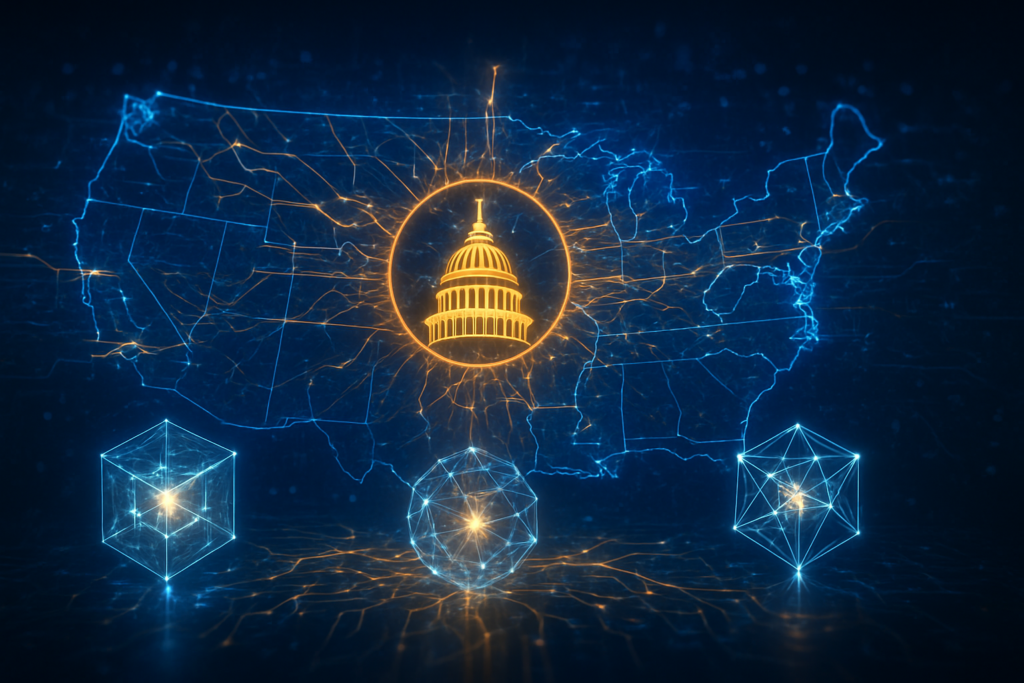
In a move that fundamentally reshapes the American technological landscape, President Donald Trump has signed a sweeping Executive Order aimed at establishing a singular national framework for artificial intelligence. Signed on December 11, 2025, the order—titled "Ensuring a National Policy Framework for Artificial Intelligence"—seeks to prevent a "patchwork" of conflicting state-level regulations from hindering the development and deployment of AI technologies. By asserting federal preemption, the administration is effectively sidelining state-led initiatives in California, Colorado, and New York that sought to impose strict safety and transparency requirements on AI developers.
The immediate significance of this order cannot be overstated. It marks the final pivot of the administration’s "Make America First in AI" agenda, moving away from the safety-centric oversight of the previous administration toward a model of aggressive deregulation. The White House argues that for the United States to maintain its lead over global competitors, specifically China, American companies must be liberated from the "cumbersome and contradictory" rules of 50 different states. The order signals a new era where federal authority is used not to regulate, but to protect the industry from regulation.
The Mechanics of Preemption: A New Legal Shield for AI
The December Executive Order introduces several unprecedented mechanisms to enforce federal supremacy over AI policy. Central to this is the creation of an AI Litigation Task Force within the Department of Justice, which is scheduled to become fully operational by January 10, 2026. This task force is charged with challenging any state law that the administration deems "onerous" or an "unconstitutional burden" on interstate commerce. The legal strategy relies heavily on the Dormant Commerce Clause, arguing that because AI models are developed and deployed across state and national borders, they are inherently beyond the regulatory purview of individual states.
Technically, the order targets specific categories of state regulation that the administration has labeled as "anti-innovation." These include mandatory algorithmic audits for "bias" and "discrimination," such as those found in Colorado’s SB 24-205, and California’s rigorous transparency requirements for large-scale foundation models. The administration has categorized these state-level mandates as "engineered social agendas" or "Woke AI" requirements, claiming they force developers to bake ideological biases into their software. By preempting these rules, the federal government aims to provide a "minimally burdensome" standard that focuses on performance and economic growth rather than social impact.
Initial reactions from the AI research community are sharply divided. Proponents of the order, including many high-profile researchers at top labs, argue that a single federal standard will accelerate the pace of experimentation. They point out that the cost of compliance for a startup trying to navigate 50 different sets of rules is often prohibitive. Conversely, safety advocates and some academic researchers warn that by stripping states of their ability to regulate, the federal government is creating a "vacuum of accountability." They argue that the lack of local oversight could lead to a "race to the bottom" where safety protocols are sacrificed for speed.
Big Tech and the Silicon Valley Victory
The announcement has been met with quiet celebration across the headquarters of America’s largest technology firms. Major players such as Microsoft (NASDAQ: MSFT), Alphabet (NASDAQ: GOOGL), Meta Platforms (NASDAQ: META), and NVIDIA (NASDAQ: NVDA) have long lobbied for a unified federal approach to AI. For these giants, the order provides the "clarity and predictability" needed to deploy trillions of dollars in capital. By removing the threat of a fragmented regulatory environment, the administration has essentially lowered the long-term operational risk for companies building the next generation of Large Language Models (LLMs) and autonomous systems.
Startups and venture capital firms are also positioned as major beneficiaries. Prominent investors, including Marc Andreessen of Andreessen Horowitz, have praised the move as a "lifeline" for the American startup ecosystem. Without the threat of state-level lawsuits or expensive compliance audits, smaller AI labs can focus their limited resources on technical breakthroughs rather than legal defense. This shift is expected to consolidate the U.S. market, making it more attractive for domestic investment while potentially disrupting the plans of international competitors who must still navigate the complex regulatory environment of the European Union’s AI Act.
However, the competitive implications are not entirely one-sided. While the order protects incumbents and domestic startups, it also removes certain consumer protections that some smaller, safety-focused firms had hoped to use as a market differentiator. By standardizing a "minimally burdensome" framework, the administration may inadvertently reduce the incentive for companies to invest in the very safety and transparency features that European and Asian markets are increasingly demanding. This could create a strategic rift between U.S.-based AI services and the rest of the world.
The Wider Significance: Innovation vs. Sovereignty
This Executive Order represents a major milestone in the history of AI policy, signaling a complete reversal of the approach taken by the Biden administration. Whereas the previous Executive Order 14110 focused on managing risks and protecting civil rights, Trump’s EO 14179 and the subsequent December preemption order prioritize "global AI dominance" above all else. This shift reflects a broader trend in 2025: the framing of AI not just as a tool for productivity, but as a critical theater of national security and geopolitical competition.
The move also touches on a deeper constitutional tension regarding state sovereignty. By threatening to withhold federal funding—specifically from the Broadband Equity Access and Deployment (BEAD) program—for states that refuse to align with federal AI policy, the administration is using significant financial leverage to enforce its will. This has sparked a bipartisan backlash among state Attorneys General, who argue that the federal government is overstepping its bounds and stripping states of their traditional role in consumer protection.
Comparisons are already being drawn to the early days of the internet, when the federal government largely took a hands-off approach to regulation. Supporters of the preemption order argue that this "permissionless innovation" is exactly what allowed the U.S. to dominate the digital age. Critics, however, point out that AI is fundamentally different from the early web, with the potential to impact physical safety, democratic integrity, and the labor market in ways that static websites never could. The concern is that by the time the federal government decides to act, the "unregulated" development may have already caused irreversible societal shifts.
Future Developments: A Supreme Court Showdown Looms
The near-term future of this Executive Order will likely be decided in the courts. California Governor Gavin Newsom has already signaled that his state will not back down, calling the order an "illegal infringement on California’s rights." Legal experts predict a flurry of lawsuits in early 2026, as states seek to defend their right to protect their citizens from deepfakes, algorithmic bias, and job displacement. This is expected to culminate in a landmark Supreme Court case that will define the limits of federal power in the age of artificial intelligence.
Beyond the legal battles, the industry is watching to see how the Department of Commerce defines the "onerous" laws that will be officially targeted for preemption. The list, expected in late January 2026, will serve as a roadmap for which state-level protections are most at risk. Meanwhile, we may see a push in Congress to codify this preemption into law, which would provide a more permanent legislative foundation for the administration's "One Nation, One AI" policy and make it harder for future administrations to reverse.
Experts also predict a shift in how AI companies approach international markets. As the U.S. moves toward a deregulated model, the "Brussels Effect"—where EU regulations become the global standard—may strengthen. U.S. companies may find themselves building two versions of their products: a "high-performance" version for the domestic market and a "compliant" version for export to more regulated regions like Europe and parts of Asia.
A New Chapter for American Technology
The "Ensuring a National Policy Framework for Artificial Intelligence" Executive Order marks a definitive end to the era of cautious, safety-first AI policy in the United States. By centralizing authority and actively dismantling state-level oversight, the Trump administration has placed a massive bet on the idea that speed and scale are the most important metrics for AI success. The key takeaway for the industry is clear: the federal government is now the primary, and perhaps only, regulator that matters.
In the history of AI development, this moment will likely be remembered as the "Great Preemption," a time when the federal government stepped in to ensure that the "engines of innovation" were not slowed by local concerns. Whether this leads to a new golden age of American technological dominance or a series of unforeseen societal crises remains to be seen. The long-term impact will depend on whether the federal government can effectively manage the risks of AI on its own, without the "laboratory of the states" to test different regulatory approaches.
In the coming weeks, stakeholders should watch for the first filings from the AI Litigation Task Force and the reactions from the European Union, which may see this move as a direct challenge to its own regulatory ambitions. As 2026 begins, the battle for the soul of AI regulation has moved from the statehouses to the federal courts, and the stakes have never been higher.
This content is intended for informational purposes only and represents analysis of current AI developments.
TokenRing AI delivers enterprise-grade solutions for multi-agent AI workflow orchestration, AI-powered development tools, and seamless remote collaboration platforms.
For more information, visit https://www.tokenring.ai/.