The Omni Shift: How GPT-4o Redefined Human-AI Interaction and Birthed the Agent Era
As we look back from the close of 2025, few moments in the rapid evolution of artificial intelligence carry as much weight as the release of OpenAI’s GPT-4o, or "Omni." Launched in May 2024, the model represented a fundamental departure from the "chatbot" era, transitioning the industry toward a future where AI does not merely process text but perceives the world through a unified, native multimodal lens. By collapsing the barriers between sight, sound, and text, OpenAI set a new standard for what it means for an AI to be "present."
The immediate significance of GPT-4o was its ability to operate at human-like speeds, effectively ending the awkward "AI lag" that had plagued previous voice assistants. With an average latency of 320 milliseconds—and a floor of 232 milliseconds—GPT-4o matched the response time of natural human conversation. This wasn't just a technical upgrade; it was a psychological breakthrough that allowed AI to move from being a digital encyclopedia to a real-time collaborator and emotional companion, laying the groundwork for the autonomous agents that now dominate our digital lives in late 2025.
The Technical Leap: From Pipelines to Native Multimodality
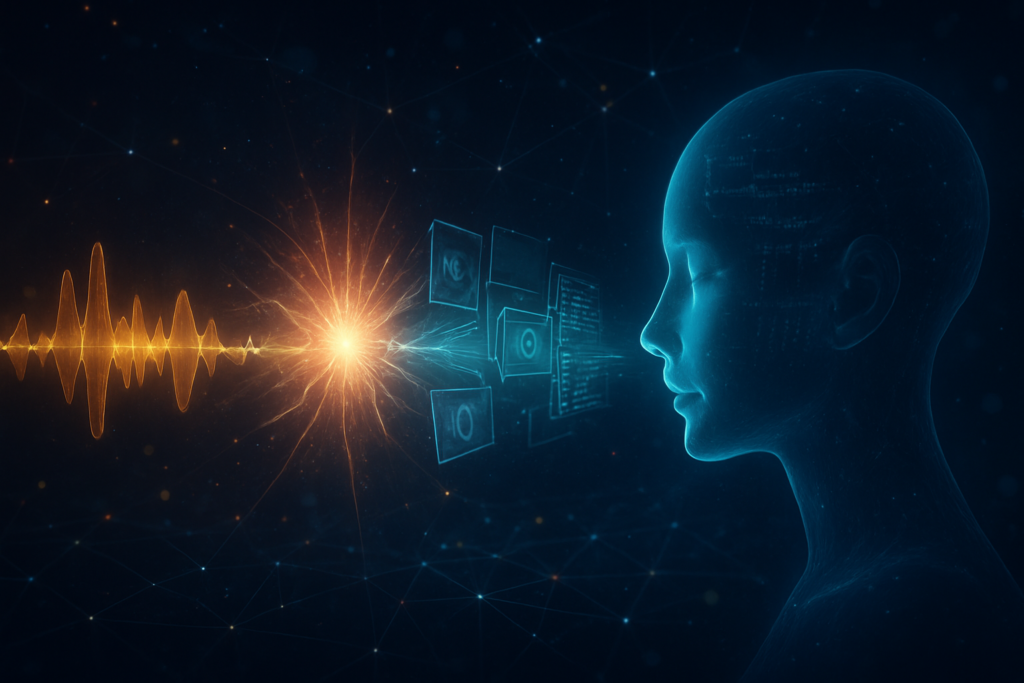
The technical brilliance of GPT-4o lay in its "native" architecture. Prior to its arrival, multimodal AI was essentially a "Frankenstein" pipeline of disparate models: one model (like Whisper) would transcribe audio to text, a second (GPT-4) would process that text, and a third would convert the response back into speech. This "pipeline" approach was inherently lossy; the AI could not "hear" the inflection in a user's voice or "see" the frustration on their face. GPT-4o changed the game by training a single neural network end-to-end across text, vision, and audio.
Because every input and output was processed by the same model, GPT-4o could perceive raw audio waves directly. This allowed the model to detect subtle emotional cues, such as a user’s breathing patterns, background noises like a barking dog, or the specific cadence of a sarcastic remark. On the output side, the model gained the ability to generate speech with intentional emotional nuance—whispering, singing, or laughing—making it the first AI to truly cross the "uncanny valley" of vocal interaction.
The vision capabilities were equally transformative. By processing video frames in real-time, GPT-4o could "watch" a user solve a math problem on paper or "see" a coding error on a screen, providing feedback as if it were standing right behind them. This leap from static image analysis to real-time video reasoning fundamentally differentiated OpenAI from its competitors at the time, who were still struggling with the latency issues inherent in multi-model architectures.
A Competitive Earthquake: Reshaping the Big Tech Landscape
The arrival of GPT-4o sent shockwaves through the tech industry, most notably affecting Microsoft (NASDAQ: MSFT), Alphabet (NASDAQ: GOOGL), and Apple (NASDAQ: AAPL). For Microsoft, OpenAI’s primary partner, GPT-4o provided the "brain" for a new generation of Copilot+ PCs, enabling features like Recall and real-time translation that required the low-latency processing the Omni model excelled at. However, the most surprising strategic shift came via Apple.
At WWDC 2024, Apple announced that GPT-4o would be the foundational engine for its "Apple Intelligence" initiative, integrating ChatGPT directly into Siri. This partnership was a masterstroke for OpenAI, giving it access to over a billion high-value users and forcing Alphabet (NASDAQ: GOOGL) to accelerate its own Gemini Live roadmap. Google’s "Project Astra," which had been teased as a future vision, suddenly found itself in a race to match GPT-4o’s "Omni" capabilities, leading to a year of intense competition in the "AI-as-a-Companion" market.
The release also disrupted the startup ecosystem. Companies that had built their value propositions around specialized speech-to-text or emotional AI found their moats evaporated overnight. GPT-4o proved that a general-purpose foundation model could outperform specialized tools in niche sensory tasks, signaling a consolidation of the AI market toward a few "super-models" capable of doing everything from vision to voice.
The Cultural Milestone: The "Her" Moment and Ethical Friction
The wider significance of GPT-4o was as much cultural as it was technical. The model’s launch was immediately compared to the 2013 film Her, which depicted a man falling in love with an emotionally intelligent AI. This comparison was not accidental; OpenAI’s leadership, including Sam Altman, leaned into the narrative of AI as a personal, empathetic companion. This shift sparked a global conversation about the psychological impact of forming emotional bonds with software, a topic that remains a central pillar of AI ethics in 2025.
However, this transition was not without controversy. The "Sky" voice controversy, where actress Scarlett Johansson alleged the model’s voice was an unauthorized imitation of her own, highlighted the legal and ethical gray areas of vocal personality generation. It forced the industry to adopt stricter protocols regarding the "theft" of human likeness and vocal identity. Despite these hurdles, GPT-4o’s success proved that the public was ready—and even eager—for AI that felt more "human."
Furthermore, GPT-4o served as the ultimate proof of concept for the "Agentic Era." By providing a model that could see and hear in real-time, OpenAI gave developers the tools to build agents that could navigate the physical and digital world autonomously. It was the bridge between the static LLMs of 2023 and the goal-oriented, multi-step autonomous systems we see today, which can manage entire workflows without human intervention.
The Path Forward: From Companion to Autonomous Agent
Looking ahead from our current 2025 vantage point, GPT-4o is seen as the precursor to the more advanced GPT-5 and o1 reasoning models. While GPT-4o focused on "presence" and "perception," the subsequent generations have focused on "reasoning" and "reliability." The near-term future of AI involves the further miniaturization of these Omni capabilities, allowing them to run locally on wearable devices like AI glasses and hearables without the need for a cloud connection.
The next frontier, which experts predict will mature by 2026, is the integration of "long-term memory" into the Omni framework. While GPT-4o could perceive a single conversation with startling clarity, the next generation of agents will remember years of interactions, becoming truly personalized digital twins. The challenge remains in balancing this deep personalization with the massive privacy concerns that come with an AI that is "always listening" and "always watching."
A Legacy of Presence: Wrapping Up the Omni Era
In the grand timeline of artificial intelligence, GPT-4o will be remembered as the moment the "user interface" of AI changed forever. It moved the needle from a text box to a living, breathing (literally, in some cases) presence. The key takeaway from the GPT-4o era is that intelligence is not just about the ability to solve complex equations; it is about the ability to perceive and react to the world in a way that feels natural to humans.
As we move deeper into 2026, the "Omni" philosophy has become the industry standard. No major AI lab would dream of releasing a text-only model today. GPT-4o’s legacy is the democratization of high-level multimodal intelligence, making it free for millions and setting the stage for the AI-integrated society we now inhabit. It wasn't just a better chatbot; it was the first step toward a world where AI is a constant, perceptive, and emotionally aware partner in the human experience.
This content is intended for informational purposes only and represents analysis of current AI developments.
TokenRing AI delivers enterprise-grade solutions for multi-agent AI workflow orchestration, AI-powered development tools, and seamless remote collaboration platforms.
For more information, visit https://www.tokenring.ai/.