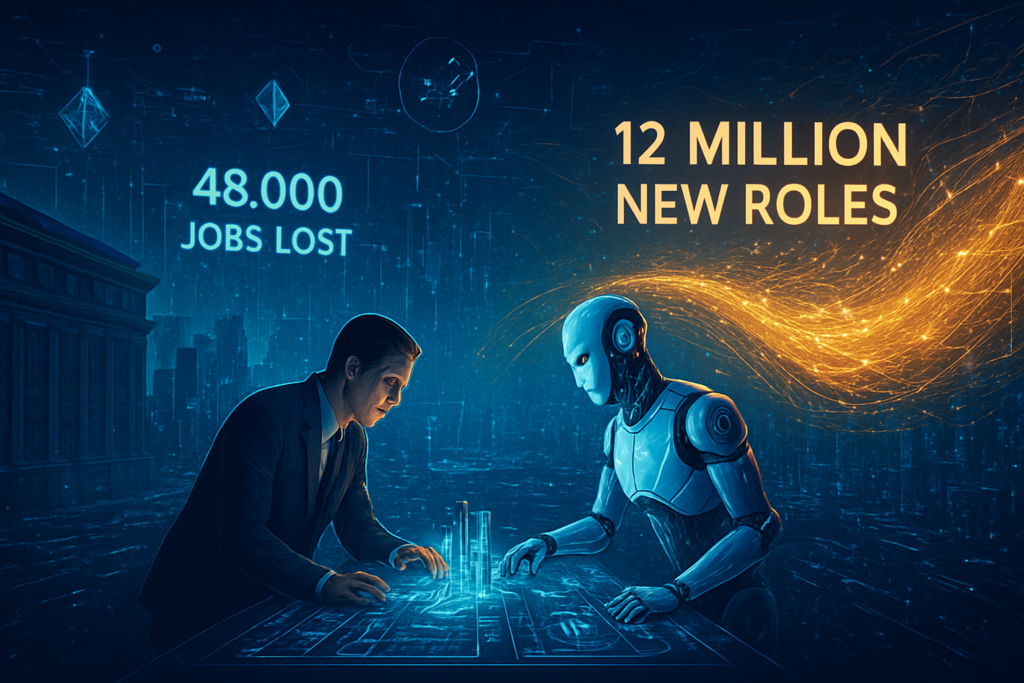
The latest Forbes AI Workforce Report 2025 has sent ripples through the global economy, unveiling a paradoxical landscape of labor. While the report acknowledges a stark 48,414 job losses directly attributed to artificial intelligence in the United States this year, it counterbalances those figures with a staggering projection: the creation of 12 million new roles globally by the end of 2025. This data marks a definitive shift in the narrative from a "robot takeover" to a massive, systemic reorganization of human labor.
The significance of these findings cannot be overstated. As of December 25, 2025, the global workforce is no longer merely "preparing" for AI; it is actively being restructured by it. The report highlights that while the displacement of nearly 50,000 workers is a localized tragedy for those affected, the broader trend is one of "augmentation" and "redesign." This suggests that the primary challenge of the mid-2020s is not a lack of work, but a profound mismatch between existing skills and the requirements of a new, AI-integrated economy.
The Anatomy of the 12 Million: Beyond the 48k Baseline
The report’s data, drawing from analysts at Challenger, Gray & Christmas and the World Economic Forum, provides a granular look at the current transition. The 48,414 job cuts in the U.S. represent roughly 4% of total layoffs for the year, indicating that while AI is a factor, it is not yet the primary driver of unemployment. These losses are largely concentrated in routine data processing, basic administrative support, and junior-level technical roles. In contrast, the 12 million new roles are emerging in "AI-adjacent" sectors where human judgment remains indispensable—such as AI-assisted healthcare diagnostics, ethical compliance, and complex supply chain orchestration.
Technically, this shift is driven by the maturation of Agentic AI—systems capable of executing multi-step workflows rather than just answering prompts. Unlike the early generative AI of 2023, the 2025 models are integrated into enterprise resource planning (ERP) systems, allowing them to handle the "drudge work" of logistics and data entry. This leaves humans to focus on exception handling and strategic decision-making. Initial reactions from the AI research community have been cautiously optimistic, with many noting that the "productivity frontier" is moving faster than previously anticipated, necessitating a rethink of the standard 40-hour work week.
Industry experts emphasize that the "new roles" are not just for Silicon Valley engineers. They include "Prompt Architects" in marketing firms, "AI Safety Auditors" in legal departments, and "Human-in-the-Loop" supervisors in manufacturing. The technical specification for the modern worker has shifted from "knowing the answer" to "knowing how to verify the machine's answer." This fundamental change in the human-machine interface is what is driving the massive demand for a new type of professional.
Corporate Strategy: The Rise of the Internal AI Academy
The Forbes report reveals a strategic pivot among tech giants and Fortune 500 companies. IBM (NYSE: IBM) and Amazon (NASDAQ: AMZN) have emerged as leaders in this transition, moving away from expensive external hiring toward "internal redeployment." IBM, in particular, has been vocal about its "AI First" internal training programs, which aim to transition thousands of back-office employees into AI-augmented roles. This strategy not only mitigates the social cost of layoffs but also retains institutional knowledge that is often lost during traditional downsizing.
For major AI labs like Microsoft (NASDAQ: MSFT) and Alphabet Inc. (NASDAQ: GOOGL), the report suggests a competitive advantage for those who can provide the most "user-friendly" orchestration tools. As companies scramble to reskill their workforces, the platforms that require the least amount of technical "re-learning" are winning the market. This has led to a surge in specialized startups focusing on "No-Code AI" and "Natural Language Orchestration," threatening to disrupt traditional software-as-a-service (SaaS) models that rely on complex, manual user interfaces.
The market positioning is clear: companies that view AI as a tool for "headcount reduction" are seeing short-term gains but long-term talent shortages. Conversely, those investing in the "Great Reskilling"—the report notes that 68% of C-suite leaders now prioritize human-AI collaboration—are building more resilient operations. This strategic advantage is becoming the primary differentiator in the 2025 fiscal landscape.
The Societal Blueprint: Addressing the Entry-Level Crisis
Beyond the corporate balance sheets, the Forbes report examines the wider societal implications of this shift. One of the most concerning trends identified is the "hollowing out" of entry-level positions. Historically, junior roles served as a training ground for future leaders. With AI now performing the tasks of junior coders, paralegals, and analysts, the "on-ramp" to professional careers is being dismantled. This creates a potential talent gap in the 2030s if the industry does not find new ways to apprentice young workers in an AI-dominated environment.
The "massive reskilling shift" involves an estimated 120 million workers globally who will need retraining by 2027. This is a milestone that dwarfs previous industrial revolutions in both speed and scale. The report notes that the premium has shifted heavily toward "human-centric" skills: empathy, leadership, and complex problem-solving. In a world where a machine can write a perfect legal brief, the value of a lawyer who can navigate the emotional nuances of a courtroom or a negotiation has skyrocketed.
However, concerns remain regarding the "digital divide." While 12 million new roles are being created, they are not necessarily appearing in the same geographic regions or socioeconomic brackets where the 48,000 jobs were lost. This geographic and skill-based mismatch is a primary concern for policymakers, who are now looking at "AI Transition Credits" and subsidized lifelong learning programs to ensure that the workforce is not left behind.
The Horizon: Predictive Maintenance of the Human Workforce
Looking ahead, the next 18 to 24 months will likely see the emergence of "Personalized AI Career Coaches"—AI systems designed to help workers identify their skill gaps and navigate their own reskilling journeys. Experts predict that the concept of a "static degree" is effectively dead; the future of work is a continuous cycle of micro-learning and adaptation. The report suggests that by 2026, "AI Fluency" will be as fundamental a requirement as literacy or basic numeracy.
The challenges are significant. Educational institutions are currently struggling to keep pace with the 12-million-role demand, leading to a "skills vacuum" that private companies are having to fill themselves. We can expect to see more partnerships between tech companies and universities to create "fast-track" AI certifications. The long-term success of this transition depends on whether the 12 million roles can be filled quickly enough to offset the social friction caused by localized job losses.
Final Reflections: A History in the Making
The Forbes AI Workforce Report 2025 serves as a definitive marker in the history of the Fourth Industrial Revolution. It confirms that while the "AI apocalypse" for jobs hasn't materialized in the way doomsayers predicted, the "AI transformation" is deeper and more demanding than many optimists hoped. The net gain of 11.95 million roles is a cause for celebration, but it comes with the heavy responsibility of global reskilling.
As we move into 2026, the key metric to watch will not be the number of jobs lost, but the speed of "time-to-retrain." The significance of this development lies in its confirmation that AI is not a replacement for human ingenuity, but a powerful new canvas for it. The coming months will be defined by how well society manages the transition of the 48,000 to the 12 million, ensuring that the AI-driven economy is as inclusive as it is productive.
This content is intended for informational purposes only and represents analysis of current AI developments.
TokenRing AI delivers enterprise-grade solutions for multi-agent AI workflow orchestration, AI-powered development tools, and seamless remote collaboration platforms.
For more information, visit https://www.tokenring.ai/.