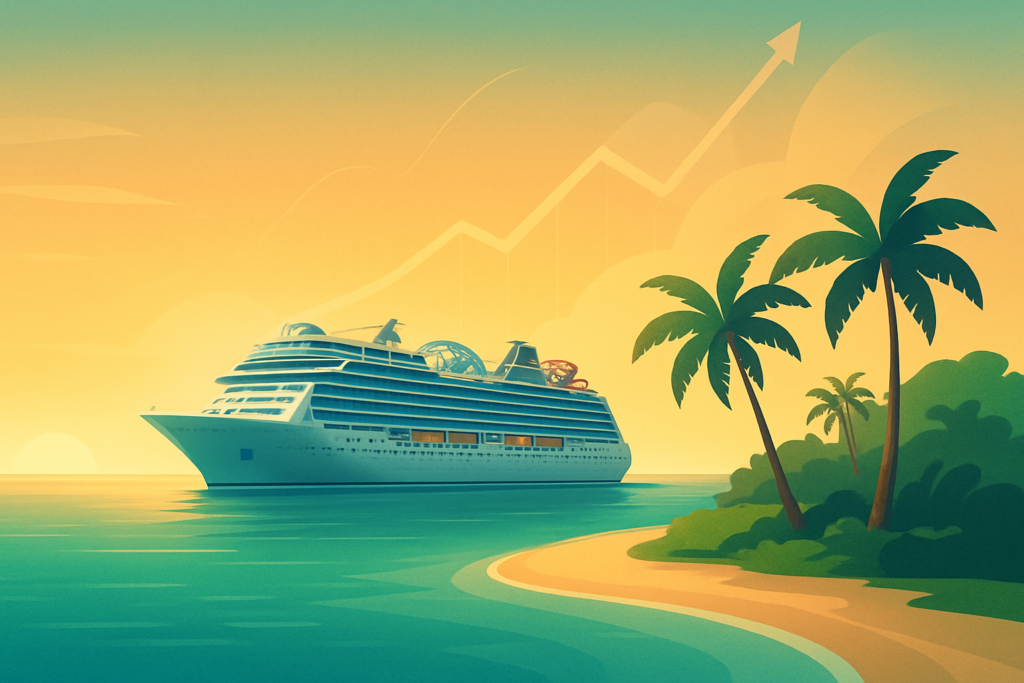
As of December 26, 2025, Royal Caribbean Group (NYSE: RCL) stands as a titan of the global tourism industry, having navigated one of the most tumultuous periods in maritime history to emerge stronger, more efficient, and more profitable than ever. Once viewed through the lens of pandemic recovery, RCL is now defined by its aggressive "yield quality" strategy and the successful launch of its revolutionary Icon-class vessels. With the travel industry shifting toward high-end experiential vacations, Royal Caribbean has positioned itself not merely as a cruise operator, but as a premier global vacation brand competing directly with land-based resorts and theme parks.
Historical Background
Founded in 1968 in Miami, Royal Caribbean was the brainchild of American entrepreneur Edwin Stephan and a trio of Norwegian shipping firms: Anders Wilhelmsen & Co., Gotaas-Larsen, and I.M. Skaugen & Company. Stephan’s vision was to create "propelled hotels" specifically designed for warm-water Caribbean cruising—a departure from the repurposed ocean liners that dominated the era.
The company’s first ship, Song of Norway (1970), introduced the signature Viking Crown Lounge, setting an architectural precedent for the brand. Over the decades, the company became synonymous with industry "firsts." In 1988, the Sovereign of the Seas launched the mega-ship era, while 1999’s Voyager of the Seas brought ice rinks and rock-climbing walls to the ocean.
A pivotal strategic shift occurred in 1997 with the $1.3 billion acquisition of Celebrity Cruises, allowing the company to capture the premium market. This was followed by the phased acquisition of Silversea Cruises between 2018 and 2020, completing a three-tiered portfolio that covers contemporary, premium, and ultra-luxury segments.
Business Model
Royal Caribbean Group operates a diversified business model centered on three wholly-owned global brands:
- Royal Caribbean International: The flagship brand focusing on families and multi-generational travelers, known for massive ships and high-energy amenities.
- Celebrity Cruises: A "modern luxury" brand targeting affluent travelers with a focus on design, culinary excellence, and wellness.
- Silversea Cruises: An ultra-luxury and expedition brand offering intimate, all-inclusive experiences in remote destinations.
Additionally, the company holds a 50% stake in a joint venture that operates TUI Cruises and Hapag-Lloyd Cruises, serving the German-speaking market.
Revenue is generated through two primary streams: Ticket Sales (approximately 65-70%) and Onboard Spending (30-35%), which includes casinos, specialty dining, beverages, and shore excursions. A critical component of the modern business model is the "Private Destination" ecosystem, most notably Perfect Day at CocoCay in the Bahamas. These land-based extensions offer significantly higher margins than traditional port calls by capturing 100% of passenger spend on the island.
Stock Performance Overview
Royal Caribbean’s stock has been a standout performer in the post-pandemic discretionary sector. As of late December 2025, the stock is trading near the $300 mark.
- 1-Year Performance: RCL has gained approximately 22%, outperforming the broader S&P 500 as investors cheered the company's ability to raise prices without hurting occupancy.
- 5-Year Performance: The stock has seen a meteoric rise of ~337%. This reflects a complete "V-shaped" recovery from the 2020 lows, as the company proved its balance sheet could withstand extreme stress.
- 10-Year Performance: Despite the multi-year hiatus in operations during the early 2020s, the 10-year total return stands at ~241%, demonstrating the long-term compounding power of the cruise industry's high-barrier-to-entry business model.
Financial Performance
The fiscal year 2025 has been a record-breaker for RCL. Projections for the full year suggest total revenue reaching between $18.2 billion and $18.5 billion, a significant jump from 2024’s $16.5 billion.
- Profitability: Adjusted EBITDA is estimated at $7.4–$7.7 billion, with adjusted EPS forecasted in the range of $15.58 to $15.63.
- Debt Management: One of the most critical metrics for investors has been the "Trifecta" goal of debt reduction. Total debt stands at approximately $20.9 billion as of Q3 2025, but the company has successfully refinanced much of its high-interest pandemic debt, lowering its weighted average interest rate to roughly 4.64%.
- Dividends: In March 2025, RCL officially reinstated its quarterly dividend, signaling management’s confidence in sustained free cash flow.
Leadership and Management
In late 2025, Jason Liberty assumed the dual role of Chairman and CEO, succeeding the legendary Richard Fain, who remains on the board. Liberty, who served as CFO before becoming CEO in 2022, is widely credited with the company’s disciplined financial recovery and the execution of the Icon-class strategy.
The management team is bolstered by John Brock, the Independent Lead Director, whose background at Coca-Cola Enterprises brings significant consumer-goods expertise to the board. The leadership’s strategy remains focused on "Yield Quality"—optimizing the mix of ticket prices and onboard revenue while maintaining industry-leading occupancy rates (currently averaging over 105%).
Products, Services, and Innovations
Innovation is the engine of RCL's growth. The launch of the Icon of the Seas in early 2024 and the Star of the Seas in August 2025 has redefined the "vacation of the future." These ships are essentially floating cities, featuring record-breaking waterparks, multiple entertainment "neighborhoods," and advanced environmental technology.
Key innovations include:
- Icon Class Propulsion: Utilizing Liquefied Natural Gas (LNG) and fuel cell technology to reduce carbon emissions.
- AI Personalization: Implementation of AI-driven guest apps that provide personalized dining and excursion recommendations, effectively increasing per-passenger spending through targeted frictionless offers.
- Royal Beach Club Santorini: Announced for 2026, this represents the next phase of RCL’s land-based expansion, aiming to replicate the high-margin success of CocoCay in the Mediterranean.
Competitive Landscape
RCL operates in an oligopoly alongside Carnival Corporation & plc (NYSE: CCL) and Norwegian Cruise Line Holdings (NYSE: NCLH).
- vs. Carnival: While Carnival is the volume leader with a larger fleet, Royal Caribbean consistently achieves higher margins and higher per-passenger yields. Carnival has made its own impressive recovery in 2025, achieving investment-grade metrics, but it remains the "value" alternative to RCL’s "premium" positioning.
- vs. Norwegian: Norwegian targets a similar demographic to RCL but operates at a smaller scale. In 2025, NCLH has struggled to match RCL’s pricing power, partly due to RCL’s superior private island infrastructure.
Industry and Market Trends
The "Experience Economy" continues to drive the sector. Post-2023, there has been a permanent shift in consumer spending away from "things" and toward "experiences." Cruising has benefited from being perceived as a high-value alternative to land-based vacations, which have seen steeper price increases in hotels and airfare.
Demographic shifts are also playing a role; while the "Silver Tsunami" (retiring Boomers) provides a steady base for brands like Silversea, the Icon class has successfully lowered the average passenger age by attracting younger Millennials and Gen Z families who value the all-in-one resort experience.
Risks and Challenges
Despite the bullish sentiment, several risks remain:
- Macroeconomic Sensitivity: While luxury and mid-market travelers have been resilient, a sustained global recession would eventually impact "close-in" booking demand and onboard spending.
- Operational Costs: Volatility in fuel prices and labor costs remains a constant pressure. Management has guided for potential headwinds in 2026 related to energy costs and currency fluctuations.
- Geopolitical Tensions: Conflicts in the Middle East and Eastern Europe have forced itinerary changes in 2025, which can lead to lower yields if ships are moved from high-priced regions to more crowded markets like the Caribbean.
Opportunities and Catalysts
The primary catalyst for 2026 is the full-year contribution of Star of the Seas and the continued expansion of the Royal Beach Club collection. Furthermore, RCL’s expansion into the luxury river cruise market via Celebrity Cruises (launched in 2025) offers a new avenue for growth in a high-margin, underserved segment.
Wall Street is also watching for potential share buybacks. Now that the dividend has been reinstated and debt is being managed, excess cash flow is likely to be directed toward reducing the share count, which would provide an additional tailwind for EPS.
Investor Sentiment and Analyst Coverage
Sentiment among institutional investors is overwhelmingly positive, with a "Strong Buy" consensus. Analysts have a median price target of approximately $327.47. Hedge funds and institutional holders, including Vanguard and BlackRock, remain heavily overweight in RCL, citing its best-in-class management and clear growth visibility through its ship-building pipeline.
Retail sentiment is equally bullish, often buoyed by the tangible excitement surrounding new ship launches, which generate billions of social media impressions and serve as free marketing for the brand.
Regulatory, Policy, and Geopolitical Factors
RCL faces tightening environmental regulations from the International Maritime Organization (IMO) regarding carbon intensity (CII) and sulfur emissions. The company has committed to "Destination Net Zero," aiming for net-zero emissions by 2050.
Geopolitically, the company must navigate varying port regulations and the potential for new environmental taxes in European ports. However, the shift to LNG-powered vessels provides a significant regulatory advantage over older, more polluting fleets operated by smaller competitors.
Conclusion
Royal Caribbean Group has successfully transitioned from a story of survival to a story of dominance. By December 2025, it has proven that its "resort-at-sea" model is not only resilient but capable of generating record-breaking returns. The company’s focus on high-margin private destinations and its technological lead in ship design have created a formidable moat.
Investors should monitor the company’s ability to maintain its pricing power as more capacity enters the market in 2026 and 2027. While valuation is currently at a premium, the combination of disciplined management, a clear path to debt reduction, and the secular tailwind of experiential travel makes RCL a cornerstone of the modern travel and leisure portfolio.
This content is intended for informational purposes only and is not financial advice.