Birmingham, England--(Newsfile Corp. - January 9, 2026) - Buy Fencing Direct, online retailer and publisher of DIY fencing resources, has recently updated their 'How to Install a Fence Post: Expert Tips on Fitting Fence Posts Securely' guide to include a new infographic 'The Complete Guide to Installing Fence Posts.'
Fence post installation is one of the most searched-for DIY gardening topics with common themes like: how deep to dig, how to handle hard ground, what exactly "set" and what "cure" are for concrete, and what preventative measures can help posts stay in position for longer. This new guide captures those details and combines them with an infographic, designed for a quick read or printed format for easy-to-follow instructions.
"Fence posts form the structure of the fence line, so the basics need to be clear and repeatable," a spokesperson at Buy Fencing Direct said. "This update provides the general guidance people ask for most including depth, drainage, alignment and curing, all contained within a single page so the most important information can be accessed quickly."
The update is a refresh, not a change in direction. The original guide published in January 2025 was updated to include the infographic as a companion asset in December 2025. Buy Fencing Direct describes the infographic as a quick reference guide, outlining the key steps. The content available in each format is structured around actionable steps that typically determine whether a fence stays straight over time, including setup and tools, digging and drainage, mixing and curing concrete, keeping alignment while the concrete sets, and steps for preventing rot and movement post-installation.
One headline statistic in the infographic covers the depth rule: A fence post hole should be roughly a third of the height of the fence. The infographic uses a worked example for a typical UK height fence which indicates a 6ft fence typically requires a 2ft depth hole and an 8ft post. The infographic discusses drainage requirements in cases of heavy clay and waterlogged soils, such as a gravel layer at the bottom of the hole as a drainage technique. This has a durability related aspect to it and is often mentioned in customer questions. Keeping wooden panels and posts up off the ground with gravel boards can add 5-10 years to lifespan in damp UK soils.
"The most common issues begin below ground level," Buy Fencing Direct added. "Depth and drainage are not extras, they're the basics. Our infographic places those checks at the beginning of the process, alongside the common 6ft example people build around."
The refreshed materials clearly indicate the difference between hardening concrete in the first place vs. the longer curing period associated with strength development. Quick-set concrete is mentioned with the headline "as little as 20 minutes," while curing is described as the more lengthy timeframe that determines long-term performance. It continues to specify the target consistency for mixing, saying that concrete should be thick and creamy, with no lumps. It further states that curing reaches about 70-80% of the design strength within 7 days 3-4 weeks to reach full strength.
"When the concrete first feels hard, people like to think of the job as finished," Buy Fencing Direct said. "The updated guide confirms the difference between the initial set and the extended curing time, because that affects how alignment and support should be handled."
The alignment and supports section of the infographic explains the checks required to maintain posts upright while concrete sets, naming common safety equipment and supports such as a spirit level (or electronic level) and bracing materials (metal battens or wooden rods). The framing is as much about stability issues as athletics, with the guide referencing straight posts as being a baseline for an even fence line.
Toolkit coverage takes place within the headline of the infographic and is highlighted as the first stage. Instead of a sales list, it presents practical inventory designed to minimise on-the-job delays as well as ad hoc fixes. The update also mentions durability and reasons why fences often fall short at given points, citing water damage at the tops of fence posts as the prime culprit for wood rot, and how post caps can help. Lifespan ranges for wooden posts which contact soil are discussed, with posts lasting up to 10 years or 15 to 25 years if it is adequately treated.
"Longevity is measured by repeatable behaviours. This means keeping timber dry, minimal water exposure at the top of posts, checking movement before it turns into failure," Buy Fencing Direct responded. "Those are the very the kinds of points our guide keeps in focus."
Access the "How to Install a Fence Post" guide below
The updated guide, "How to Install a Fence Post: Expert Tips on Fitting Fence Posts Securely [UPDATED]," is available at:
https://www.buyfencingdirect.co.uk/blog/post/how-to-install-fence-posts
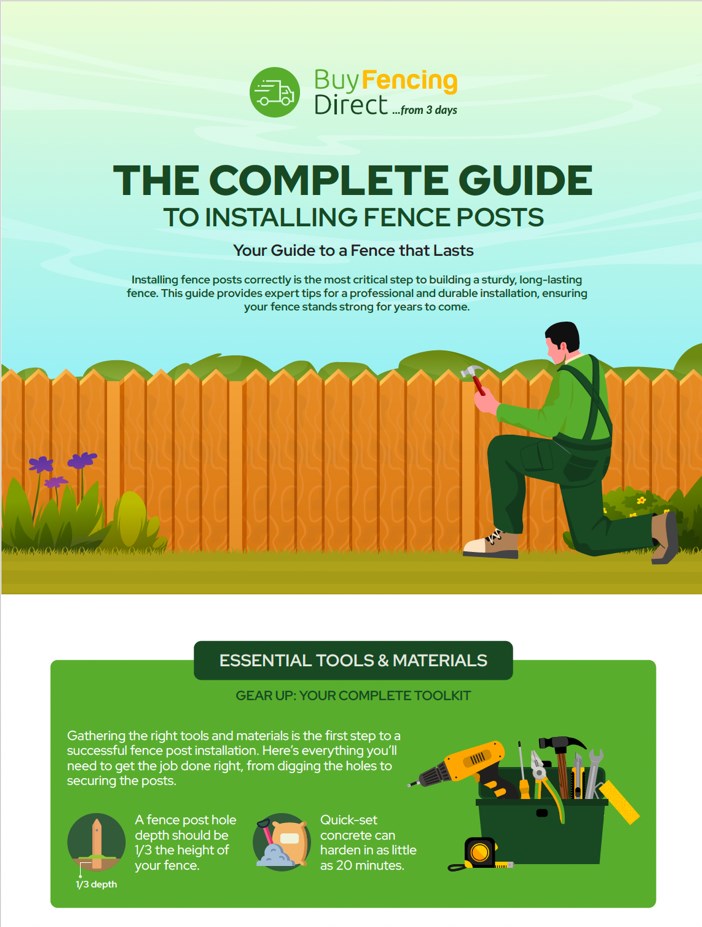
A complete guide to installing fence posts infographic by Buy Fencing Direct
To view an enhanced version of this graphic, please visit:
https://images.newsfilecorp.com/files/9721/279815_0738d794045d891c_001full.jpg
The full "The Complete Guide to Installing Fence Posts" infographic is included as a companion asset within the above article.
About Buy Fencing Direct
Buy Fencing Direct is a UK retailer of fencing products including fence panels, posts, gates, trellis and garden structures, and publishes practical support resources on its website. Customer support is available via phone, online contact and live chat.
Media contact
PR Manager, Buy Fencing Direct
Email: info@buyfencingdirect.co.uk
Phone: 0333 033 0515
Website: buyfencingdirect.co.uk
- ENDS -
To view the source version of this press release, please visit https://www.newsfilecorp.com/release/279815