The global aviation sector faced a brutal awakening on Monday, March 9, 2026, as airline stocks plummeted in pre-market and early morning trading. The catalyst for the sell-off was a dramatic surge in crude oil prices, which breached the psychological $100-per-barrel mark following an escalating geopolitical crisis in the Middle East. For an industry that had spent much of 2025 forecasting record-breaking profits and expanding international routes, the sudden spike in jet fuel costs has sent shockwaves through boardrooms and trading floors alike.
Investors reacted swiftly and severely to the news, with major carriers seeing their market valuations evaporate in a matter of hours. The "big three" U.S. airlines—Delta Air Lines, United Airlines, and American Airlines—bore the brunt of the volatility. As oil prices stabilized in the $105 to $115 range, analysts began a frantic race to slash profit projections for the remainder of the 2026 fiscal year, warning that the "golden era" of post-pandemic travel margins may be coming to an abrupt, expensive halt.
A Black Monday for Aviation: The $100 Oil Shock
The roots of the current market turmoil can be traced back to late February 2026, following a series of military escalations involving U.S. and Israeli forces and Iranian infrastructure. The situation reached a breaking point over the weekend when Iran moved to restrict traffic through the Strait of Hormuz, a critical maritime artery responsible for roughly 20% of the world's oil supply. By the time markets opened on Monday, March 9, Brent crude had spiked nearly 15% in a single week, leaving the airline industry—which typically accounts for fuel as its second-largest expense after labor—exposed and vulnerable.
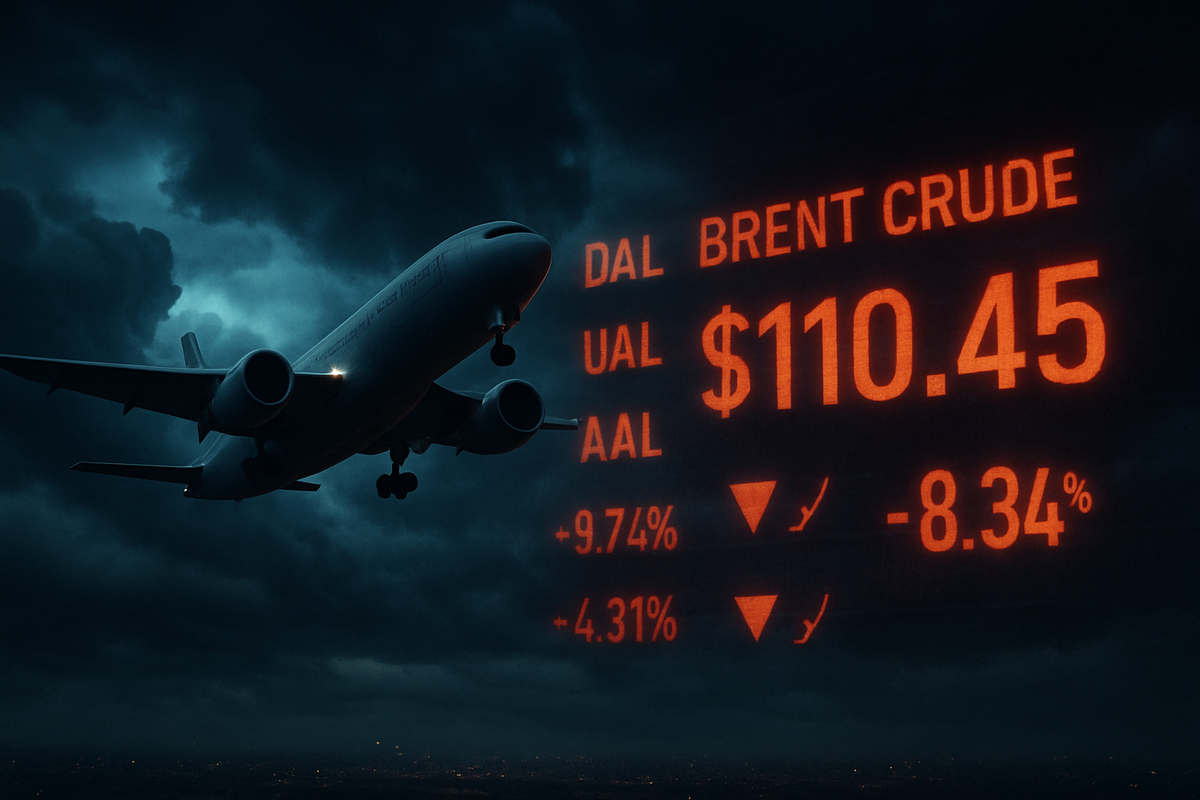
The immediate market reaction was visceral. United Airlines Holdings (NASDAQ: UAL) saw the steepest decline, with shares dropping as much as 8.7% in early trading as investors weighed the company’s heavy exposure to long-haul international routes. Delta Air Lines (NYSE: DAL) and American Airlines Group (NASDAQ: AAL) followed closely, shedding 5.8% and 6.3% respectively. The speed of the oil price "velocity" caught many by surprise, particularly since many carriers had moved away from aggressive fuel hedging programs in 2025, opting instead to capitalize on then-stable energy prices to fund stock buybacks and debt reduction.
Industry stakeholders, including the International Air Transport Association (IATA), have expressed "grave concern" over the sustainability of current flight schedules if oil remains above triple digits. While the industry has historically shown resilience, the sheer scale of this supply-side shock is forcing an immediate re-evaluation of Q1 and Q2 earnings guidance. By mid-morning, several brokerage firms had already issued "Neutral" or "Underperform" ratings on the sector, citing a high probability of "earnings evaporation" in the coming months.
Winners and Losers: A Widening Gap in Financial Fortitude
While the entire sector is under pressure, the impact of $100 oil is not being felt equally. American Airlines (NASDAQ: AAL) appears to be in the most precarious position. With operating margins that have historically lagged behind its peers—hovering between 1% and 5% in late 2025—American lacks the financial cushion to absorb a prolonged fuel spike. Analysts estimate that every $0.10 increase in jet fuel prices results in a 25% swing in American's earnings per share (EPS), making it the most sensitive to energy volatility among the majors.
Conversely, Delta Air Lines (NYSE: DAL) is leaning on its unique structural advantages to weather the storm. Delta remains the only major carrier to own its own oil refinery, Monroe Energy, which provides a natural hedge against refining margins (the "crack spread"). While the refinery does not protect Delta from the rising cost of raw crude, it does offer a level of vertical integration that its competitors lack. Furthermore, Delta’s high concentration of premium-cabin revenue provides a buffer, as high-net-worth travelers are generally less price-sensitive to the inevitable fare hikes that follow fuel spikes.
United Airlines Holdings (NASDAQ: UAL) finds itself in the middle ground. While its "United Next" growth strategy has modernized its fleet with more fuel-efficient aircraft like the Boeing 737 MAX and 787 Dreamliner, its aggressive expansion into the Pacific and European markets makes it highly susceptible to shifts in global jet fuel prices. CEO Scott Kirby, known for his direct communication style, warned that the "meaningful impact" on Q1 results would likely necessitate a tactical pivot in capacity management, potentially leading to the cancellation of less profitable regional routes to preserve cash.
The Broader Significance: Inflation and Industry Precedents
The March 9 crash is more than just a bad day for airline investors; it is a signifier of a broader shift in the global economy. This event mirrors the energy crisis of March 2022, when the invasion of Ukraine sent oil prices soaring. However, the 2026 crisis arrives at a time when consumer savings have largely normalized, and the "revenge travel" boom has cooled into a more standard demand cycle. The current spike threatens to reignite inflationary pressures, as airlines are forced to pass on fuel surcharges to customers, potentially pricing out middle-class leisure travelers.
Furthermore, this event highlights the "unhedged" risk that has become common in the U.S. aviation industry. For years, carriers like Southwest Airlines (NYSE: LUV) were famous for their sophisticated hedging strategies, but many major players abandoned these practices during the low-interest-rate, low-energy-price environment of the early 2020s. The 2026 oil shock may lead to a permanent regulatory or strategic shift, forcing boards of directors to mandate more conservative fuel-buying programs to protect against future "Black Swan" events in the Middle East.
From a policy perspective, the $100 oil mark is likely to accelerate the industry's transition toward Sustainable Aviation Fuel (SAF). While SAF currently remains more expensive than traditional kerosene-based jet fuel, the narrowing price gap caused by $100 crude may provide the economic incentive needed for companies like Alaska Air Group (NYSE: ALK) and JetBlue Airways (NASDAQ: JBLU) to double down on their green initiatives, seeking long-term energy independence from the volatile global oil market.
The Road Ahead: Strategic Pivots and Market Realities
In the short term, travelers should prepare for a "fare-hike fever." History suggests that for every $0.01 increase in the price of a gallon of jet fuel, the annual expenses for a major carrier like Delta rise by roughly $40 million. To offset this, airlines will likely implement "fuel recovery surcharges" almost immediately. We can also expect a "capacity pull-back" where carriers reduce the frequency of flights on secondary routes to ensure that every plane in the air is flying at maximum occupancy—a strategy known as "load factor optimization."
Long-term, the 2026 oil spike may trigger a new wave of consolidation or strategic alliances. Smaller, low-cost carriers (LCCs) that operate on razor-thin margins may find it impossible to compete if they cannot pass costs on to their price-sensitive customer base. This could lead to a market where the "Big Three" and Southwest solidify their dominance, while others are forced to merge or exit the market entirely. Investors will be watching for any signs of government intervention or strategic petroleum reserve releases, which could provide temporary relief.
Ultimately, the March 9 plunge serves as a stark reminder of the airline industry's inherent fragility. Despite the technological advancements and "fortress balance sheets" built up during the mid-2020s, the sector remains a hostage to global geopolitics and the price of a barrel of oil. The coming months will test the leadership of Scott Kirby, Ed Bastian, and Robert Isom as they navigate a landscape where the cost of doing business has just increased by double digits overnight.
Conclusion: What to Watch in the Coming Months
The events of March 9, 2026, mark a definitive turning point for the aviation industry’s post-pandemic trajectory. The key takeaway for investors is the importance of "margin resiliency"—the ability of a company to maintain profitability in the face of skyrocketing input costs. Delta and United appear better equipped to handle this turbulence than American Airlines, but no one is truly immune to $115 oil. The market will now pivot its focus to the Q1 earnings calls in April, where management teams will be expected to provide clear roadmaps for navigating this high-cost environment.
Moving forward, the primary metric to watch is the "crack spread" and the stability of the Strait of Hormuz. If geopolitical tensions de-escalate and oil returns to the $80 range, we may see a rapid "relief rally" in airline stocks. However, if triple-digit oil becomes the "new normal" for 2026, the industry will have to undergo a painful restructuring of its cost basis. Investors should look for airlines that are successfully managing capacity and maintaining "yield" (the average fare paid per mile per passenger) as the primary indicators of who will survive the 2026 energy shock.
This content is intended for informational purposes only and is not financial advice.