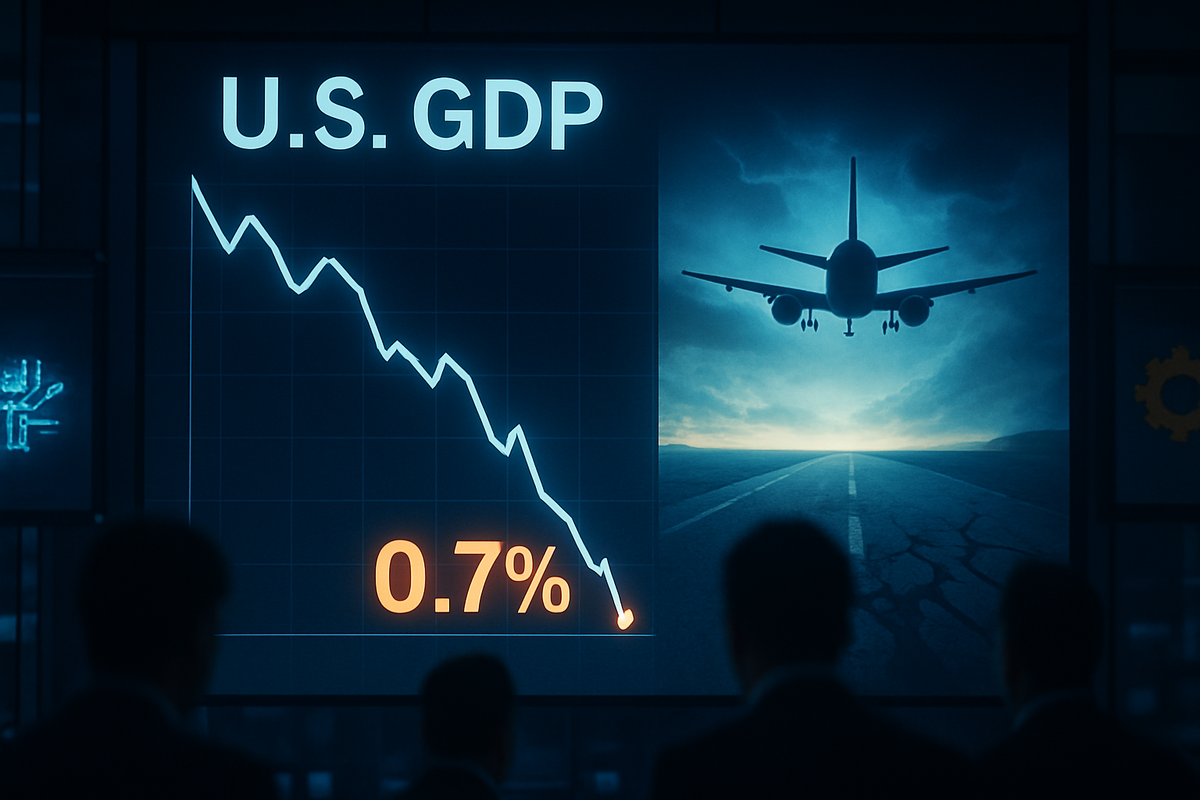
The dream of a "soft landing" for the United States economy faced a harsh reality check this week as the Bureau of Economic Analysis (BEA) released its final revision for fourth-quarter 2025 Gross Domestic Product (GDP). The data revealed a staggering downward adjustment, placing growth at a mere 0.7% annualized rate—half of the initial 1.4% estimate and a dramatic collapse from the 4.4% growth recorded in the third quarter of 2025.
This sharp deceleration has sent ripples through the financial markets, forcing investors and policymakers to confront a "bumpy taxiing" scenario that looks increasingly like a period of prolonged stagnation. With the current date of March 18, 2026, marking the end of the first quarter of the new year, the revised data suggests that the momentum which carried the U.S. through much of 2025 has effectively evaporated, leaving the economy vulnerable to a potential technical recession in the coming months.
A "Perfect Storm" of Shutdowns and Spending Fatigue
The revision to 0.7% is not merely a statistical anomaly but the result of a "perfect storm" of fiscal and commercial headwinds that converged at the end of 2025. The most significant drag on the economy was the 43-day partial federal government shutdown that spanned October and November. This political impasse alone is estimated to have shaved approximately 1.16 percentage points off the GDP, as federal spending and investment plunged at a 16.7% annual rate during the quarter.
Beyond the halls of Washington, American consumers—long the bedrock of economic resilience—showed signs of significant fatigue. Personal consumption, which accounts for two-thirds of the economy, was revised down to 2.0% from 2.4%. While spending on services remained relatively stable, the appetite for high-ticket goods plummeted as high interest rates and the cumulative weight of three years of inflation finally broke the back of lower- and middle-income household budgets. Furthermore, business investment in non-residential structures fell by 7.1%, as corporations delayed major capital projects amidst escalating global trade tensions and a new wave of protective tariffs.
Market Fallout: The Divide Between AI Resilience and Cyclical Struggles
The equity markets have responded with a flight to safety, creating a stark divide between the "haves" of the digital age and the "have-nots" of the physical economy. NVIDIA (NASDAQ: NVDA) and Microsoft (NASDAQ: MSFT) have remained relative safe havens, buoyed by the ongoing artificial intelligence supercycle that seems insulated from broader macroeconomic shifts. However, even the tech sector is not immune; Adobe (NASDAQ: ADBE) saw its shares slide 7.6% as investors questioned whether enterprise software growth can be sustained in a sub-1% growth environment.
The real carnage, however, has been felt in the industrial and consumer sectors. Caterpillar (NYSE: CAT) and Deere & Co. (NYSE: DE) have been hit by a "near-stall" in new equipment orders, while Axon Enterprise (NASDAQ: AXON) saw its stock tumble 14% following the report. The retail landscape is equally grim; Ulta Beauty (NASDAQ: ULTA) plummeted 17% after missing profit targets, and Nike (NYSE: NKE) announced massive restructuring charges as its Converse brand hit a 15-year sales low. Walmart (NYSE: WMT) and Target (NYSE: TGT) have both warned of a "hiring recession," noting that while wealthy shoppers are still spending, "Main Street" sentiment has hit recessionary lows not seen since the 2008 financial crisis.
Stagflation Lite and the Fed’s Strategic Paralysis
The 0.7% growth figure complicates the Federal Reserve’s roadmap for 2026. Typically, such low growth would trigger a pivot toward interest rate cuts. However, the Fed is currently trapped in a state of "strategic paralysis." While growth has stalled, Core PCE inflation remains sticky at 3.1%, well above the Fed's 2.0% target. This "stagflation lite" environment leaves the central bank with no easy moves. If they cut rates to stimulate the 0.7% economy, they risk reigniting inflation; if they hold rates steady at the current 3.50%–3.75% range, they risk pushing the U.S. into a full-blown hard landing.
Historically, periods where GDP growth falls below 1% while inflation remains elevated are rare and often precede a shift in the labor market. We are seeing those signs now. For the first time since the post-pandemic recovery, the focus of the economic debate has shifted from "how high will prices go?" to "how many jobs will be lost?" Monthly hiring in early 2026 has slowed to its weakest pace since 2002, excluding the 2020 pandemic anomaly.
Navigating the Bumpy Road Ahead
Looking forward, the immediate question is whether the 0.7% reading was a temporary "shutdown hangover" or a permanent structural shift. Short-term, market analysts at JPMorgan Chase & Co. (NYSE: JPM) have raised their recession probability for late 2026 to 35%. Financial institutions are also bracing for impact, with Fiserv (NYSE: FI) and Global Payments (NYSE: GPN) monitoring rising credit default risks as consumer debt levels reach record highs against a backdrop of slowing wage growth.
Strategic pivots are already underway. Companies are moving away from expansion and toward margin preservation. For the public, this likely means a period of "corporate belt-tightening," characterized by more layoffs in the middle-management tiers and a continued pullback in discretionary services. Investors should watch for the next round of manufacturing and services PMI data; if these indices fall below the 50-point contraction threshold, the "soft landing" narrative will be officially buried in favor of preparing for a technical recession.
Summary of the Economic Re-Rating
The revision of Q4 2025 GDP to 0.7% serves as a sobering reminder that the "higher for longer" interest rate environment has a delayed but potent effect. The key takeaways for investors are clear: the buffer provided by post-pandemic savings has been depleted, government fiscal instability can have a direct and measurable impact on growth, and the divide between the "AI economy" and the "real economy" is widening.
As we move through the first half of 2026, the market will likely remain volatile as it re-prices the risk of a hard landing. The resilience of the labor market remains the final pillar holding the economy together. Should the unemployment rate begin to tick up significantly from its current levels, the Fed may be forced to choose between its inflation mandate and its employment mandate—a choice that will define the financial landscape for years to come.
This content is intended for informational purposes only and is not financial advice