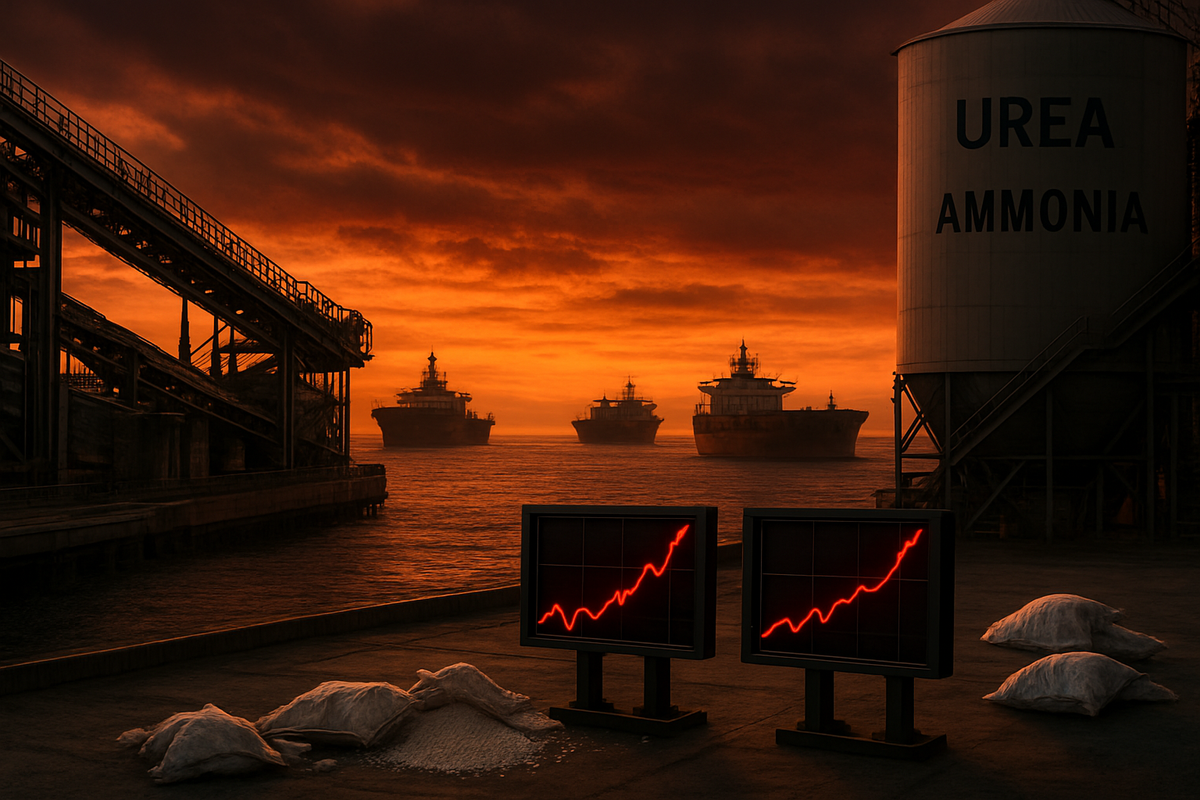
The global agricultural sector is facing its most significant supply chain fracture in years as the closure of the Strait of Hormuz has sent fertilizer prices into a parabolic ascent. Following the military escalations of late February 2026, the vital waterway—responsible for nearly a third of the world’s seaborne fertilizer trade—has become a maritime dead zone. For farmers entering the critical 2026 Northern Hemisphere planting season, the timing could not be worse, as the physical absence of urea and ammonia supplies from the Middle East threatens to collapse crop yields and ignite a secondary wave of global food inflation.
The immediate implications are stark: ammonia and urea prices have decoupled from their historical energy-price correlations, moving instead on a scarcity-driven trajectory. With major exporters like Qatar and Saudi Arabia physically unable to move product past the blockade, the global market is scrambling for alternatives. The resulting price shocks are already rippling through commodity exchanges, forcing agricultural giants and national governments to reassess their food security strategies in a world where the "just-in-time" delivery of crop nutrients has effectively vanished.
A Chokepoint Tightens: The Timeline of the 2026 Fertilizer Crisis
The current crisis traces its roots to February 28, 2026, following the onset of "Operation Epic Fury," a series of precision strikes on regional infrastructure that led Iran to declare the Strait of Hormuz closed to Western-aligned merchant shipping. By March 12, 2026, more than 150 tankers and bulk carriers were reported anchored outside the Persian Gulf, unable to secure war-risk insurance or naval escorts. This geopolitical lockdown has effectively trapped approximately 16 million tonnes of annual fertilizer capacity within the Gulf, removing nearly 35% of the world’s seaborne urea and phosphate from the market overnight.
Energy markets reacted with predictable volatility, with Brent crude oil soaring to $126 per barrel by March 8. However, the fertilizer market’s reaction has been even more extreme due to the seasonal urgency of the spring planting window. In the United States, urea prices at the Port of New Orleans (NOLA) surged 30% in the first two weeks of March alone, fluctuating between $520 and $550 per ton. The crisis is not merely a matter of cost but of physical availability; major producers like the Qatar Fertilizer Company (QAFCO) and SABIC Agri-Nutrients (TADAWUL: 2020) have seen their export terminals go silent, leaving core markets in India, Brazil, and the U.S. in a desperate search for replacement volumes.
Initial market reactions have seen a frantic rotation into North American and European producers who sit outside the immediate conflict zone. However, even these producers are struggling to fill the void. The "Nitrogen Trap" of 2026 is characterized by a high-cost energy environment in Europe, where natural gas prices have spiked above €60/MWh, making local production increasingly uncompetitive even as global prices rise. This has left the global agricultural market dependent on a dwindling number of "safe" production hubs, primarily in North America.
Market Winners and Losers in the New Geopolitical Reality
The sudden supply vacuum has created a stark bifurcation among public companies in the sector. CF Industries (NYSE: CF) has emerged as the primary beneficiary of the disruption. As a pure-play nitrogen producer with the bulk of its assets in the United States, CF Industries benefits from relatively stable domestic natural gas prices (Henry Hub) while selling into a global market starved for supply. On March 13, its shares jumped 13.2% as investors bet on the company's role as the "world's backup supplier." Similarly, Nutrien (NYSE: NTR) has seen its shares rise roughly 7%, supported by its massive Canadian potash and nitrogen footprint which remains insulated from the Middle Eastern blockade.
Conversely, the outlook is more clouded for The Mosaic Company (NYSE: MOS). While phosphate prices are rising, Mosaic is highly vulnerable to the soaring cost of sulfur—a critical raw material for phosphate production. With approximately 44% of the world's seaborne sulfur passing through the Strait of Hormuz, sulfur prices have doubled in early March, leading analysts to project a potential $250 million hit to Mosaic’s EBITDA for the first quarter of 2026. The company is now racing to secure alternative sulfur sources from North American refineries, but the logistics are both complex and costly.
European giant Yara International (OTC: YARIY) faces perhaps the most challenging scenario. Yara traditionally relies on Middle Eastern urea for its extensive blending operations in Europe and Asia. The loss of these volumes, combined with the new Carbon Border Adjustment Mechanism (CBAM) costs that went into effect on January 1, 2026, has put immense pressure on its margins. Investors in broader sector ETFs, such as the Global X Fertilizer/AgTech ETF (NYSE: KROP) and the VanEck Agribusiness ETF (NYSE: MOO), are witnessing high volatility as the market weighs the benefits of higher output prices against the surging costs of logistics and raw materials.
Broader Significance: The End of Cheap Food?
This disruption fits into a broader, more alarming trend of "polycrisis" affecting global agriculture. Since 2022, the industry has dealt with energy spikes, climate volatility, and now, a total blockade of one of its most essential shipping lanes. The 2026 Hormuz crisis is unique because it coincides with the implementation of strict new environmental regulations in Europe and the Americas. The CBAM, for instance, has already made "dirty" ammonia imports more expensive, and the current supply crunch is making it nearly impossible for farmers to find compliant, low-carbon nutrients, potentially forcing a rollback or delay in environmental policy goals.
The ripple effects on competitors and partners are profound. In India, where the government heavily subsidizes fertilizer to maintain social stability, the sudden spike in urea costs is threatening to blow a massive hole in the national budget. In Brazil, the world's largest exporter of soybeans and corn, the lack of imported potash and phosphates could lead to a significant reduction in acreage for the upcoming season. This creates a feedback loop: lower yields lead to higher grain prices, which in turn drive up the cost of livestock feed, eventually manifesting as higher meat and dairy prices for the global consumer by late 2026.
Historically, the market can be compared to the 1970s oil shocks, but with a critical difference: the global population is now far more dependent on intensive, fertilizer-reliant agriculture. While previous spikes were often driven by temporary demand surges, the 2026 event is a structural supply-side failure. If the Strait remains closed through the end of the second quarter, the global food system may face a "hard landing" that traditional monetary policy cannot easily solve.
What Comes Next: A Precarious Path for the 2026 Season
In the short term, the market is watching for any signs of a "green corridor" or naval escort system for essential commodities. If military intervention can secure even a limited flow of traffic through the Strait, some of the scarcity premium may evaporate. However, as of March 18, 2026, no such agreement is in sight. Investors should expect continued volatility and potential rationing of fertilizer supplies in regions like Sub-Saharan Africa and Southeast Asia, which lack the purchasing power of the U.S. and China.
In the long term, this crisis will likely accelerate the transition toward "localized" and "green" fertilizer production. We may see a strategic pivot toward green ammonia projects in Australia, Chile, and the United States, as nations seek to decouple their food security from the volatile geopolitics of the Middle East. For companies like ICL Group (NYSE: ICL), which has diversified operations in Israel and Europe, the challenge will be navigating the increased insurance and shipping costs that are becoming a permanent fixture of the 2026 trading landscape.
Wrap-Up: The Fertilizer Market Moving Forward
The closure of the Strait of Hormuz has transformed the 2026 planting season from a logistical challenge into a global crisis. The key takeaways for investors are the extreme resilience of North American nitrogen producers like CF Industries and the vulnerability of companies reliant on global shipping loops for raw materials like sulfur. As the "physical availability crisis" persists, the focus of the market will shift from price to procurement at any cost.
Moving forward, the market will remain on edge, sensitive to every geopolitical headline from the Persian Gulf. The lasting impact of this event may be the permanent realignment of global trade routes and a renewed emphasis on national self-sufficiency in agricultural inputs. For the coming months, watch for the Q1 earnings reports of the major fertilizer firms, which will reveal the true extent of the margin squeeze caused by the blockade.
This content is intended for informational purposes only and is not financial advice.