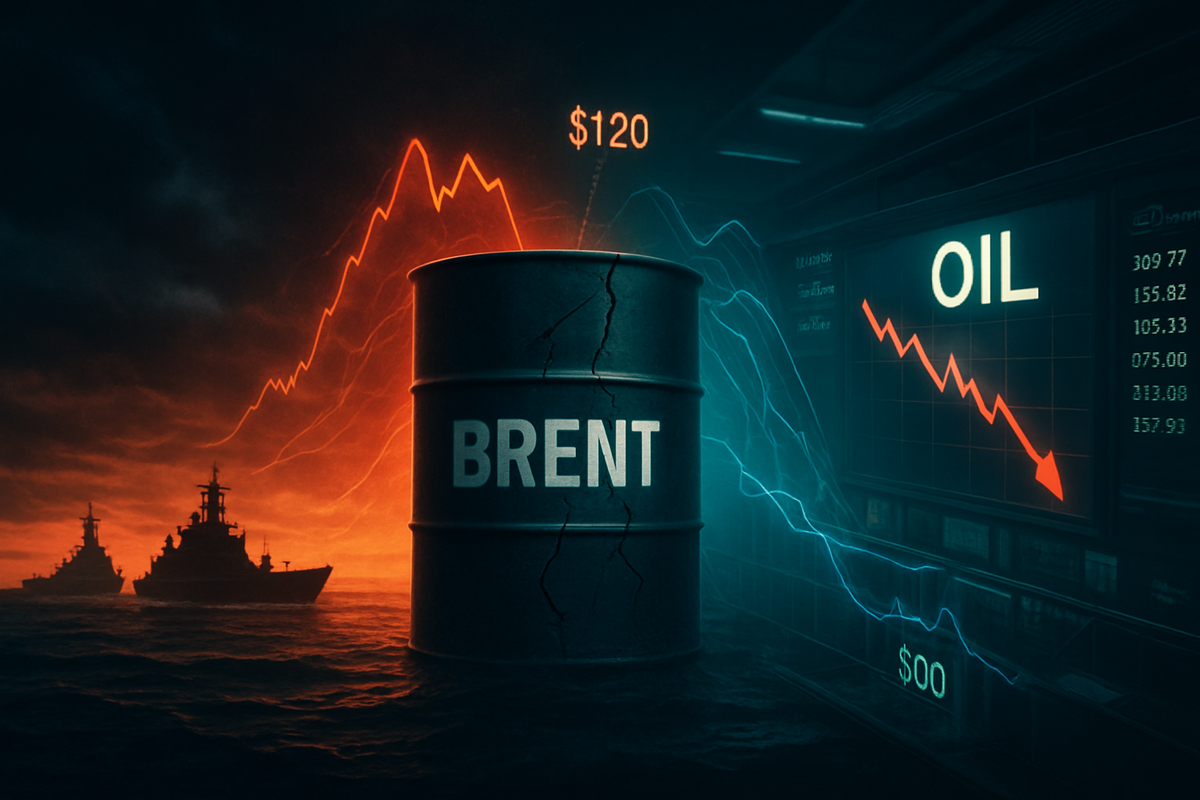
The global energy market has been plunged into a state of unprecedented turbulence, as Brent crude prices experienced a staggering $30 collapse within a mere 48-hour window. This historic "round-trip" saw prices peak at an intraday high of $119.50 on March 9, 2026, before crashing back toward the $90 mark following a series of reassurances from President Donald Trump regarding the scope of U.S. military objectives in the Middle East. As of today, March 17, 2026, market participants are grappling with a landscape where energy benchmarks have become tethered more to the President’s social media feeds and impromptu press conferences than to traditional supply-and-demand fundamentals.
The volatility, which the World Bank has now officially categorized as a 50-year high, stems from the fallout of Operation Epic Fury—a high-stakes military campaign aimed at neutralizing Iranian infrastructure. While the initial strikes sent shockwaves through the Strait of Hormuz, the subsequent price retreat highlights the market's desperate search for a "de-escalation floor." However, with the CBOE Crude Oil Volatility Index (OVX) hitting levels not seen since the 2020 pandemic, the era of stable energy pricing appears to have vanished, replaced by a regime of extreme daily swings that threaten global economic stability.
The Road to 'Epic Fury' and the 48-Hour Crash
The seeds of the current market chaos were sown on February 28, 2026, when the United States and Israel launched Operation Epic Fury. The operation, described by the Pentagon as a surgical strike against Iranian nuclear and command facilities, immediately paralyzed the Strait of Hormuz. As shipping insurers withdrew coverage and Iran vowed "total retaliation," Brent crude futures skyrocketed, gaining nearly 25% in a single week. By the morning of March 9, the energy world was bracing for a return to $150 oil, a level that would almost certainly trigger a global recession.
The narrative shifted abruptly on the afternoon of March 10. Speaking from a House GOP retreat, President Trump characterized the intense military campaign as a "short-term excursion" designed to "get rid of some evil" rather than a prolonged occupation. He further stunned observers by claiming the military goals were "very complete, pretty much," suggesting that the most kinetic phase of the conflict was already "ahead of schedule." These comments, paired with the International Energy Agency’s (IEA) announcement of a record 400-million-barrel strategic reserve release, acted as a pressure-release valve for the market, causing the most violent 48-hour price drop in the history of the Brent contract.
Winners and Losers in the Volatility Vortex
The rapid rise and fall of crude prices have created a stark divide across the corporate landscape. Integrated oil majors like ExxonMobil (NYSE: XOM) and Chevron (NYSE: CVX) initially saw their valuations surge by over 4% as the risk premium peaked. These companies remain well-positioned to capitalize on higher average floor prices, even at $90, provided they can navigate the logistical nightmares caused by the closure of key shipping lanes. Meanwhile, Petrobras (NYSE: PBR) has emerged as a favorite among institutional investors, with its record-breaking production levels offering a non-Middle Eastern alternative for hungry global markets.
On the other side of the ledger, the defense and shipping sectors have seen divergent fortunes. Defense giant BAE Systems (LSE:BA) saw its stock jump 5% as demand for precision-guided munitions surged following the onset of Operation Epic Fury. Conversely, tanker companies like Frontline (NYSE: FRO) and DHT Holdings (NYSE: DHT) are facing a "feast or famine" scenario; while spot rates for diverted routes around the Cape of Good Hope have tripled, the actual volume of crude being moved remains suppressed by the Iranian naval threat. For refiners like Valero (NYSE: VLO) and Marathon Petroleum (NYSE: MPC), the massive swings in crude input costs have made margin management nearly impossible, despite diesel "crack spreads" reaching their highest levels since the 2022 energy crisis.
A 50-Year High for Market Instability
The current state of the oil market is being compared by many to the 1973 oil embargo, but with a modern, digital twist. The World Bank’s recent assessment that commodity volatility is at a 50-year high reflects a world where geopolitical "policy uncertainty" is the primary driver of value. Unlike the 1970s, where supply was physically constrained for months, the 2026 volatility is driven by the perception of supply risk, modulated by real-time presidential rhetoric. The surge of the OVX index to 121 underscores that traders are no longer pricing oil based on barrels in the ground, but on the likelihood of the next "Death, Fire, and Fury" post from the White House.
Historically, such levels of volatility have preceded major structural shifts in the energy industry. The massive IEA reserve release—double the size of any previous intervention—indicates that Western powers are willing to exhaust their strategic buffers to prevent a total economic meltdown. However, this leaves the market vulnerable to secondary shocks. If Iran’s "effectively non-functional" navy, as described by Trump, manages even a minor retaliatory strike on a Saudi processing facility, the $30 price drop could be reversed even faster than it occurred.
The Strategy of Uncertainty: What Comes Next?
In the short term, the market is looking for evidence that the "short-term excursion" is indeed coming to a close. Strategic pivots are already underway; many hedge funds have shifted from long crude positions to "volatility plays," betting on the continued width of daily price ranges rather than a specific direction. For the oil majors, the focus has shifted toward securing "safe" supply chains that bypass the Persian Gulf entirely, potentially accelerating the development of offshore projects in the Atlantic Basin and the Eastern Mediterranean.
The most likely scenario for the remainder of 2026 is a "high-plateau" of volatility. Even if the military phase of Operation Epic Fury concludes, the diplomatic vacuum left behind suggests that the risk premium is here to stay. Investors should prepare for a world where $90 is the new floor and $120 is just one headline away. The "short-term" nature of the excursion may satisfy political goals, but the economic ripples—particularly in the form of persistent energy inflation—are likely to be felt well into 2027.
Investor Outlook and Summary
The past two weeks have served as a brutal reminder of how quickly geopolitical rhetoric can upend financial markets. President Trump's ability to talk the market down by $30 is a testament to the power of the "bully pulpit" in an era of high-frequency trading. However, the underlying supply shock remains unresolved; the Strait of Hormuz is not yet fully operational, and the long-term status of Iranian exports remains a black hole in global supply models.
Moving forward, investors must keep a close watch on two critical indicators: the pace of the IEA’s reserve depletion and any signs of Iranian asymmetrical retaliation against regional energy hubs. While the "short-term excursion" has provided a temporary breather for the global economy, the 50-year high in volatility suggests that the storm is far from over. In this environment, diversification into energy services and non-Gulf producers appears to be the most prudent path for those looking to weather the ongoing "Epic Fury."
This content is intended for informational purposes only and is not financial advice.