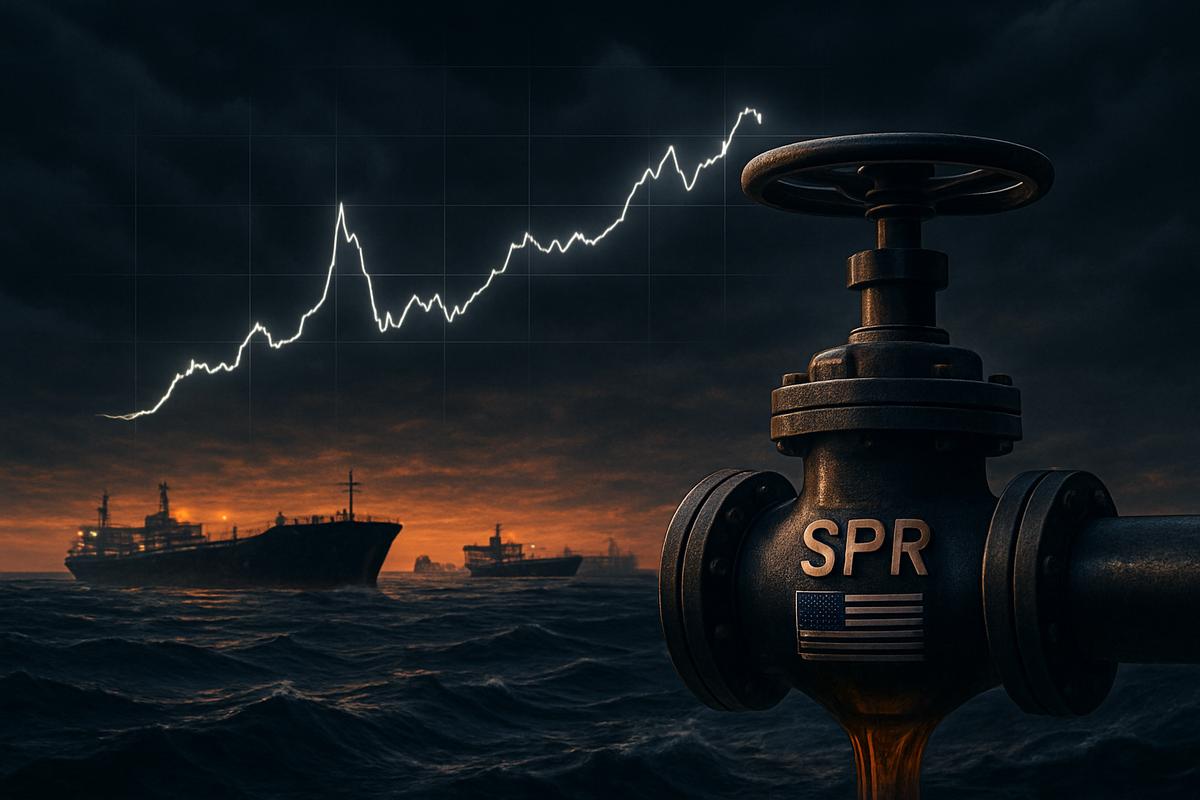
In a move of unprecedented scale, the G7 and the International Energy Agency (IEA) have authorized the release of 400 million barrels of oil from global strategic reserves to combat a crippling supply shock. The intervention, finalized this week, comes as a direct response to the total halt of transit through the Strait of Hormuz following the outbreak of the 2026 Iran War. U.S. Energy Secretary Chris Wright spearheaded the announcement, committing a massive 172-million-barrel contribution from the United States Strategic Petroleum Reserve (SPR) to stabilize a global economy teetering on the edge of an energy-induced recession.
The immediate implications of this historic drawdown are two-fold: providing a temporary "bridge" for refineries facing a catastrophic shortfall and attempting to break the back of a parabolic price spike that saw Brent crude briefly touch $126 per barrel. While the volume is the largest in the history of the IEA—dwarfing the 2022 release following the invasion of Ukraine—analysts warn that even 400 million barrels may struggle to offset the loss of 20 million barrels per day (mbpd) typically flowing through the Persian Gulf. As of today, March 17, 2026, the market remains on a knife-edge, with the first physical barrels from the SPR scheduled to hit the system within the next 48 hours.
The Siege of Hormuz: A Timeline of the Global Supply Shock
The current crisis traces its roots to "Operation Epic Fury," a late February 2026 military campaign that dramatically escalated tensions in the Middle East. Following a series of tactical strikes on regional infrastructure, the Islamic Revolutionary Guard Corps (IRGC) retaliated on March 2 by officially closing the Strait of Hormuz. By March 6, maritime traffic through the world's most critical oil chokepoint had ground to a halt, effectively removing 20% of the world’s oil and liquefied natural gas (LNG) supply overnight. The resulting panic sent West Texas Intermediate (WTI) and Brent crude into a vertical climb, leaving policymakers with few options beyond their strategic stockpiles.
U.S. Energy Secretary Chris Wright, representing the Trump administration’s energy-first policy, detailed the 172-million-barrel U.S. commitment during an emergency G7 briefing. "We are deploying the full might of our strategic reserves to ensure that the American economy—and the global energy market—cannot be held hostage by regional conflict," Wright stated. The U.S. release is uniquely structured, consisting of both crude oil and refined products like diesel and gasoline to directly assist consumers at the pump. The IEA's 32 member nations, including Japan and Germany, are contributing the remaining 228 million barrels in a coordinated effort to prevent a total "freeze" of global industrial activity.
Initial market reactions have been a whirlwind of volatility. Upon the March 11 announcement of the release, oil prices saw a brief $3-per-barrel "relief dip" as algorithmic traders processed the sheer volume of the news. However, the optimism was short-lived. By this morning, March 17, 2026, Brent crude had climbed back to $102.69 (NYSE: XOM), as the reality set in: 400 million barrels represents only about 20 days of the lost Hormuz volume. Major players in the energy sector are now recalibrating their expectations for a "lower for longer" supply environment, even as the first IEA barrels begin to move.
Winners and Losers: Corporate Giants Navigating the Crisis
The massive SPR release and the accompanying price volatility have created a bifurcated landscape for public energy companies. For integrated majors like ExxonMobil (NYSE: XOM) and Chevron (NYSE: CVX), the crisis is a double-edged sword. While their upstream divisions are reaping record profits from $100+ oil prices, their refining segments are under immense pressure due to the loss of Middle Eastern imports. However, the targeted release of "sour" crude from the SPR—a specific grade of oil that Gulf Coast refineries are designed to process—has allowed these giants to maintain throughput and avoid costly operational shutdowns.
Pure-play refiners such as Marathon Petroleum (NYSE: MPC) and Valero Energy (NYSE: VLO) have emerged as surprising beneficiaries of the chaos. The closure of Hormuz didn't just stop crude; it stopped the flow of refined products from the massive "mega-refineries" of the Middle East. This has caused "crack spreads"—the profit margin for turning oil into fuel—to widen to historic levels. With the SPR providing the necessary feedstock, MPC and VLO are capturing record margins, with some analysts estimating refining profits could exceed $18 per barrel this quarter. Conversely, companies focused solely on exploration and production, such as Occidental Petroleum (NYSE: OXY), are seeing their free cash flow explode, though the SPR release acts as a strategic "cap" to prevent the $150-per-barrel scenarios that some bulls had predicted.
The shipping and logistics sector is facing the most complex challenges. Tanker companies like Frontline (NYSE: FRO) and Euronav (NYSE: EURN) are seeing VLCC (Very Large Crude Carrier) spot rates quadruple as ships are forced to reroute around the Cape of Good Hope, a journey that adds up to 14 days to transit times. While these higher rates should lead to massive revenue, they are being offset by a 12-fold spike in "war-risk" insurance premiums and ballooning fuel costs. For these companies, the SPR release is a stabilizing force, but it cannot fix the fundamental reality that their primary trade route is currently a combat zone.
A New Era of Energy Security: Significance and Precedents
This 400-million-barrel intervention marks a definitive shift in how the G7 views energy security. Unlike the 2022 release, which was largely seen as a move to lower prices, the 2026 release is an existential attempt to maintain the physical continuity of the supply chain. The magnitude of the release—representing roughly one-third of total IEA government-controlled reserves—signals that Western powers are willing to "empty the tank" to prevent a systemic collapse. This has led to comparisons with the 1973 oil embargo, though the existence of the SPR and the IEA gives modern policymakers a much larger "cushion" than their predecessors.
The regulatory implications of this move are already being felt in Washington. Secretary Wright has coupled the SPR release with a mandate to replace the 172 million barrels with 200 million barrels over the next year. This "buy-back" strategy is designed to act as a price floor for domestic producers, signaling to the market that the U.S. government will be a massive buyer once prices fall back into the $70 range. This policy shift effectively turns the SPR into a "strategic swing producer," using government reserves to dampen both the highs and the lows of the market, a strategy that could redefine global oil trading for the next decade.
Furthermore, the coordination between the G7 and the IEA during the Hormuz halt sets a precedent for future "energy NATO" style responses. By acting in unison, these nations have prevented a "beggar-thy-neighbor" scenario where countries compete for limited supplies. However, the move also highlights the increasing reliance on domestic production. Companies like ConocoPhillips (NYSE: COP) and EOG Resources (NYSE: EOG) are now under immense political pressure to ramp up drilling in the Permian Basin to ensure that the 200-million-barrel replenishment target can be met without relying on the very international markets that just failed.
What Comes Next: The 200-Million-Barrel Refill and Beyond
The short-term focus remains on the logistical execution of the release. Over the next 120 days, the U.S. will be discharging oil at its maximum physical capacity. Any mechanical failure at the SPR sites in Texas and Louisiana could result in immediate price spikes. Long-term, the focus will shift to the "great replenishment." Secretary Wright's plan to buy back 200 million barrels within 12 months is an ambitious goal that will require a delicate balance. If the U.S. buys back oil too quickly, it could inadvertently drive prices back up, negating the cooling effect of the current release.
Investors should watch for a potential strategic pivot toward "energy independence 2.0." If the Hormuz blockade persists, the G7 may move toward permanent fuel-switching incentives or even more aggressive domestic drilling permits. The "buy-back" plan also offers a unique opportunity for U.S. shale producers. If they can lock in long-term delivery contracts with the Department of Energy at $75 or $80 per barrel, it could provide the capital certainty needed for a massive surge in domestic investment. However, if the Iran war ends abruptly, the market could face a "supply glut" as the SPR release continues while normal trade resumes.
Conclusion: A Market Forever Changed by Strategic Intervention
The decision by the G7 and IEA to release 400 million barrels of oil is a historic acknowledgment of the fragility of the global energy architecture. While the immediate goal is to mitigate the shock of the Hormuz closure, the lasting impact will be a fundamentally different relationship between governments and the oil market. The SPR is no longer just a rainy-day fund; it is being used as a high-stakes tool of geopolitical warfare and economic stabilization.
For the market moving forward, volatility is the only certainty. While the release provides a temporary buffer, it does not resolve the underlying conflict in the Middle East. Investors should keep a close eye on crack spreads for refiners like Valero (NYSE: VLO) and the progress of the "buy-back" announcements from the Department of Energy. The success of Secretary Wright’s plan depends on the ability of the U.S. to transition from being a massive seller of oil today to a massive buyer tomorrow—all while navigating the most dangerous geopolitical environment in fifty years.
This content is intended for informational purposes only and is not financial advice.