SAN JOSE, CA — The annual Nvidia GTC conference commenced today, March 16, 2026, at the San Jose Convention Center, once again positioning itself as the epicenter of the global technology landscape. As NVIDIA Corporation (NASDAQ: NVDA) CEO Jensen Huang took the stage for his highly anticipated keynote, the market responded with characteristic fervor. Nvidia shares climbed 2.2% in early trading, a move that set a bullish tone for the broader indices and sparked a synchronized rally among AI-adjacent giants such as Salesforce, Inc. (NYSE: CRM) and Caterpillar Inc. (NYSE: CAT).
The atmosphere in San Jose is electric, reflecting a shift in the industry's narrative from the experimental generative AI era of 2023-2024 to a new epoch defined by "Agentic" and "Physical" AI. With thousands of developers, engineers, and enterprise leaders in attendance, the event serves as a critical barometer for the semiconductor and software sectors, signaling that the demand for high-performance computing shows no signs of a "plateau" that some skeptics had predicted for 2026.
The 'Rubin' Reveal: Pushing the Boundaries of Silicon
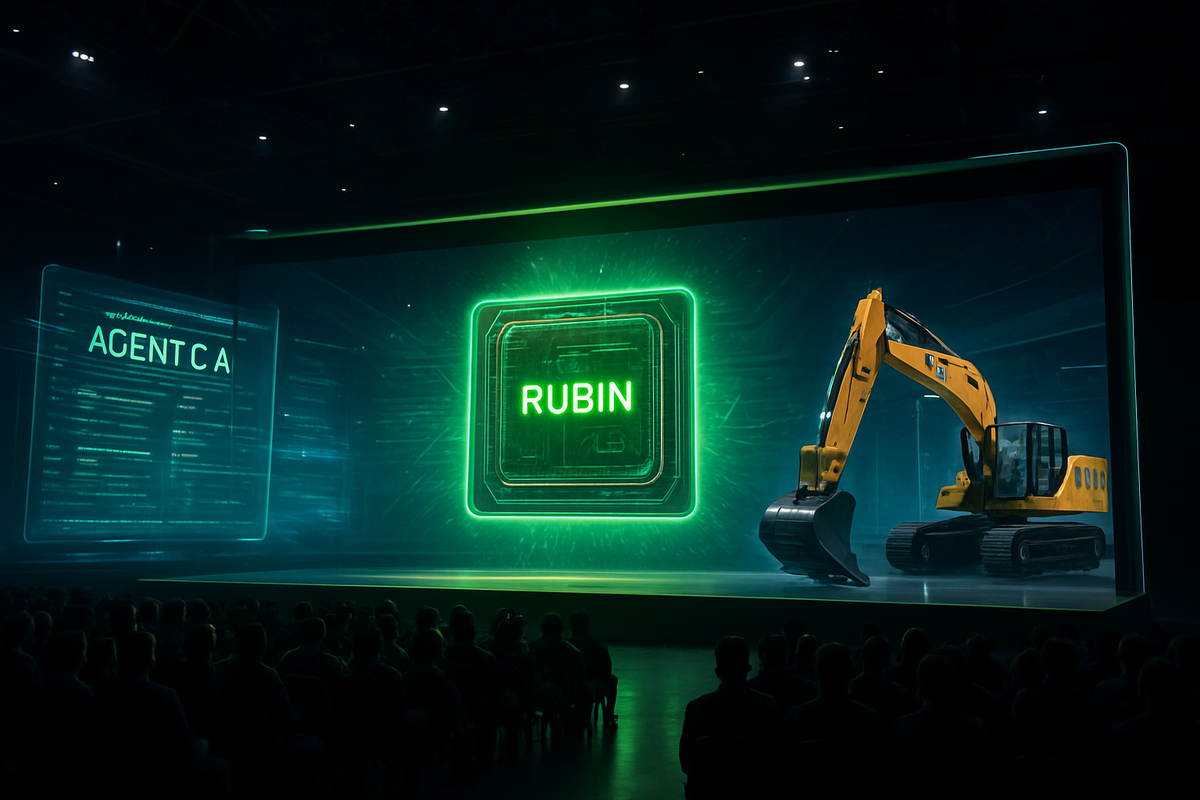
The centerpiece of today’s opening was the official unveiling of the "Vera Rubin" architecture, the successor to the Blackwell line that dominated 2025. Named after the pioneering astronomer, the Rubin (R100) GPU is a marvel of modern engineering, featuring a staggering 336 billion transistors and manufactured on Taiwan Semiconductor Manufacturing Company (NYSE: TSM) advanced 3nm process. Crucially, the Rubin platform marks the debut of HBM4 (High Bandwidth Memory), offering nearly triple the memory bandwidth of its predecessor.
The timeline leading to this moment has been one of relentless execution. Following the "Blackwell Ultra" bridge products released in mid-2025, Nvidia has successfully shifted to an annual release cadence to keep pace with the exponential growth in model complexity. Beyond the GPU, Huang introduced the "Vera CPU," an ARM-based processor optimized for the sequential reasoning required by autonomous AI agents. The market's immediate reaction—a 2.2% jump for NVDA—underscores investor confidence in Nvidia’s ability to maintain its lead in the data center while expanding into edge computing and sophisticated networking through its new NVLink 6 and Spectrum-X800 interconnects.
Beyond the Chips: Salesforce and Caterpillar Lead the AI-Integrated Charge
While Nvidia provided the hardware foundation, the "GTC effect" rippled through the Dow and S&P 500, lifting companies that have successfully integrated AI into their core business models. Salesforce saw its stock gain momentum as the conference highlighted the success of "Agentforce," its platform for autonomous AI agents. Unlike the chatbots of years past, these 2026-era agents—powered by Nvidia’s Vera processors—are capable of autonomously managing Tier-1 customer service and complex sales pipelines. Analysts note that Salesforce’s integration of Informatica’s data fabric has been a key differentiator, allowing its AI to ground itself in real-time enterprise data.
In a surprising but increasingly common trend, industrial heavyweight Caterpillar Inc. also emerged as a primary beneficiary of the AI buzz. Once viewed strictly as a "smoke and steel" company, Caterpillar has rebranded itself as a leader in "Physical AI." At GTC, Caterpillar showcased its "Cat AI Nexus" mini excavator, which utilizes the Nvidia Isaac robotics platform for autonomous grading and digging. The collaboration between the two companies has turned construction sites into high-tech laboratories, with Caterpillar’s stock rising as investors realize the massive margin expansion potential of autonomous machinery and predictive maintenance services in the heavy industry sector.
The Wider Significance: From Generative Hype to Agentic Utility
The 2026 GTC conference represents a fundamental shift in how the market views artificial intelligence. We are moving past the "ChatGPT moment" into an era where AI is not just generating text, but acting as a physical and digital agent. This event fits into a broader industry trend where the "Scaling Laws" are being applied not just to model size, but to the efficiency of inference. By reducing the cost of inference tenfold with the Rubin architecture, Nvidia is making it economically viable for companies to deploy millions of autonomous agents simultaneously.
However, the event also highlights emerging challenges, particularly regarding the "power wall." As data centers scale toward gigawatt-level consumption, Nvidia’s focus on energy efficiency and liquid cooling has become a competitive necessity rather than a luxury. Regulatory scrutiny is also intensifying, with policymakers closely watching how these autonomous systems are governed. The precedents set this week in San Jose regarding AI "safety guardrails" and data sovereignty will likely influence global tech policy for the remainder of the decade.
What’s Next: The Road to 1.6 Nanometers and the 'Feynman' Era
Looking ahead, the short-term focus will remain on the production ramp-up of the Rubin R100, with full-scale shipments expected to begin in late 2026. For competitors like Advanced Micro Devices, Inc. (NASDAQ: AMD), the pressure to match Nvidia's HBM4 integration will be intense. In the long term, Nvidia has already teased its 2028 roadmap, dubbed "Feynman," which aims to transition into the "Angstrom Era" (1.6nm) using silicon photonics to replace traditional copper interconnects.
For the enterprise sector, the challenge will be organizational. As Salesforce and Caterpillar have demonstrated, the winners of 2026 are not just those who buy the chips, but those who possess the "Data Foundation" to make those chips useful. We expect to see a surge in strategic pivots from mid-cap software companies trying to emulate Salesforce's "Agentic" model, though many may struggle with the high technical debt and fragmented data silos that still plague the industry.
Summary of the 2026 AI Landscape
In conclusion, the start of GTC 2026 has reaffirmed Nvidia’s role as the primary engine of the modern economy. The 2.2% rise in its shares is a modest reflection of the profound technological shift the company is orchestrating. From the Rubin architecture to the "Physical AI" breakthroughs at Caterpillar, the conference has provided a clear roadmap for the next three years of innovation.
Investors should watch closely for the partnership announcements expected later this week, particularly those involving hyperscalers like Microsoft (NASDAQ: MSFT) and Amazon.com, Inc. (NASDAQ: AMZN), who are the primary buyers of these next-generation systems. As the "Agentic AI" era begins in earnest, the distinction between "tech companies" and "industrial companies" will continue to blur, creating a new set of market leaders defined by their ability to harness the power of silicon to navigate the physical and digital worlds.
This content is intended for informational purposes only and is not financial advice.