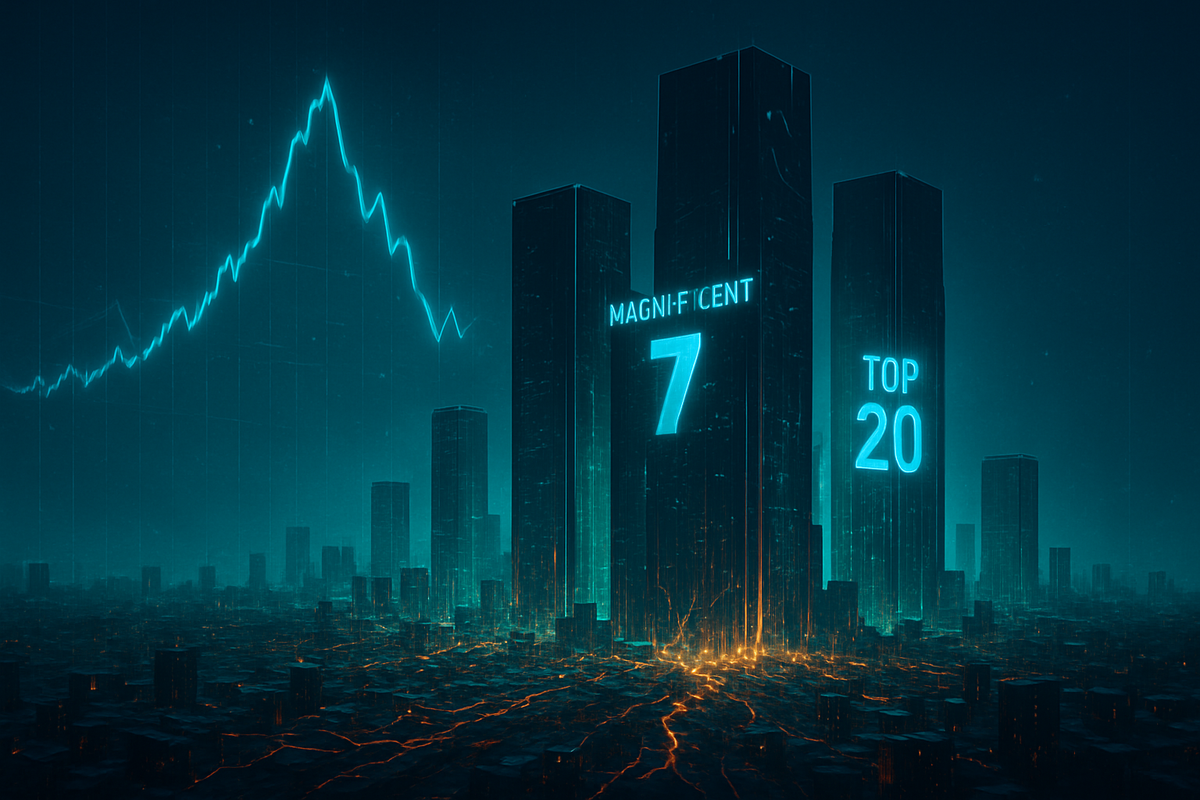
The S&P 500, once the ultimate symbol of American industrial diversification, has reached a point of unprecedented structural vulnerability. As of March 13, 2026, the index’s top 20 stocks now account for nearly 45% of its total weight, a level of concentration that surpasses the peak of the 2000 Dot-com bubble. This top-heavy architecture has effectively transformed the benchmark into a concentrated mega-cap tech fund, leaving the broader retirement accounts of millions of Americans exposed to any sudden shift in artificial intelligence (AI) sentiment.
The immediate implications are stark: the market’s "safety in numbers" philosophy has been hollowed out. While the equal-weighted S&P 500 has begun to show signs of life, the cap-weighted index—the one most closely tracked by passive investors—is now a prisoner to the fortunes of a handful of tech titans. With the AI narrative shifting from "growth at any cost" to a "show-me-the-money" phase, a correction in just three or four names could trigger a systemic deleveraging event that the remaining 480 stocks would be powerless to offset.
A Fragile Foundation: The Road to 45%
The journey to this historic concentration has been a years-long feedback loop of passive index flows and aggressive AI-driven speculation. By the end of 2025, the S&P 500 had posted a robust 17.5% annual gain, largely fueled by triple-digit surges in names like Nvidia (NASDAQ: NVDA) and Alphabet (NASDAQ: GOOGL). However, as 2026 opened, the cracks began to widen. On March 9, 2026, Bank of America warned that the index was approaching a "40% tipping point" for its top 10 holdings, a threshold that has since been crossed, with the top 10 now commanding 41.2% of the total market capitalization.
The catalyst for the current instability arrived on February 3, 2026, with the release of Anthropic’s "Claude Cowork" (Opus 4.6). This agentic AI model demonstrated the ability to autonomously handle end-to-end enterprise workflows—everything from financial auditing to legal drafting—without the need for traditional software interfaces. The fallout was immediate, with traders dubbing it the "SaaSpocalypse." Investors began to question the long-term viability of the per-seat pricing models that sustained the software industry for a decade. The initial reaction was a violent sell-off in the Software-as-a-Service (SaaS) sector, which quickly bled into the broader tech sector as the S&P 500 broke its critical 6,770 support level earlier this week.
Winners and Losers in the Great Rotation
The high-flyers of the previous era are currently the most vulnerable. Microsoft (NASDAQ: MSFT) has entered a period of "margin fatigue," falling roughly 20% from its 52-week highs as investors balk at the company's record-breaking capital expenditures on AI infrastructure that has yet to yield a proportional increase in net income. Similarly, Amazon (NASDAQ: AMZN) and Tesla (NASDAQ: TSLA) have seen year-to-date declines of 11.3% and 12.7% respectively. The software giants have fared even worse; Salesforce (NYSE: CRM) and ServiceNow (NYSE: NOW) have seen their valuations crater as the market re-evaluates the "AI helper" narrative in favor of "AI replacement" fears.
Conversely, the "Great Rotation" has found safe harbors in sectors that were neglected during the tech boom. Energy giants like ExxonMobil (NYSE: XOM) and Chevron (NYSE: CVX) have surged 20% or more this year, bolstered by oil prices climbing to $120 per barrel and a renewed focus on tangible assets. Industrials and value-oriented stocks are finally outperforming their growth counterparts on an equal-weighted basis, suggesting that while the "index" is struggling, the broader economy may be more resilient than the S&P 500's price action implies.
The Ghost of 2000 and the New Regulatory Reality
The current market structure bears a haunting resemblance to the Dot-com crash, though the specifics have evolved. The S&P 500’s Shiller Cyclically Adjusted Price-to-Earnings (CAPE) ratio now sits at 40, a level previously reached only in 1929 and 2000. While the "Magnificent 7" are far more profitable than the "Four Horsemen" of 1999, their dominance over the index is nearly double. In 1999, the top 10 stocks represented roughly 20% of the S&P 500; today, that figure is over 41%. This means any regulatory headwind or hardware bottleneck affecting the top tier has a disproportionately larger impact on the entire financial system.
Furthermore, the concentration has attracted the attention of regulators. In both the U.S. and the EU, antitrust scrutiny is no longer just about consumer prices; it is increasingly focused on the "AI compute moat" held by the largest firms. If regulators decide to force interoperability or limit the data-harvesting advantages of the tech giants, the very moats that justified their trillion-dollar valuations could evaporate, leaving the S&P 500 without its primary engine of growth.
What Comes Next: The 'Show-Me' Era
In the short term, the market is entering a "show-me-the-money" phase. The euphoria surrounding generative AI has been replaced by a rigorous analysis of return on investment (ROI). Companies will need to prove that their multi-billion dollar AI investments are translating into actual bottom-line growth, not just "productivity experiments." Strategic pivots are already underway; Meta (NASDAQ: META) and Alphabet have begun shifting their messaging toward "efficient AI," prioritizing cost reduction over raw model size to combat margin compression.
The long-term challenge will be the "unwinding" of the concentration risk. As passive investment continues to dominate, the only way to rebalance the index may be through a period of sustained underperformance by the leaders or a massive, broad-based rally in the "Other 480" stocks. Neither scenario is particularly comfortable for the average investor. If a tech-led correction deepens, we may see a resurgence in active management as investors seek to dodge the "index trap" created by mega-cap dominance.
Summary and Investor Outlook
The S&P 500 is currently more a reflection of the global tech sector's health than a diversified gauge of the American economy. With 20 stocks controlling 45% of the index, the margin for error is razor-thin. The "SaaSpocalypse" of early 2026 has served as a warning shot, proving that even the most robust narratives can shift overnight when technological disruption accelerates.
Investors should watch the 6,600 level on the S&P 500 closely in the coming weeks. If the index fails to hold this floor, a broader liquidation of passive positions could be triggered. Moving forward, the key metrics will be AI-to-revenue conversion and the persistence of the "Great Rotation" into value sectors. In this environment, the greatest risk is not being out of the market, but being overly concentrated in a index that has forgotten how to be diversified.
This content is intended for informational purposes only and is not financial advice.