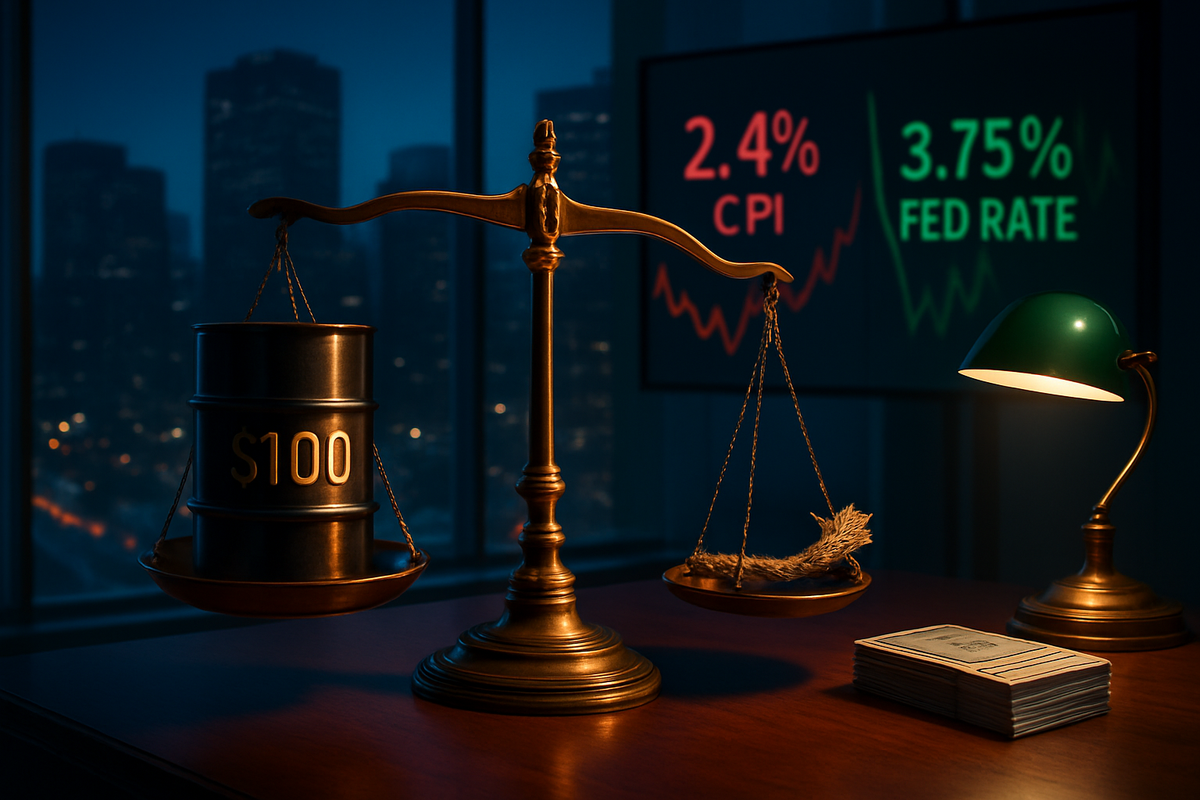
As the Federal Reserve prepares for its critical March 17-18 policy meeting, the U.S. economy has entered a precarious "policy trap" that pits a cooling labor market against a violent resurgence in energy costs. Data released this week shows the February 2026 Consumer Price Index (CPI) holding steady at 2.4% year-over-year, while core inflation—which excludes volatile food and energy—remains stubbornly "sticky" at 2.5%. This stagnation in disinflation, coupled with Brent crude prices surging past the $100 mark, has effectively paralyzed the central bank's ability to provide the interest rate relief demanded by both Wall Street and Washington.
The immediate implications are stark for a market that had, until recently, priced in a series of rate cuts for 2026. With the CME FedWatch Tool now showing a staggering 99% probability that the Fed will hold the federal funds rate in the 3.5%–3.75% range next week, investor sentiment is pivoting from optimism to defensive positioning. The "last mile" of the inflation fight has proven to be an uphill battle, as geopolitical tensions in the Middle East disrupt global supply chains and force the Federal Reserve to choose between crushing the remaining embers of inflation or preventing a broader economic slowdown as unemployment begins to creep toward 4.5%.
Stagnation and Spikes: The Road to the March Mandate
The current economic impasse is the result of a "perfect storm" of domestic fiscal policy and international volatility. Throughout late 2025, the Federal Reserve managed to deliver three 25-basis-point cuts, leading many to believe a "soft landing" was secured. However, the February 2026 CPI report delivered a reality check. While the headline number of 2.4% met consensus, the underlying details revealed a structural resistance in service-sector costs and shelter. Analysts point to the lagged pass-through effect of aggressive 2025 tariffs on electronics and apparel as a primary driver for why core inflation has refused to budge below the 2.5% threshold.
Adding fuel to the fire—literally—is the sudden escalation of conflict in the Middle East, which has seen Brent crude futures spike briefly to $119 per barrel before settling back just above $100. This energy shock acts as a "tax" on the American consumer, threatening to push headline inflation back toward 3.7% by mid-summer if sustained. For the Federal Open Market Committee (FOMC), led by Chair Jerome Powell, this represents a classic stagflationary headache: energy prices are pushing inflation up, while a softening labor market—now at 4.4% unemployment—suggests the economy is already feeling the weight of restrictive rates.
The political backdrop has only added to the volatility. President Donald Trump has ramped up his rhetoric against the central bank, publicly calling for the Fed to slash rates to 1% or lower to support his "Big Beautiful Bill" fiscal expansion and manage the $38 trillion national debt. This direct pressure, which includes reported Department of Justice inquiries into Fed operations, has put the central bank in a defensive posture, as any move to cut rates now might be perceived by the markets as a surrender of its independence rather than a response to economic data.
Winners and Losers in a High-Rate, High-Oil Regime
The divergence in the 2026 economy is creating clear winners in the energy and defensive sectors while weighing heavily on growth-sensitive stocks. The most obvious beneficiaries of the current "policy trap" are the major oil producers. ExxonMobil (NYSE: XOM) and Chevron (NYSE: CVX) have seen renewed interest as Brent crude’s move above $100 pads their bottom lines and enables further share buybacks. These companies are effectively acting as a hedge for investors against the very inflation that is hampering the rest of the market.
Conversely, large-cap technology and growth companies are feeling the squeeze of "higher-for-longer" expectations. NVIDIA (NASDAQ: NVDA) and Apple (NASDAQ: AAPL), which trade on high multiples of future earnings, are seeing their valuations pressured as the 10-year Treasury yield climbs toward 4.16%. While these companies remain profitable, the lack of a "Fed pivot" in March removes the tailwind of declining discount rates that had fueled their 2025 gains. Furthermore, consumer discretionary firms are facing a double-edged sword: higher fuel costs are eating into household budgets, while elevated borrowing costs for cars and credit cards are dampening overall spending.
The banking sector also faces a mixed outlook. While higher rates generally support net interest margins, the persistence of an inverted or flat yield curve—and the rising risk of loan defaults as unemployment ticks up—has dampened sentiment for giants like JPMorgan Chase & Co. (NYSE: JPM). Meanwhile, the iShares 20+ Year Treasury Bond ETF (NASDAQ: TLT) has become a focal point for volatility, as bond investors demand a higher "term premium" to compensate for the risk of "fiscal dominance," where government borrowing needs begin to dictate the path of interest rates regardless of Fed policy.
The Specter of Fiscal Dominance and Historical Parallels
The current scenario bears a haunting resemblance to the "stop-go" monetary policy of the 1970s, where premature rate cuts led to a second, more virulent wave of inflation. Many economists worry that the Fed is caught in a modern version of this trap. If they cut rates now to satisfy political pressure or support a weakening labor market, they risk "de-anchoring" inflation expectations, especially with oil prices remaining high. If they hold or hike, they risk a hard landing and a potential "bond market rebellion" where investors flee Treasuries due to fears of a debt-fueled recession.
This era is increasingly being defined by "fiscal dominance"—a state where the sheer size of the national debt and the government's deficit spending (projected at 6.6% of GDP for 2026) make it nearly impossible for the Fed to act independently. As the Treasury Department floods the market with new debt to finance government operations, the Fed is being pressured to keep rates low to prevent debt-servicing costs from ballooning. This conflict between fiscal expansion and monetary restriction is the defining trend of early 2026, creating a "bear steepening" in the yield curve that hasn't been seen in decades.
Furthermore, the "last mile" of inflation is proving more difficult than the initial drop from 9% to 3%. In the 1980s, Paul Volcker had to maintain double-digit rates even as unemployment soared to break the back of inflation. While today's Fed is far from those extremes, the principle remains: inflation that is rooted in structural supply issues and fiscal policy is far harder to kill with interest rates alone than demand-driven inflation.
Looking Ahead: The Powell Succession and the 2027 Horizon
The next three months are set to be the most transformative for U.S. monetary policy in recent history. All eyes are on May 2026, when Jerome Powell’s term as Fed Chair is set to expire. The shortlist for his successor, including names like Kevin Warsh and Kevin Hassett, suggests a potential shift in the Fed's ideological center. A "Trump-aligned" Fed could prioritize growth and debt management over the 2% inflation target, a move that would fundamentally reprice every asset class in the global market.
In the short term, the March 17-18 meeting will likely see the Fed maintain its "wait-and-see" posture, but the accompanying "dot plot" of rate projections will be the real market mover. If the Fed removes its projection for cuts later this year, we could see a significant correction in the S&P 500 as the "soft landing" narrative evaporates. Investors should also watch for any signs of "insurance hikes"—a hawkish move that some FOMC members have quietly discussed to combat the energy shock.
Strategic pivots will be required for both institutional and retail investors. The "60/40" portfolio is under threat as bonds fail to provide a hedge against inflation-driven equity sell-offs. We may see a continued shift into "hard assets," including gold, commodities, and real estate, as well as a preference for "quality" companies with strong cash flows that can navigate a period of high costs and stagnant growth.
Navigating the Trap: A Summary for the Strategic Investor
The March 2026 policy trap is the culmination of years of massive fiscal stimulus, a shifting global geopolitical order, and a central bank struggling to maintain its autonomy in an era of populism. The primary takeaways are that core inflation is no longer falling, energy costs are a renewed threat, and the Federal Reserve has run out of easy options. The "99% hold" probability for the March meeting is not just a sign of stability, but a sign of a central bank that is boxed into a corner.
Moving forward, the market will likely be characterized by heightened volatility and a "regime change" in how we value assets. The era of low-interest-rate certainty is over, replaced by a period of "fiscal dominance" and political interference. Investors should brace for a potential "bond market rebellion" if the Fed appears to lose its grip on inflation or its independence.
In the coming months, the critical factors to watch will be the April CPI report, the progression of Brent crude prices, and the official nomination of the next Fed Chair. As the "Gordian Knot" of 2026 tightens, the distinction between being a passive investor and a proactive risk manager has never been more vital.
This content is intended for informational purposes only and is not financial advice.