The global mergers and acquisitions (M&A) landscape has officially shifted from a period of high-rate hibernation to an era of "megadeal" dominance. On February 4, 2026, Evercore (NYSE: EVR) reported record-breaking fourth-quarter earnings that not only shattered analyst expectations but also served as a definitive bellwether for a broader market resurgence. After a transformative 2025 that saw global deal volumes climb to a staggering $4.5 trillion, the narrative for 2026 is no longer about recovery—it is about a structural "supercycle" driven by national security, AI infrastructure, and a massive deployment of private equity capital.
The implications for the financial markets are profound. While the previous two years were defined by caution and valuation gaps, the current environment is characterized by "rate visibility" and aggressive strategic repositioning. As the Federal Reserve’s terminal rate settles into a predictable 3.25% to 3.50% range, corporate boards have moved from the sidelines to the center of the arena, triggering a surge in large-cap transactions that analysts believe will redefine the industrial and technological landscape for the next decade.
A Record-Breaking Quarter in a Trillion-Dollar Year
Evercore’s Q4 2025 earnings report, released just days ago, provided the hard data to support the growing optimism on Wall Street. The firm posted an adjusted diluted earnings per share (EPS) of $5.13, a nearly 27% beat over consensus estimates. More impressively, Evercore’s adjusted net revenue for the quarter reached $1.3 billion, a 32% year-over-year increase. For the full year of 2025, the firm generated $3.88 billion in revenue, driven primarily by its advisory business, which saw the firm participate in five of the fifteen largest global transactions of the year.
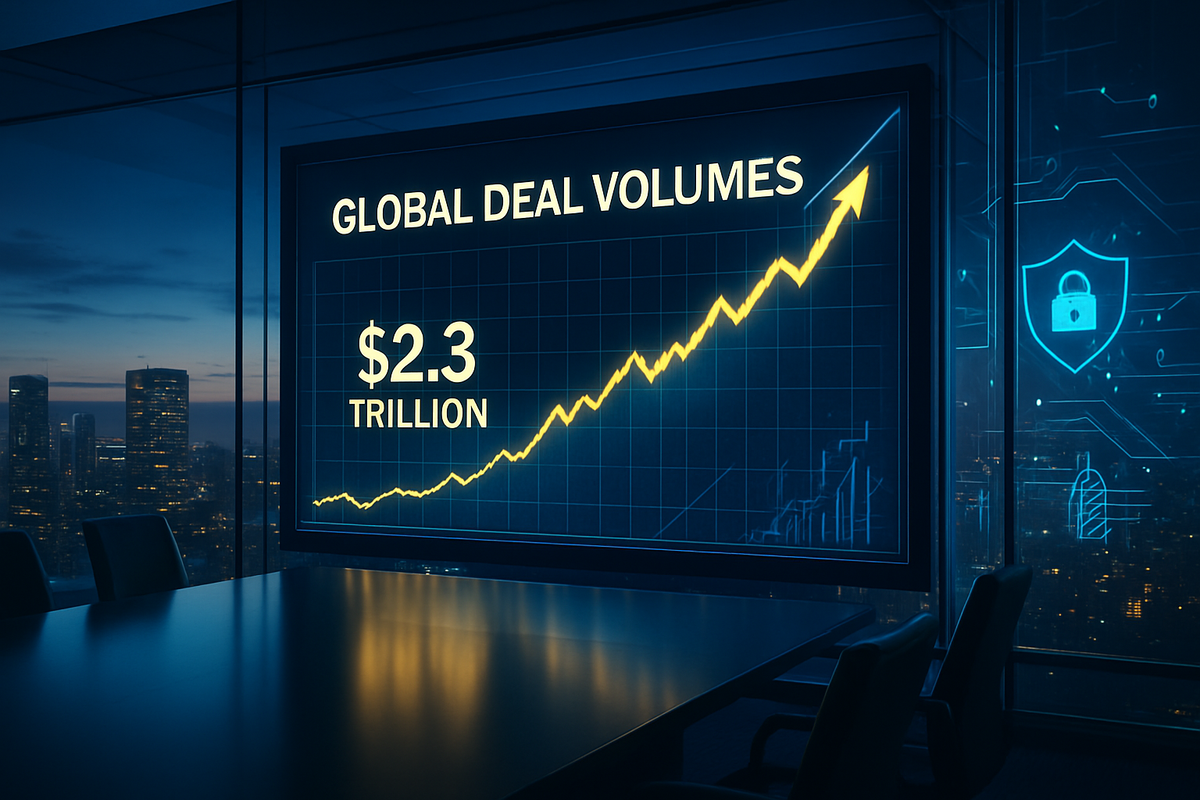
The backdrop to Evercore’s success was a global M&A market that experienced a "V-shaped" recovery in 2025. Total deal value reached $4.5 trillion, marking a nearly 50% increase from the lows of 2024. This rebound was fueled by the return of the "megadeal," with 70 transactions exceeding the $10 billion mark. High-profile maneuvers, such as Union Pacific (NYSE: UNP) bidding $85 billion for Norfolk Southern (NYSE: NSC), underscored a new appetite for massive, transformative consolidations. CEO John Weinberg noted during the earnings call that the firm’s backlog entering 2026 is at an all-time high, suggesting that the momentum is accelerating rather than tapering.
The Winners and Losers of the M&A Renaissance
The primary beneficiaries of this resurgence are elite independent advisory shops and major investment banks that have maintained deep talent pools during the downturn. Beyond Evercore, firms like Goldman Sachs (NYSE: GS) and Morgan Stanley (NYSE: MS) are seeing a revitalized pipeline as the IPO window reopens and large-cap corporates seek to deploy cash hoards. These firms are winning because the current market favors "complex, high-conviction" deals that require sophisticated structuring and deep industry expertise, particularly in the tech and energy sectors.
However, the recovery has been "K-shaped" in nature. While large-cap M&A is thriving, mid-market activity has lagged. Smaller advisory firms and regional banks may find themselves on the losing side of this cycle as mid-market volume remains suppressed by persistent valuation gaps and higher financing costs for smaller players. Furthermore, companies that failed to adapt to the "AI-first" economy are becoming targets rather than hunters. In the 2026 landscape, the "losers" are increasingly seen as those with legacy physical assets that lack a digital security or AI-integration strategy, making them prime candidates for hostile takeovers or forced consolidations.
The 'Security Supercycle' and Broader Industry Trends
The most significant trend identified by market analysts for 2026 is the emergence of the "Security Supercycle." This concept refers to a multi-year surge in capital allocation toward safeguarding both physical and digital infrastructure. Cybersecurity has become a prerequisite for AI scaling, exemplified by Palo Alto Networks (NASDAQ: PANW) and their strategic acquisitions to secure the growing AI data center footprint. The need to protect sensitive AI models has turned security from a "cost center" into a "strategic imperative," driving massive M&A premiums for specialized firms.
Beyond the digital realm, "security" now encompasses energy and national defense. Geopolitical tensions have triggered a decade-long investment cycle in defense technology, with the U.S. and European nations ramping up spending to levels not seen since the Cold War. This has created a ripple effect where energy security—the ability to provide 24/7 carbon-free power for AI and industrial needs—has become a top priority for corporate acquirers. We are seeing a historical precedent similar to the post-WWII industrial boom, where the intersection of government policy, technological leaps, and private capital creates a "supercycle" of investment that transcends traditional market cycles.
What Lies Ahead: A 2026 Outlook
Looking forward, the remainder of 2026 appears poised for continued expansion. The "dry powder" held by global private equity firms remains at a record $3.2 trillion. With the exit environment improving and corporate tax rates potentially moving toward 15% in the U.S., the pressure on PE sponsors to deploy capital is immense. This "wall of money" is expected to floor the market, providing support for valuations even if macroeconomic headwinds persist. Strategic pivots will be required; companies can no longer rely on cheap debt but must instead prove that M&A will yield immediate operational efficiencies through AI and automation.
The short-term challenge will be the regulatory landscape. While some anticipate a more "liberated" regulatory environment following recent political shifts, the sheer size of the megadeals currently on the table will inevitably invite scrutiny. Companies will need to be more creative in their deal structures—utilizing spin-offs and joint ventures to navigate antitrust hurdles. The primary market opportunity lies in "vertical AI" acquisitions, where established giants acquire niche AI players to transform legacy operations, a trend that is expected to dominate the second half of 2026.
Market Assessment and Final Thoughts
The rebound in M&A, spearheaded by firms like Evercore, signals a new phase for the global economy. The transition from $4.5 trillion in 2025 to what many expect to be an even stronger 2026 is built on the pillars of interest rate stability, technological necessity, and geopolitical reality. The "Security Supercycle" is not just a catchphrase; it is a fundamental shift in how corporations prioritize their capital. Investors should recognize that the market has moved past the "recession fear" stage and into a high-stakes "strategic positioning" stage.
As we move through the coming months, the key metrics to watch will be the "realization" of these megadeals and the speed at which private equity begins to churn its $3 trillion backlog. For the individual investor, the message is clear: the era of large-cap consolidation is here, and the companies providing the infrastructure for security, energy, and AI are the ones likely to lead the next leg of the bull market. The record earnings from the advisory giants are just the beginning of what looks to be a historic year for Wall Street.
This content is intended for informational purposes only and is not financial advice.