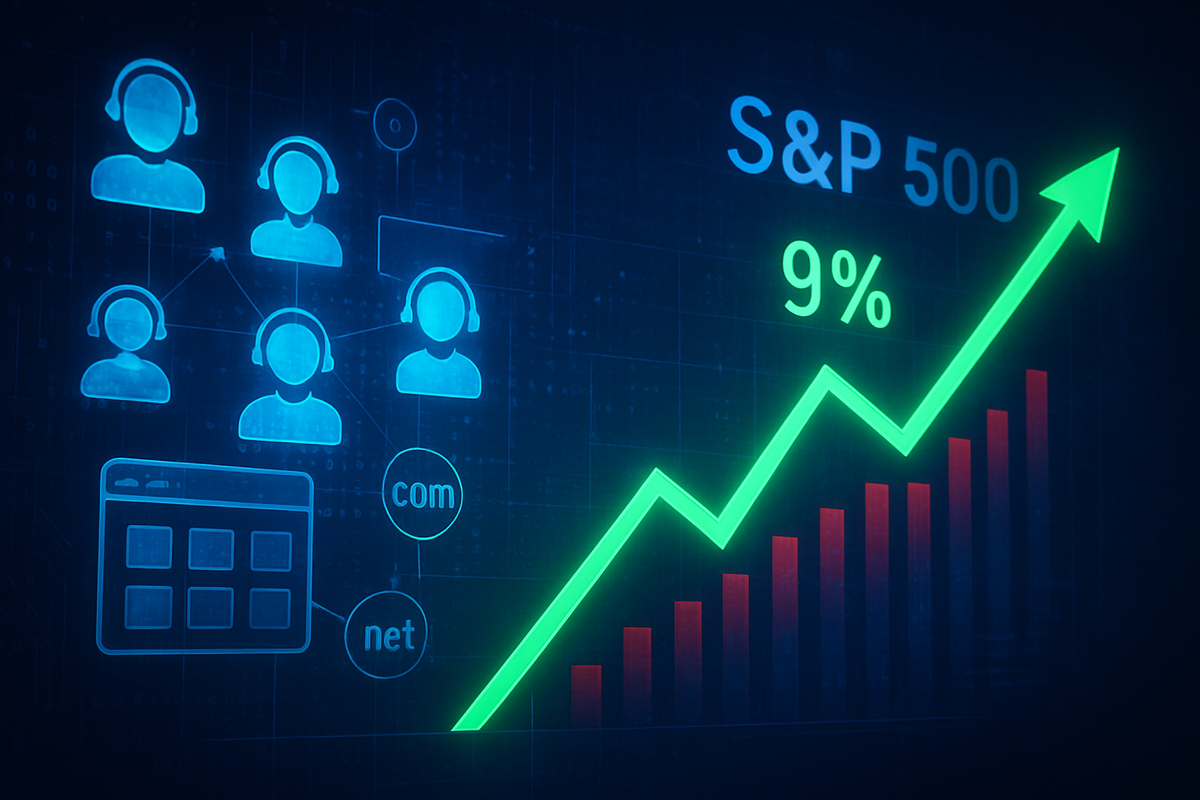
In a week defined by high-stakes earnings and extreme market volatility, GoDaddy Inc. (NYSE: GDDY) emerged as a standout performer in the final days of February 2026. On February 26, the internet services giant surged nearly 9%, securing its position as one of the top gainers in the S&P 500 index. The rebound followed a turbulent 48-hour period where the stock swung from earnings-induced optimism to a sharp selloff, ultimately finding its footing as investors reconsidered the company’s long-term profitability in an "agentic AI" era.
The surge, which saw GDDY shares climb 8.95%, was more than just a technical bounce; it signaled a renewed confidence in the company’s ability to defend its margins while integrating advanced artificial intelligence into its core offerings. As of February 27, 2026, the market appears to have priced in a "bottoming" effect, with the stock successfully breaking through key resistance levels that had previously capped its growth during the mid-winter slump.
A Rollercoaster Week: From Pessimism to Technical Breakout
The journey to the top of the S&P 500 began on February 24, when GoDaddy reported its fourth-quarter 2025 results. Initially, the news seemed positive: the company posted an earnings per share (EPS) of $1.80, handily beating the consensus estimate of $1.58. Revenue for the quarter reached $1.27 billion, a 7% year-over-year increase driven largely by its Applications & Commerce (A&C) segment. However, the celebration was short-lived. On February 25, the stock plummeted nearly 16% to a two-year low, bottoming out between $77 and $84 after management issued 2026 revenue guidance that fell short of aggressive analyst targets.
The narrative shifted dramatically on February 26, dubbed "Turnaround Thursday" by many floor traders. The primary catalyst for the nearly 9% recovery was a sector-wide "software relief rally" triggered by comments from Nvidia (NASDAQ: NVDA) CEO Jensen Huang. Huang addressed growing fears that AI would cannibalize traditional enterprise software, arguing instead that AI agents would amplify productivity and demand for digital infrastructure. This macro tailwind allowed investors to refocus on GoDaddy’s internal efficiencies, particularly its 160-basis-point margin expansion to 33.8%.
Technical analysts noted that the surge allowed GoDaddy to break through immediate resistance at $84.79 and $89.01. By clearing these hurdles, the stock signaled a "max pessimism" reversal, attracting institutional buyers who viewed the previous day’s 16% drop as an overreaction to conservative guidance. The rebound was supported by heavy trading volume, confirming that the move was backed by significant conviction rather than just a short-covering rally.
The Competitive Landscape: Winners and Losers in the Web Services War
GoDaddy’s recent performance has highlighted a growing divide within the web services and domain registration sector. While GoDaddy thrived, Verisign Inc. (NASDAQ: VRSN) struggled, hitting new 52-week lows in February. Verisign, which manages the .com and .net registries, has been weighed down by weak Q4 earnings and conservative growth forecasts that suggest a saturated market for traditional domain names—a stark contrast to GoDaddy’s successful pivot toward higher-margin software services.
Meanwhile, Wix.com Ltd. (NASDAQ: WIX) followed a similar trajectory to GoDaddy, seeing its own 9% jump during the February 26 relief rally. However, Wix remains under significant pressure, down approximately 70% over the last several years as it struggles with the broader tech selloff. Notably absent from this competitive fray is Squarespace, which was taken private by Permira in late 2024 for approximately $6.9 billion. The lack of a public Squarespace has left GoDaddy and Wix as the primary barometers for the health of the small-business digital economy.
The "winner" in this scenario appears to be GoDaddy’s platform-centric model. By moving beyond simple domain registration and into "agentic AI" tools that handle website building, compliance, and marketing, GoDaddy has managed to push its Average Revenue Per User (ARPU) up 10% to $242. This metric has become a key differentiator, as competitors like Verisign remain tied to the slower-growth "plumbing" of the internet.
The Shift to Agentic AI: A New Industry Standard
The surge in investor confidence is inextricably linked to GoDaddy’s evolution from basic generative AI to what CEO Aman Bhutani describes as an "agentic AI" model. By mid-February 2026, the GoDaddy Airo platform had deployed 25 active AI agents capable of autonomously handling complex tasks for small business owners. This shift is significant because it moves AI from being a conversational novelty to a functional utility that directly impacts the bottom line.
The efficiency gains from this transition are internal as well as external. GoDaddy revealed that a majority of its own new code is now AI-generated, which has dramatically shortened product development cycles and allowed the company to maintain high margins even while investing in new tech. This trend mirrors a broader movement in the software industry where companies are aggressively using AI to reduce headcount-related costs.
Historically, GoDaddy was viewed as a slow-moving legacy player in the domain space. However, its recent performance draws comparisons to the "cloud pivot" seen by legacy tech giants a decade ago. By successfully integrating AI agents into its workflow, GoDaddy is positioning itself as an essential partner for the "solopreneur" economy—a segment that has grown rapidly as AI tools lower the barrier to entry for starting a business.
Looking Ahead: Growth vs. Guidance
The short-term outlook for GoDaddy remains a tug-of-war between its stellar current profitability and its conservative 2026 guidance. While the 9% surge recaptured much of the ground lost after the earnings report, management must now prove that it can hit its target of 33%+ EBITDA margins consistently. The market will be watching closely to see if the 30% faster "second-product attach rate" seen among Airo users can be sustained as the platform scales.
A potential challenge lies in the regulatory environment. As AI agents begin to handle more sensitive tasks like business compliance and legal filings, GoDaddy could face increased scrutiny regarding the accuracy and liability of its automated tools. Additionally, if the broader "software relief rally" loses steam, GoDaddy will need to rely solely on its fundamentals rather than sector-wide tailwinds to maintain its current valuation.
In the long term, GoDaddy’s strategic pivot toward being an AI-first service provider requires continuous adaptation. The company must ensure that its AI agents stay ahead of open-source alternatives that could potentially offer similar website-building capabilities for free. The upcoming quarters will be a test of whether GoDaddy can maintain its dominant market share in domains while converting those customers into long-term subscribers of its high-margin AI ecosystem.
Summary for Investors: The Road to 2027
GoDaddy’s emergence as an S&P 500 top gainer in late February 2026 marks a pivotal moment for the company. The nearly 9% surge validated the company's aggressive move into agentic AI and its ability to expand margins despite a cooling revenue growth forecast. The key takeaway for investors is that GoDaddy is no longer just a domain registrar; it is a productivity-software play that is successfully leveraging AI to increase user value and internal efficiency.
As the market moves forward, the "Turnaround Thursday" event serves as a reminder of the volatility inherent in the current tech landscape. Investors should watch for continued growth in ARPU and the adoption rates of the Airo platform’s new AI agents. If GoDaddy can continue to demonstrate that its AI tools are driving real-world business results for its customers, the stock may find further room to run, even in a cautious macroeconomic environment.
The final verdict on GoDaddy’s February performance is one of resilience. By weathering an initial earnings crash and riding a wave of AI optimism, the company has proven that it remains a central player in the digital economy. For those watching the S&P 500, GDDY remains a critical stock to monitor as a bellwether for how legacy internet companies can reinvent themselves for the age of artificial intelligence.
This content is intended for informational purposes only and is not financial advice.