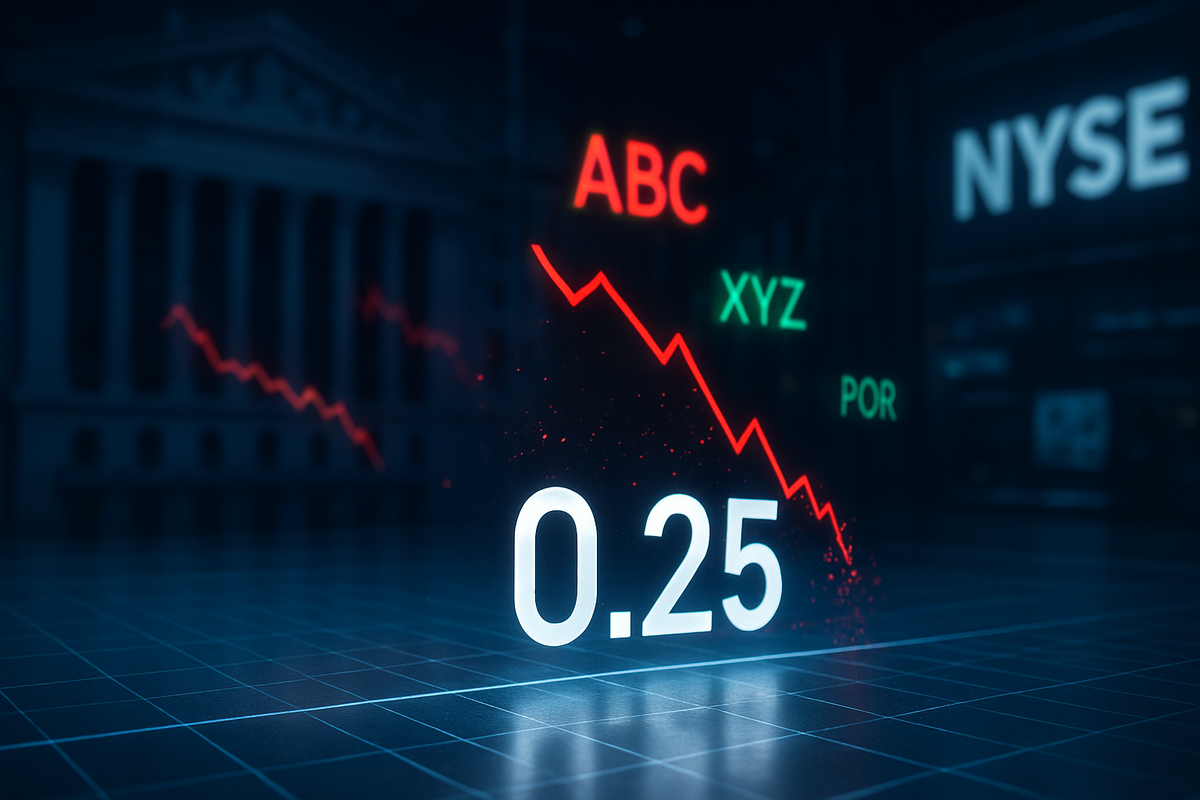
The New York Stock Exchange (NYSE) has taken a definitive stand against the rising tide of low-priced securities, formally proposing a new rule that establishes a "hard floor" of $0.25 per share for continued listing. Under the proposal, filed with the Securities and Exchange Commission (SEC) in late 2025, any security whose closing price falls below the $0.25 threshold would face immediate suspension and the commencement of delisting procedures. Unlike the longstanding $1.00 minimum bid price rule, which traditionally offers companies a six-month "cure period" to regain compliance, this new $0.25 mandate provides no such grace, acting as an emergency kill switch for stocks in freefall.
The immediate implications for the market are stark: dozens of micro-cap companies, particularly in the clinical-stage biotechnology and electric vehicle sectors, now face an existential deadline. While the NYSE has proposed an effective date of October 1, 2026, to allow currently listed firms to reorganize, the mere announcement has sent shockwaves through the small-cap ecosystem. Investors are already beginning to price in the "delisting risk" for companies trading near the dollar mark, as the safety net of a lengthy compliance period is effectively being removed for the most distressed assets.
A Swift Hammer: The Mechanics of the $0.25 Rule
The proposal, which would amend Section 802.01C of the NYSE Listed Company Manual, was officially introduced on December 3, 2025. It represents the most aggressive tightening of listing standards in decades, specifically targeting what the exchange calls "abnormally low" price levels. The rule functions as a secondary, stricter layer of enforcement. While a company can still enter a six-month cure period if its average closing price falls below $1.00 over 30 consecutive trading days, that cure period is immediately terminated if the share price touches $0.25 at any point. This "sudden death" provision is designed to prevent "zombie" companies from lingering on a premier exchange while their equity value evaporates.
This move follows a series of regulatory escalations throughout 2025. In January 2025, the NYSE and its peer, the Nasdaq Stock Market (NASDAQ), implemented rules that restricted the frequency and cumulative ratio of reverse stock splits. These measures were intended to stop the "split-and-slide" cycle, where companies repeatedly consolidate shares to artificially maintain a $1.00 price while their underlying business continues to deteriorate. The new $0.25 floor essentially closes the loop, ensuring that if a stock’s absolute value collapses, the exchange’s reputation is protected by an immediate exit of that security to the Over-the-Counter (OTC) markets.
Stakeholders, including the Council of Institutional Investors (CII), have generally supported the move, arguing that extremely low-priced stocks are hotbeds for "pump-and-dump" schemes and excessive intraday volatility. The NYSE has argued that a one-cent move on a $0.05 stock constitutes a 20% swing, a level of volatility that is often detached from fundamental business developments and can lead to disorderly markets. By enforcing a $0.25 floor, the exchange aims to ensure that every listed company maintains a baseline level of investor interest and price stability.
Winners and Losers: The Small-Cap Survival Race
The primary "losers" in this regulatory shift are the "distressed" public companies currently navigating the $1.00 compliance window. As of February 25, 2026, several notable firms are already feeling the heat. BRC Inc. (NYSE: BRCC), the parent of Black Rifle Coffee, received a formal deficiency notice on February 10, 2026, after its average price dipped below $1.00. While the company traditionally would have six months to recover, the looming $0.25 "hard floor" significantly narrows its margin for error. Similarly, BARK, Inc. (NYSE: BARK) and Wallbox N.V. (NYSE: WBX) have been identified by analysts as companies that must maintain upward momentum to avoid the high-stakes delisting trap.
In the more speculative tiers of the market, the impact is even more pronounced. Companies like AEON Biopharma, Inc. (NYSE American: AEON) and Azitra, Inc. (NYSE American: AZTR) have historically navigated the lower bounds of listing requirements. For these biotechnology firms, where clinical trial results can cause massive price swings, the $0.25 rule introduces a "binary risk" where a single negative data release could not only crater the stock but lead to an instant loss of its major exchange listing. For retail investors, the "loser" is often liquidity; once a stock is delisted and moved to the OTC markets, the ability to buy or sell shares at tight spreads vanishes, often leading to a further collapse in value.
Conversely, the "winners" appear to be institutional investors and the exchanges themselves. For large funds, a cleaner NYSE with fewer "penny stocks" reduces the noise and risk of market manipulation. The NYSE Group (ICE) stands to win by reinforcing its brand as the "gold standard" of listing venues, differentiating itself from the perceived volatility of the micro-cap space. By clearing out the bottom tier of companies, the exchange may actually attract higher-quality IPOs that were previously hesitant to be associated with an exchange home to hundreds of penny-range tickers.
Wider Significance: A Return to Quality in a Post-Meme Era
The NYSE's proposal is not an isolated event but part of a broader industry trend toward "market hygiene." Following the "meme stock" era of 2021-2023, where retail speculation often drove low-priced stocks to irrational heights, regulators have been under pressure to safeguard the infrastructure of the public markets. Nasdaq (NASDAQ) has recently implemented its own version of this crackdown, though it opted for a $0.10 "Low Price Requirement" effective in January 2026. The NYSE’s choice of $0.25—a significantly higher floor—signals a desire to be the more exclusive, "safe" venue for investors.
This regulatory tightening also reflects a shift in SEC policy under current leadership. There is an increasing emphasis on ensuring that public markets are populated by viable, transparent businesses rather than "shells" or companies that are public in name only. Historically, the $1.00 rule was the primary guardrail, but the proliferation of aggressive reverse stock splits (some as high as 1-for-500) rendered that rule nearly toothless. By implementing a price floor that overrides the cure period, the NYSE is effectively ending the "reverse split loophole."
The ripple effects will likely be felt in the private markets and the venture capital (VC) ecosystem. With the "exit ramp" of a public listing becoming more difficult to maintain, late-stage private companies will face higher scrutiny. VCs can no longer rely on a "quick flip" to the public markets for a struggling company if that company cannot realistically maintain a share price well above the $0.25 and $1.00 thresholds. This could lead to a healthy consolidation of the biotech and EV sectors, as weaker players are forced to merge or go private rather than clinging to a public listing.
The Road to October: Strategic Pivots and Market Opportunity
As the October 1, 2026, implementation date approaches, the market should expect a flurry of corporate actions. In the short term, there will likely be a surge in "preemptive" reverse stock splits as companies try to put as much daylight as possible between their share price and the $0.25 floor. However, because of the new restrictions on the frequency of these splits, companies only have one "bullet" to use. If a 1-for-20 split only raises the price to $2.00, and the stock continues to fall, the company may find itself unable to perform another split within the necessary timeframe, leading to an inevitable delisting.
Strategic pivots will be required for companies currently in the danger zone. We may see an increase in "take-private" transactions, where private equity firms buy out distressed public companies at a discount, or "alternative financing" rounds that aim to provide a cash cushion to bolster investor confidence. For savvy investors, this creates a "quality vs. trash" screening opportunity. Companies that can successfully navigate these tighter rules without relying on accounting gimmicks or excessive splits may prove to be the most resilient in their respective sectors.
Potential scenarios for the coming year include a "migration" of distressed stocks to the OTC Markets (OTCQX or OTCQB). While this is a downgrade, the OTC has been modernizing its own reporting standards to capture this spillover. We may see the emergence of a more robust "middle market" for these $0.25 to $1.00 stocks, provided they can maintain transparency. However, for many, the loss of a NYSE ticker will be the final blow to their ability to raise capital.
Conclusion: A Turning Point for Market Integrity
The NYSE’s proposed $0.25 minimum price rule marks a pivotal moment in the evolution of the U.S. capital markets. By removing the safety net of the "cure period" for stocks that hit rock bottom, the exchange is prioritizing market quality and investor protection over the raw number of listed entities. This "tough love" approach is a clear message to the corporate world: a public listing on the world’s most prestigious exchange is a privilege that must be maintained through consistent value, not just regulatory maneuvering.
Moving forward, the market is likely to be cleaner but potentially more volatile in the small-cap segment as the "death spiral" risk of hitting the $0.25 mark becomes a reality. Investors should brace for a period of adjustment where "zombie" stocks are purged, potentially leading to a more stable and reputable environment for the survivors. The era of the "infinite reverse split" is over, replaced by a regime that demands fundamental business health.
In the coming months, investors should closely monitor the SEC's final approval of the rule and watch the "Deficient Companies" list on the NYSE website. Particular attention should be paid to the clinical milestones of biotech firms and the delivery targets of EV startups; in the new $0.25 regime, a single miss could be the difference between a major exchange listing and a quiet exit to the shadows of the OTC.
This content is intended for informational purposes only and is not financial advice.