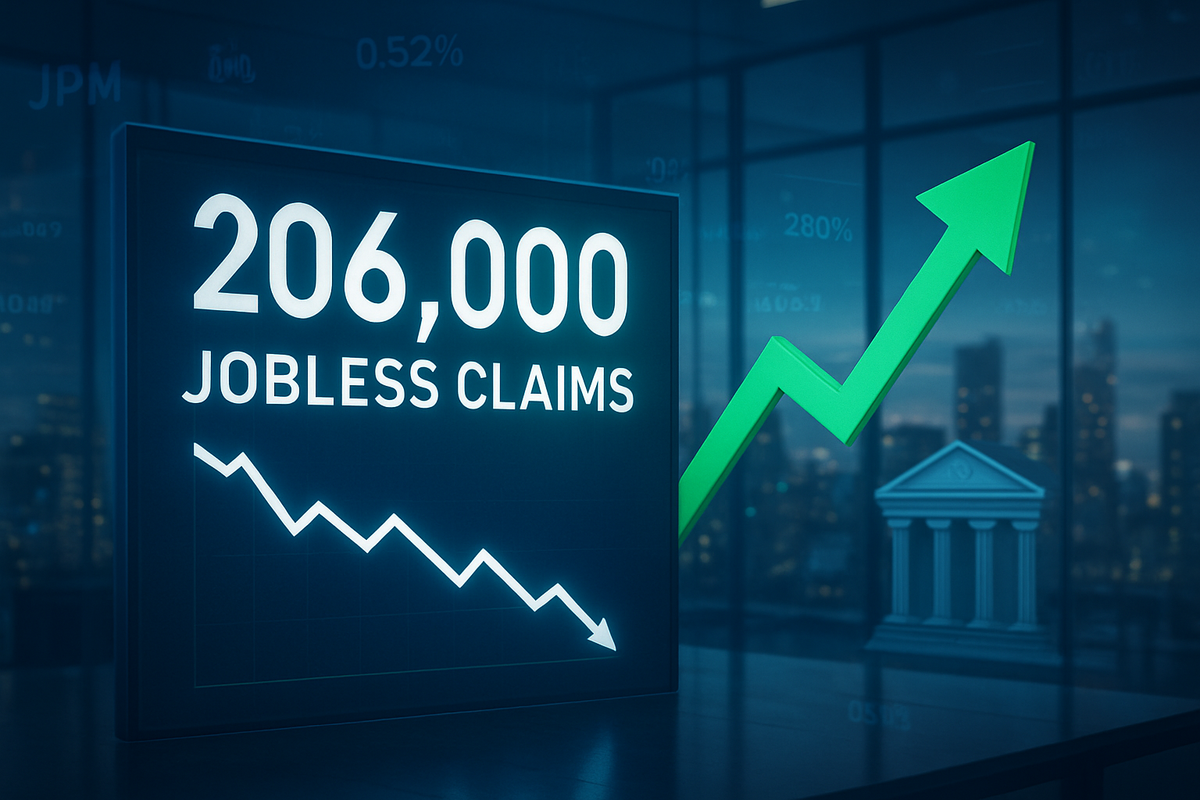
The U.S. labor market continues to display a startling degree of resilience, with initial jobless claims for the week ending February 14, 2026, falling to 206,000. This figure significantly outperformed Wall Street’s consensus estimate of 221,000, signaling that the widely anticipated "cooling" of the American workforce remains elusive. While a tight labor market is traditionally a sign of economic health, this latest data point has sent a shiver through the fixed-income markets, reinforcing the Federal Reserve's "higher for longer" interest rate stance and complicating the narrative of a slowing national economy.
The immediate implications of this data are twofold: it provides a robust buffer against fears of a recessionary spiral, but it also effectively extinguishes any remaining hopes for a spring interest rate cut. With the Dow Jones Industrial Average recently breaching the 50,000 mark, investors are grappling with a "good news is bad news" paradox. The strength of the labor market suggests that consumer spending—the primary engine of U.S. GDP—may remain durable enough to keep inflationary pressures simmering, leaving the Federal Reserve with little incentive to pivot toward more accommodative policy.
The Resilience Paradox: Labor Strength vs. GDP Stagnation
The drop to 206,000 claims represents the lowest level of filings since November 2025, marking a "low-hire, low-fire" equilibrium that has characterized the first quarter of 2026. This data arrives at a critical juncture; just weeks ago, the Bureau of Economic Analysis reported that Q4 2025 GDP growth had plummeted to a meager 1.4%, down from 4.4% in the previous quarter. Much of that deceleration was attributed to the record-breaking 43-day government shutdown that paralyzed federal operations late last year, subtracting an estimated 1.5 percentage points from the headline growth figure. However, the labor market appears to have looked past the fiscal turmoil in Washington, with private-sector firms choosing to hoard talent rather than initiate the mass layoffs typical of a growth slowdown.
The timeline leading up to this moment has been defined by a tense tug-of-war between fiscal shocks and private-sector momentum. Throughout January 2026, many analysts expected a "lagged effect" from the shutdown to finally manifest in higher unemployment claims. Instead, the data has consistently beat expectations. Key stakeholders, including Treasury Secretary Janet Yellen and outgoing Fed Chair Jerome Powell, have noted that while the "speed bump" in GDP was significant, the underlying structural demand for labor in sectors like AI infrastructure and healthcare remains historically high. The market reaction on Thursday saw 10-year Treasury yields spike as traders recalibrated their expectations, pushing the first potential rate cut out to the second half of 2026.
Winners and Losers in a Persistent High-Rate Environment
The persistence of the 3.5%–3.75% federal funds rate, bolstered by this labor data, has created a stark divide in equity performance. Financial behemoths like JPMorgan Chase & Co. (NYSE: JPM) stand as primary beneficiaries. High interest rates allow major lenders to maintain wider net interest margins, and the lack of unemployment claims suggests that loan defaults will remain low, protecting the bank’s balance sheet. Similarly, "Real Economy" giants in the energy sector, such as Exxon Mobil Corp. (NYSE: XOM), have seen renewed interest as investors rotate out of speculative growth and into cash-flow-positive value stocks that benefit from sustained industrial activity.
Conversely, the "Magnificent Seven" and other high-valuation technology stocks are feeling the heat. NVIDIA Corp. (NASDAQ: NVDA) and Microsoft Corp. (NASDAQ: MSFT), which have driven much of the market’s gains over the last two years, faced mid-February sell-offs as the "higher for longer" narrative took hold. These companies, while fundamentally strong, are highly sensitive to the discount rates used to value future earnings. Furthermore, consumer-facing companies like Apple Inc. (NASDAQ: AAPL) are being watched closely; while the labor market is strong, the "K-shaped" economic trend means that lower-income consumers are increasingly stretched, which may eventually weigh on hardware sales and services revenue despite the low unemployment figures.
The "Warsh Doctrine" and the Shifting Fed Landscape
This labor data fits into a broader, more complex trend of "regime change" at the Federal Reserve. On January 30, 2026, the nomination of Kevin Warsh to succeed Jerome Powell as Fed Chair in May sent waves through the financial community. Warsh is widely expected to implement a "two-sided" policy approach—potentially more aggressive in reducing the Fed’s massive balance sheet (Quantitative Tightening) while remaining "opportunistic" regarding rate adjustments. The strength of the current labor market gives the incoming leadership "policy space" to remain restrictive for longer without fearing an immediate collapse in consumer demand.
Historically, periods of slowing GDP growth paired with tight labor markets are rare and often precede a "soft landing" or a period of stagflation. The 2026 experience, however, is unique due to the massive capital expenditures in Artificial Intelligence and green energy. These sectors are creating a "labor floor" where technical skills are in such high demand that broader economic headwinds cannot easily dislodge employment levels. This creates a regulatory challenge for the Fed: if they cut rates to stimulate the slowing GDP, they risk over-heating an already tight labor market and reigniting inflation.
Looking Ahead: The Pivot to H2 2026
In the short term, the market must prepare for a volatile transition period as Powell prepares to hand over the gavel to Warsh. The consensus for a rate cut has now moved decisively from March to either July or September of 2026. Companies will likely spend the next two quarters focusing on balance sheet repair and cost-cutting measures that do not involve layoffs—such as reducing capital expenditures or pausing stock buybacks—to navigate the high cost of debt.
The most significant scenario for investors to watch is the "rebound effect" of the government shutdown's end. If GDP growth bounces back to the 3% range in Q1 or Q2 2026, while labor claims remain near the 200,000 mark, the Federal Reserve may find itself in a position where rates must stay at current levels through the end of the year. This would represent a major strategic pivot for hedge funds and institutional investors who had spent the better part of 2025 betting on a rapid return to 2% interest rates.
Summary and Investor Outlook
The latest jobless claims figure of 206,000 is a testament to the enduring strength of the American worker, but it also serves as a warning to those expecting a quick return to cheap money. The labor market’s refusal to buckle, even in the face of a significant GDP "speed bump" and political instability, confirms that the U.S. economy remains fundamentally resilient. For the Federal Reserve, this data provides the "green light" to maintain its restrictive stance to ensure that inflation is fully extinguished before any policy easing begins.
Moving forward, the market is likely to remain in a state of "ordered rotation." Investors should keep a close eye on inflation prints and the May leadership transition at the Fed. While the Dow 50,000 milestone is a psychological victory, the real story for the coming months will be whether the "Real Economy" can continue to support these valuations as the "Higher for Longer" reality settles in for the duration of 2026.
This content is intended for informational purposes only and is not financial advice