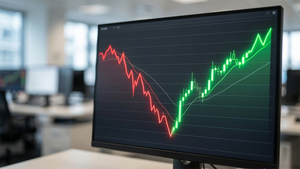
In a historic session that has redefined the boundaries of the global commodities market, gold prices surged past the psychological $5,000 barrier on February 20, 2026, reaching a record spot price of $5,027 per ounce. This seismic shift in the precious metals market was precipitated by a "perfect storm" of systemic risks: a dramatic escalation in military posturing across the Middle East and a sobering release of U.S. economic data that suggests the world's largest economy is cooling faster than many anticipated.
The immediate implications are profound, as the "yellow metal" cements its status as the ultimate hedge against both geopolitical instability and domestic fiscal fragility. With central banks across the globe accelerating their bullion purchases and institutional investors abandoning risk-on assets, the $5,027 mark represents more than just a number; it is a vote of no confidence in the prevailing global security framework and traditional fiat-denominated assets.
A Record-Breaking Surge Amid Global Tension
The journey to $5,027 was punctuated by a frantic morning of trading on the Comex and London bullion markets. The catalyst was a two-pronged development: first, the expiration of a high-stakes 15-day diplomatic ultimatum issued by the U.S. administration to Tehran regarding nuclear enrichment, which was met with defiant joint naval exercises by Iranian and Russian forces in the Gulf of Oman. Simultaneously, the U.S. Department of Commerce released revised Q4 2025 GDP figures showing growth at a mere 1.4%, significantly undercutting the 3.0% consensus and heightening fears of a "hard landing" for the American economy.
The timeline of this rally began in late 2025, following the passage of the "One Big Beautiful Bill Act," which initially sparked inflation concerns. As 2026 opened, gold prices were already trading near $4,800. However, the move from $4,800 to today's record of $5,027 occurred in a condensed 72-hour window of panic-buying. Key stakeholders, including the SPDR Gold Shares (NYSEARCA: GLD) and massive sovereign wealth funds from Asia and the Middle East, were seen aggressively liquidating equity positions to move into physical gold and gold-backed derivatives.
Market reaction was instantaneous. As the spot price ticked past $5,000 at 10:15 AM EST, trading platforms reported record-breaking volume. The yield on the 10-year Treasury note dipped as investors sought the safety of bonds, but the move into gold was notably more aggressive, suggesting that investors are increasingly wary of sovereign debt levels and are seeking "outside money" that carries no counterparty risk.
Miners and Markets: Identifying the Winners and Losers
The surge to $5,027 creates a stark divide between market winners and those facing severe operational headwinds. The most immediate beneficiaries are the "Big Three" gold miners. Newmont Corp (NYSE: NEM), the world’s largest producer, saw its shares jump as the higher spot price dramatically expands its profit margins, despite its 2026 production being in a cyclical "trough." Similarly, Agnico Eagle Mines Limited (NYSE: AEM) is being hailed as a "quality play" due to its low-risk jurisdictional footprint, with its dividend yield becoming increasingly attractive to income-starved investors.
Barrick Gold (NYSE: B), which recently underwent a structural reorganization to list its North American assets under a new ticker, is also positioned to win. However, the company faces a complex balancing act as its copper production—now 30% of its EBITDA—suffers from the same industrial slowdown that is dampening the broader economy. For these miners, the challenge will be managing the "All-In Sustaining Costs" (AISC) which are rising due to labor and energy inflation, potentially eating into the windfall from $5,000 gold.
Conversely, the losers are found in the industrial and consumer sectors. High-end jewelry retailers and technology firms that rely on gold for high-performance electronics are facing a massive spike in raw material costs. Furthermore, central banks in emerging markets that failed to diversify into gold earlier in the cycle are now finding it prohibitively expensive to bolster their reserves, potentially leading to further currency devaluations against the "gold standard."
The Macroeconomic Shift: Gold as the New Global Anchor
This event fits into a broader historical trend of "gold revaluation" during periods of transition in the global order. Much like the stagflationary environment of the late 1970s or the post-2008 financial crisis rally, the 2026 surge reflects a fundamental shift in how value is perceived. The current situation is unique, however, because of the "supply shock inflation" risks associated with the potential closure of the Strait of Hormuz, which could send oil prices—and by extension, the cost of extracting gold—even higher.
The regulatory and policy implications are significant. The U.S. Federal Reserve now finds itself in a "triple bind": it must decide whether to cut rates to support the flagging 1.4% GDP growth, raise rates to combat the inflationary pressures of $5,000 gold and rising oil, or maintain current levels while the Middle East burns. Analysts are drawing parallels to the 1971 "Nixon Shock," suggesting that we may be entering a new era where the U.S. dollar's hegemony is challenged by a multi-polar currency system backed by hard assets.
Furthermore, the "One Big Beautiful Bill Act" and its subsequent fiscal fallout have limited the government's ability to use stimulus to counter the economic slowdown. This has forced the private sector to seek its own "safety net," leading to the unprecedented demand for bullion. The ripple effect is being felt across all commodities, with silver and platinum also seeing double-digit percentage gains as investors look for cheaper alternatives to the now-exorbitant gold.
What Lies Ahead: Volatility or a New Plateau?
Looking ahead, the short-term trajectory of gold will likely depend on the developments in the Gulf of Oman. If a "meaningful" diplomatic breakthrough is reached with Iran, we could see a "sell-the-news" correction, potentially pulling spot prices back toward the $4,500 support level. However, if the military buildup continues, some technical analysts, including those at Goldman Sachs, have suggested a "bull case" scenario where gold could reach as high as $8,490 by the end of 2026.
Strategic pivots are already underway. Mining companies are expected to accelerate exploration in "safer" regions like Canada and Australia to mitigate the geopolitical risks of their more volatile assets. Meanwhile, investors must navigate a market where the traditional 60/40 portfolio is being challenged. The emergence of gold as a primary asset class may force a rebalancing of global pension funds and 401(k) allocations, creating a sustained bid for the metal for years to come.
The ultimate outcome hinges on whether the U.S. economy can manage a "soft landing" in Q1 2026. While the Atlanta Fed's "GDPNow" projects a reacceleration to 3.1%, the disconnect between the official growth forecasts and the $5,027 gold price suggests that the market is far more skeptical about the prospects for a recovery than the government's statisticians.
Summary: A Sobering Milestone for Global Finance
The surge of gold to $5,027 on February 20, 2026, marks a turning point in modern financial history. It is a clear signal that the era of low-volatility and predictable growth has been replaced by a "risk-first" environment. The primary takeaways for the market are clear: geopolitical stability is now the most important economic variable, and the "flight to safety" is no longer a temporary reaction, but a fundamental portfolio strategy.
Moving forward, the market will be characterized by extreme sensitivity to Middle Eastern headlines and U.S. fiscal data. Investors should closely watch the quarterly earnings of Newmont Corp (NYSE: NEM) and Barrick Gold (NYSE: B) to see if they can turn record prices into sustainable shareholder value. Additionally, the movement of the SPDR Gold Shares (NYSEARCA: GLD) will serve as a proxy for institutional sentiment.
In conclusion, while $5,000 gold may be a cause for celebration for long-term bullion holders, it serves as a sobering warning for the global economy. It reflects a world where the traditional pillars of stability are shaking, and the only "sure thing" is a heavy, yellow bar of metal that has outlasted every empire and currency in history.
This content is intended for informational purposes only and is not financial advice.