Shares of Comfort Systems USA, Inc. (NYSE: FIX) surged more than 12% in early trading on February 20, 2026, after the company delivered a massive beat on its fourth-quarter and full-year earnings. The Houston-based provider of mechanical, electrical, and plumbing (MEP) services reported a quarterly earnings per share (EPS) of $9.37, more than doubling the $4.09 recorded in the same period a year prior, and comfortably outstripping Wall Street estimates.
The rally reflects investor confidence in a company that has effectively hitched its wagon to the artificial intelligence (AI) infrastructure boom. CEO Brian Lane characterized the current market environment as an "industrial supercycle," noting that the demand for specialized HVAC and electrical services—particularly for the high-density "AI factories" currently replacing traditional data centers—is unlike anything the industry has seen in decades.
Record Backlog and the AI Infrastructure Pivot
The fiscal 2025 results, released late yesterday, reveal a company operating at a scale previously unimagined for the MEP sector. Comfort Systems reported a staggering year-end backlog of $11.94 billion, nearly double the $5.99 billion recorded at the end of 2024. This mountain of contracted work provides a multi-year cushion of visibility that has turned FIX into a darling of industrial growth investors. Revenue for the fourth quarter reached $2.65 billion, a 41.7% increase year-over-year, driven primarily by the technology sector, which now accounts for roughly 45% of the company’s total revenue.
This momentum has been building since late 2024, as hyperscale cloud providers accelerated their transition toward AI-capable hardware. Because AI chips generate significantly more heat than traditional processors, the cooling requirements for these facilities have moved from standard air conditioning to complex liquid-to-chip and immersion cooling systems—areas where Comfort Systems has invested heavily in technical expertise and modular manufacturing. "Our reputation for delivering outcomes in high-stakes environments has led to new levels of backlog," Lane told analysts during the earnings call, emphasizing that the company is no longer just a "contractor" but a mission-critical partner for Big Tech.
The market reaction was swift and decisive. By mid-morning on February 20, FIX shares had reached an all-time high, extending a six-month run that has seen the stock price nearly double. Analysts noted that the company’s operating margins also reached a record 16.1%, suggesting that Comfort Systems is maintaining pricing power even as it scales rapidly to meet the "unprecedented demand" cited by leadership.
Winners and Losers in the Specialized Infrastructure Race
Comfort Systems is not the only player benefiting from this capital expenditure wave. Its primary competitor, EMCOR Group, Inc. (NYSE: EME), is also seeing robust demand for similar "inside the data center" services. Like FIX, EMCOR has pivoted toward high-margin electrical and fire protection systems tailored for hyperscale environments. However, Comfort Systems’ recent focus on modular construction—off-site fabrication of cooling and power units—has given it a slight edge in speed-to-market, which is the top priority for data center operators in 2026.
Conversely, Quanta Services, Inc. (NYSE: PWR) represents a different play on the same trend. While FIX and EME dominate the interior of the data center, Quanta focuses on the "outside" infrastructure—the massive power transmission and grid modernization projects required to feed these energy-hungry facilities. While Quanta remains a winner in the broader trend, its stock growth has been slightly more tempered than FIX's due to the longer regulatory timelines associated with utility-scale grid work compared to the rapid-fire construction of individual data center campuses.
The "losers" in this environment are traditional mechanical contractors who remain focused on the commercial office and retail sectors. As the "AI supercycle" sucks up specialized labor and materials, smaller firms without the technical expertise or balance sheet to compete for hyperscale projects are finding themselves squeezed. Furthermore, companies heavily reliant on traditional air-cooled HVAC units for standard office buildings are seeing stagnating growth as the "flight to quality" in the industrial sector continues.
The Shift to Liquid Cooling and Modular "AI Factories"
The wider significance of Comfort Systems’ performance lies in what it reveals about the evolution of the data center industry. In 2026, the transition from general-purpose data centers to "AI Factories" is effectively complete. These new facilities are being designed for rack loads between 15 and 50 kW—up from the 5–8 kW standards of five years ago. This radical increase in power density has made traditional HVAC systems obsolete for the most advanced projects, necessitating the direct-to-chip cooling solutions that FIX specializes in.
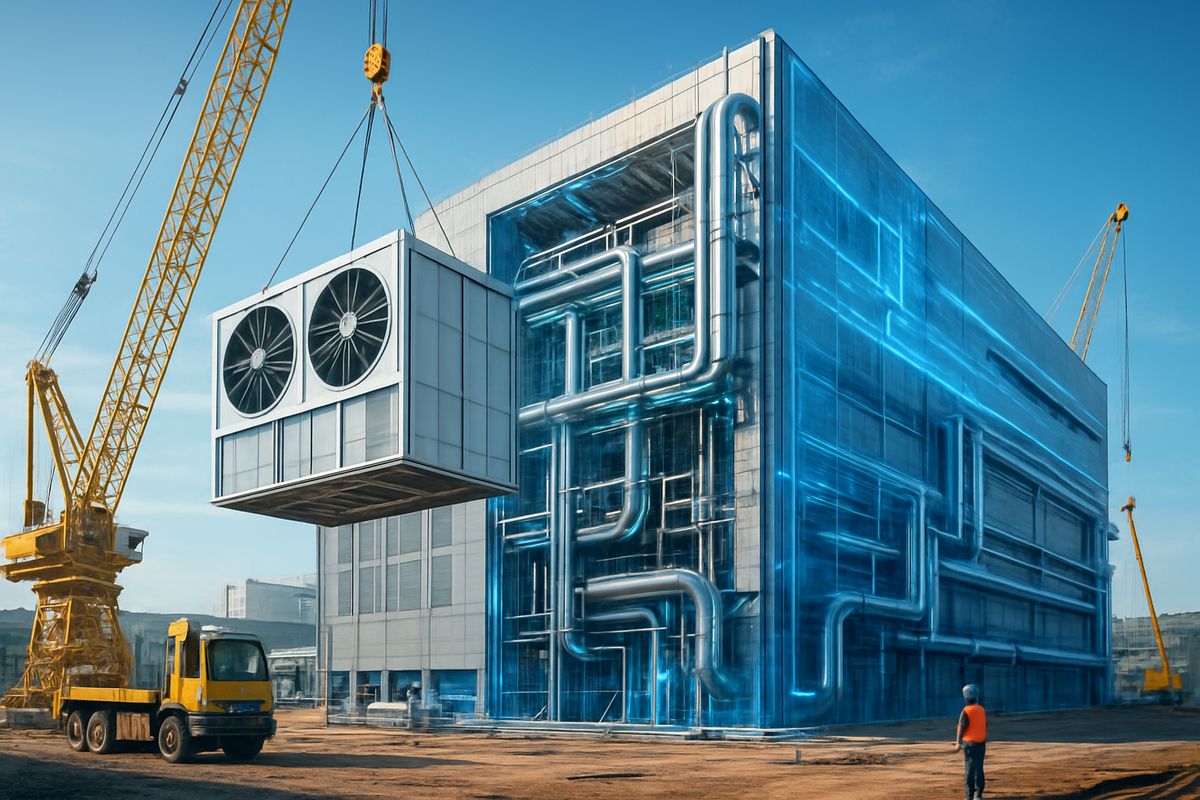
This shift has also catalyzed a move toward modularity. To circumvent chronic labor shortages and gridlock at construction sites, Comfort Systems announced it is expanding its modular manufacturing capacity from 3 million to 4 million square feet by the end of 2026. By building entire cooling skids and electrical rooms in controlled factory environments and shipping them to the site, the company is bypassing many of the logistical hurdles that have slowed down traditional construction.
Historically, the construction and MEP sectors were viewed as cyclical and low-margin. However, the current convergence of AI demand, domestic re-shoring of manufacturing, and the decarbonization of the energy grid has created a structural shift. This "triple threat" of demand drivers has decoupled firms like FIX from the broader real estate cycle, placing them squarely in the category of high-growth technology enablers.
Managing the Grid Constraints of 2026 and Beyond
Looking ahead, the primary challenge for Comfort Systems and its peers will not be a lack of demand, but the limitations of the physical world. Power grid constraints in major hubs like Northern Virginia and Dallas are forcing developers to seek "power-available" markets in secondary and tertiary cities. This geographic shift requires contractors to be more mobile and adaptable. Brian Lane noted that the company is increasingly involved in projects that include on-site power generation—such as natural gas fuel cells and Small Modular Reactors (SMRs)—to ensure their clients' facilities can actually turn on once built.
The short-term outlook remains extremely bullish, but investors are watching for potential "talent wars." With peak crew sizes on massive data center campuses now reaching 5,000 workers, the competition for skilled electricians and pipefitters is intense. Comfort Systems’ ability to maintain its record 16% margins will depend on its continued success in using modularity to reduce the total man-hours required on-site.
Strategic pivots may also be on the horizon as the industry looks toward 2030. There is a growing expectation that MEP firms will transition into long-term service and maintenance providers for the complex liquid-cooling systems they install. This would shift the revenue model from one-time construction fees to recurring, high-margin service contracts, further insulating the company from future economic downturns.
A New Era for Industrial Super-Growth
Comfort Systems USA’s blowout Q4 2025 earnings report marks a definitive moment in the industrial sector’s evolution. No longer just a proxy for the broader economy, the company has emerged as a vital pillar of the AI revolution. With a backlog that has doubled in a single year and a strategic shift toward high-tech modular manufacturing, FIX has demonstrated that "old economy" businesses can achieve "new economy" growth rates when they sit at the intersection of critical infrastructure and technological innovation.
Moving forward, investors should keep a close eye on the company's modular expansion and its ability to navigate the tightening labor market. The "industrial supercycle" Brian Lane described appears to have significant runway, but the execution risks associated with such rapid scaling remain. For now, Comfort Systems is proving that in the race to build the intelligence of the future, the companies providing the power and the cooling are just as essential as the ones designing the chips.
The market’s enthusiastic response on February 20 suggests that the "FIX" is in for a sustained period of outperformance as the world continues its frantic build-out of the digital frontier.
This content is intended for informational purposes only and is not financial advice.