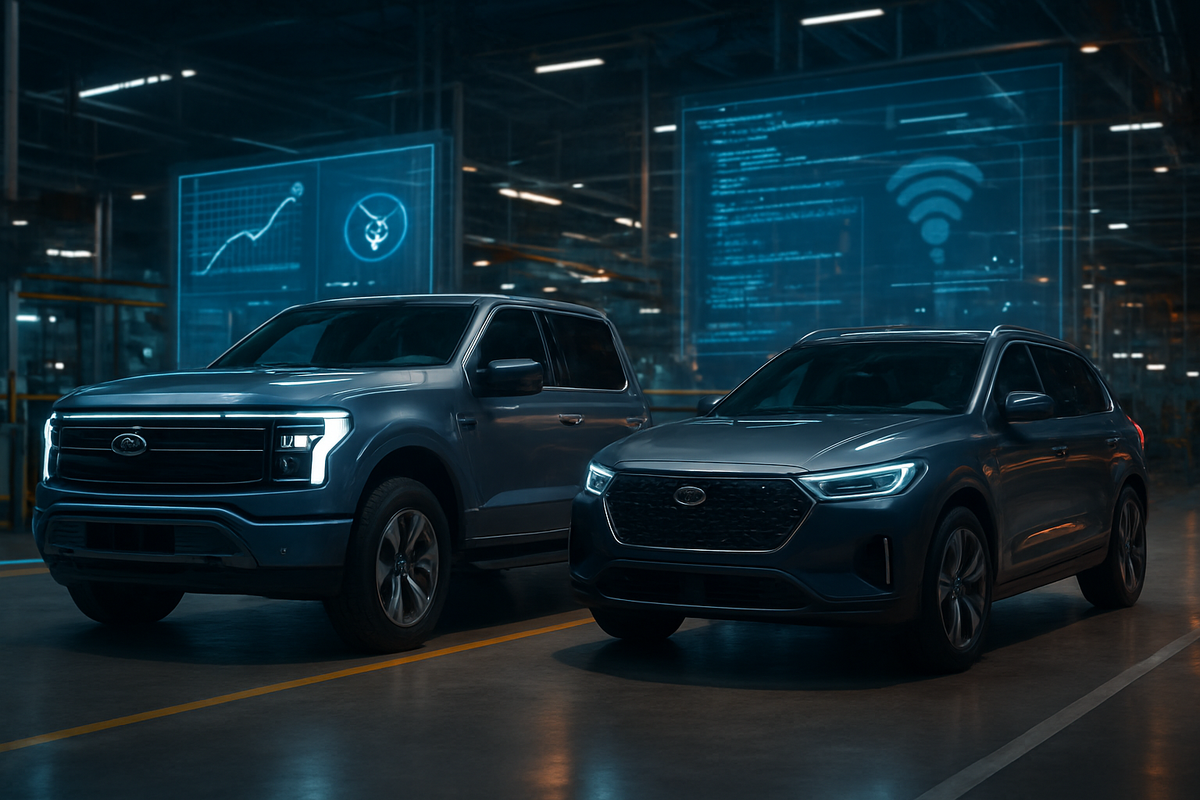
As the first full trading week of 2026 commences, the American automotive landscape finds itself in the midst of its most significant strategic realignment in decades. The "all-electric" fervor that defined the early 2020s has been replaced by a pragmatic doctrine of "powertrain pluralism," positioning General Motors (NYSE: GM) and Ford Motor Company (NYSE: F) as the primary beneficiaries of a market that is rediscovering the value of the internal combustion engine and the hybrid bridge. After a volatile 2025, investors are eyeing these Detroit giants not just as legacy manufacturers, but as restructured tech-and-truck powerhouses ready to capitalize on a cooling regulatory environment and a shift in consumer sentiment.
The immediate implications are clear: the "Big Two" have successfully navigated the "Valley of Death" for electric vehicles (EVs) by slowing their capital expenditure on money-losing battery programs and redirecting focus toward high-margin trucks and SUVs. This pivot, while costly in terms of short-term restructuring charges, has fortified their balance sheets against a backdrop of persistent high interest rates and an affordability crisis that has sidelined many first-time EV buyers. As of January 9, 2026, the market is rewarding this realism, with both stocks showing resilience compared to the pure-play EV sector.
The Trillion-Dollar Course Correction
The path to this moment was paved with massive financial write-downs and a total overhaul of manufacturing priorities. In late 2025, General Motors shocked the market by announcing a one-time charge of $6 billion to $7.1 billion to write down underperforming EV assets, effectively halting battery production at two major joint-venture plants. This was followed closely by Ford Motor Company, which took a staggering $19.5 billion restructuring charge for its "Model e" division. These moves signaled the end of the "EV-at-all-costs" era, as both companies realized that consumer demand was not scaling at the pace required to sustain their original 2030 and 2035 targets.
Throughout 2025, the industry faced a "perfect storm" of high interest rates and the expiration of federal EV tax credits on September 30, 2025. This led to a massive inventory glut of electric sedans and SUVs. In response, GM shifted its Detroit-Hamtramck "Factory Zero" back toward multi-energy production, while Ford officially canceled several pure-EV programs in favor of extended-range hybrids. The timeline of these events culminated in the current 2026 strategy: a "demand-responsive" model where production is dictated by real-time dealership data rather than aspirational government mandates.
Key players in this transition include GM CEO Mary Barra and Ford CEO Jim Farley, who have both pivoted from being EV evangelists to champions of "capital efficiency." Their leadership has been tested by the rise of international competition and the need to appease shareholders who grew weary of the billions poured into the "Model e" and "Ultium" losses. Initial market reactions in early 2026 suggest that investors are relieved; the focus has shifted from "how many EVs did you sell?" to "how much cash flow did your trucks generate?"
Winners and Losers in the New Hybrid Era
In this restructured market, the clear winners are the divisions that provide steady cash flow. Ford Pro, the commercial arm of Ford Motor Company, has emerged as a juggernaut, remaining the company's strongest earnings engine as we enter 2026. Its ability to provide fleet managers with a mix of diesel, hybrid, and electric options has made it immune to the retail EV slowdown. Similarly, GM’s focus on high-margin internal combustion engine (ICE) models, like the Cadillac Escalade and its full-size pickup lines, is expected to provide an $800 million boost to EBIT this year as the company avoids the loss-leading pricing of 2024-2025.
The losers in this scenario are the pure-play EV startups and, increasingly, Tesla (NASDAQ: TSLA). Tesla was officially dethroned by BYD (OTC:BYDDY) as the world’s largest EV manufacturer in late 2025, and it has entered 2026 fighting a brutal price war. In an attempt to defend its U.S. market share without federal tax credits, Tesla has resorted to 0% interest financing and 7-year payment plans—moves that have compressed its once-enviable margins. Meanwhile, smaller EV players like Rivian (NASDAQ: RIVN) and Lucid (NASDAQ: LCID) face an uphill battle as the "Big Two" use their massive scale to dominate the newly popular hybrid segment.
For GM and Ford, the "win" is also technological. GM is now generating approximately $2 billion in annual recurring revenue from its Ultifi software platform, offering features-on-demand like enhanced trailering and biometric access. Ford is following suit with its new AI Digital Assistant, launched just this week at CES 2026, which uses large language models to provide vehicle-specific intelligence. These software-defined vehicle (SDV) initiatives are creating higher-margin revenue streams that traditional auto sales never could.
A Structural Shift in Global Competition
The 2026 outlook is deeply influenced by broader industry trends and a significant regulatory shift. Following federal policy changes in late 2025, the U.S. Environmental Protection Agency (EPA) has adopted a "less combative" stance, granting Detroit the regulatory breathing room to delay aggressive EV transitions without facing the multi-billion dollar fines that were once feared. This policy shift is perhaps the single most important tailwind for GM and Ford as they enter the new year, allowing them to align their product cycles with actual consumer readiness.
However, a new threat looms in the form of the "Mexico Loophole." Chinese manufacturers like BYD and Xiaomi (OTC:XIACY) are increasingly using manufacturing bases in Mexico to bypass U.S. tariffs. While they have not yet flooded the American market, their global dominance in battery supply chains allows them to produce vehicles at a cost basis that Detroit still struggles to match. This has forced Ford to accelerate its BlueOval Battery Park in Michigan to produce cheaper LFP (lithium iron phosphate) cells, a move essential for its "Universal EV Platform" slated for 2027.
Historically, this moment mirrors the early 1980s, when American automakers had to radically downsize and modernize in the face of Japanese competition. The difference today is the "software layer." The competition is no longer just about horsepower or fuel economy; it is about who owns the digital ecosystem inside the car. The strategic initiatives seen in early 2026 suggest that GM and Ford have learned from history, choosing to build a profitable bridge rather than leaping into an electric abyss before the infrastructure and consumer are ready.
The Road Ahead: 2026 and Beyond
Looking forward, the next 12 to 24 months will be a period of intense execution. For General Motors, the priority is scaling its battery supply chain through partnerships like Lithium Americas (NYSE: LAC) to ensure long-term self-sufficiency. For Ford, the focus is on the 2027 launch of its affordable "Universal EV Platform," which aims to produce a midsize pickup at a price point that can finally compete with Chinese imports and Tesla’s entry-level models.
Strategic pivots will likely continue. We may see more "multi-energy" platforms where the same vehicle chassis can accommodate a gas engine, a hybrid setup, or a full battery-electric powertrain. This flexibility is the new "holy grail" of automotive manufacturing. The challenge for both companies will be managing the "affordability crisis"; with used-car inventories swelling and new-car prices remaining high, finding the "sweet spot" for the middle-class consumer will be the primary driver of market share in 2026.
Potential scenarios range from a "soft landing" where hybrid sales carry the companies to 2028's next-gen EV launches, to a more difficult path if energy prices spike or if Chinese manufacturers find a more direct way into the U.S. market. Regardless, the groundwork laid in the first week of 2026 suggests a more disciplined, profit-focused Detroit than we have seen in years.
Investor Wrap-Up: What to Watch
As the 2026 market begins, the key takeaway for investors is that the "Big Two" have successfully de-risked their portfolios. By taking massive write-downs in 2025, they have cleared the decks for a year of "clean" earnings growth driven by high-margin trucks and expanding software services. General Motors and Ford are no longer just betting on a green future; they are betting on a profitable present that funds a measured transition.
Moving forward, the market will be watching three critical indicators:
- Software Monetization: Can GM and Ford hit their targets for recurring SaaS revenue via Ultifi and BlueCruise?
- Hybrid Mix: Will the shift to "powertrain pluralism" capture the consumers who are currently shunning pure EVs?
- Inventory Levels: Can they maintain pricing power in a market where Tesla is aggressively cutting prices?
The significance of this moment cannot be overstated. After years of playing catch-up to the "Tesla model," Detroit has returned to its roots—focusing on the trucks that build America while quietly building the digital and hybrid infrastructure of the future. For the savvy investor, the 2026 automotive market is not about the fastest car, but about the most resilient business model.
This content is intended for informational purposes only and is not financial advice.