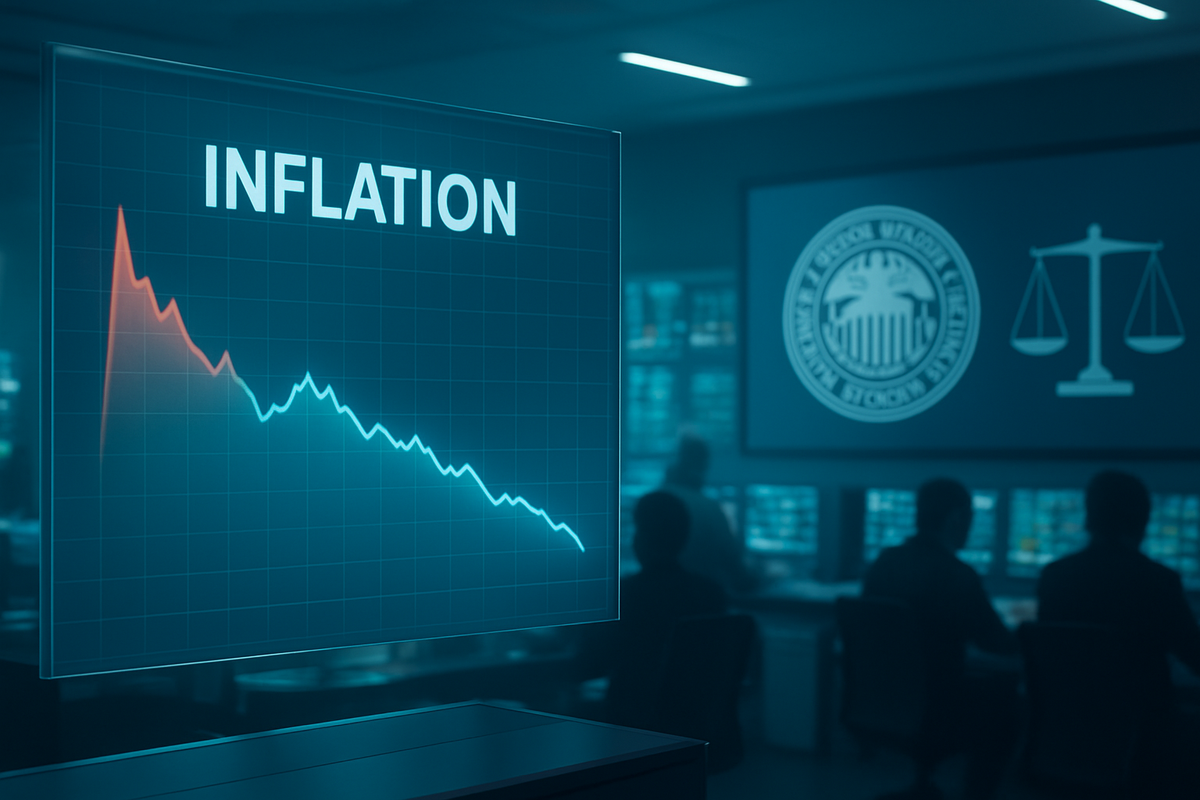
The release of the January Core Personal Consumption Expenditures (PCE) price index has provided a much-needed breath of fresh air for Wall Street, signaling that the Federal Reserve’s long battle against inflation may finally be entering its final act. The data, which arrived during a period of heightened geopolitical tension and post-shutdown economic recalibration, showed that core price pressures grew by a modest 0.2% on a monthly basis. This figure aligned perfectly with economist expectations and served as a critical "all-clear" signal for investors who had feared a resurgence in costs following late-2025 volatility.
For the broader market, the implications are immediate: the "soft landing" narrative—where inflation returns to the 2% target without a deep recession—is no longer just a hopeful theory but an increasingly likely reality. As the federal funds rate sits in the 3.50% to 3.75% range, the cooling PCE data has cemented expectations that while the Federal Reserve may pause at its current January meeting, the door remains wide open for multiple interest rate cuts throughout the remainder of 2026.
Economic Data Decoded: A Path to Stability
The specific data points released by the Bureau of Economic Analysis (BEA) on January 22, 2026, were part of a high-stakes "catch-up" report following a prolonged U.S. government shutdown that had previously blinded policymakers. The Core PCE, which excludes volatile food and energy prices, registered at 2.8% on a year-over-year basis. While this was a slight tick up from the 2.7% seen in the previous month’s delayed reporting, the monthly increase of 0.16% (rounded to 0.2%) was viewed by the market as "tame." Headline PCE also held steady at 2.8%, balanced by a 3.4% monthly drop in gasoline prices which offset stickier costs in the services sector.
The timeline leading up to this release was fraught with uncertainty. Throughout early January, markets were roiled by the "tariff scare," as the Trump administration floated 10% duties on European allies. However, the tone shifted dramatically following the World Economic Forum in Davos, where a "Greenland framework deal" and a softening of trade rhetoric began to lower the temperature. By the time the PCE data hit the tapes, investors were already looking for a reason to buy, and the evidence of stabilizing prices provided exactly that catalyst.
Key stakeholders, including Fed Chair Jerome Powell and Treasury officials, have been navigating a complex landscape where GDP growth remains surprisingly resilient at 4.4%. Initial market reactions were swift; the S&P 500 and Nasdaq saw immediate gains as the "inflationary spike" fears of 2025 dissipated. Bond yields, which had been climbing on deficit concerns, began to level off as the PCE report suggested that the Fed would not need to return to a hawkish stance to contain prices.
Corporate Impact: Tech and Homebuilders Lead the Charge
In the wake of this cooling data, the "Big Tech" sector has emerged as a primary winner. Companies like NVIDIA Corporation (NASDAQ: NVDA) and Apple Inc. (NASDAQ: AAPL) are highly sensitive to interest rate expectations; as the likelihood of future cuts increases, the present value of their future earnings becomes more attractive to investors. NVIDIA Corporation (NASDAQ: NVDA), in particular, saw its shares buoyed as the PCE data suggested that the capital-intensive AI build-out would not be choked off by a return to soaring borrowing costs.
The financial sector also saw a mixed but generally positive reaction. JPMorgan Chase & Co. (NYSE: JPM) stands to benefit from a resilient consumer and a stabilized interest rate environment that allows for healthy net interest margins without the specter of mass defaults. Conversely, the insurance and healthcare sectors faced headwinds. UnitedHealth Group Inc. (NYSE: UNH) saw its shares weighed down as investors rotated out of defensive "value" plays and into high-growth sectors, a trend exacerbated by specific regulatory concerns mentioned in recent earnings calls.
Furthermore, the housing market—a major component of the "stickiness" in inflation—is at a crossroads. Homebuilders like D.R. Horton, Inc. (NYSE: DHI) are viewed as potential winners; if cooling PCE data leads to a drop in the 10-year Treasury yield, mortgage rates are likely to follow, potentially unlocking a wave of pent-up demand from buyers who have been sidelined for years.
Global Significance and Historical Context
This PCE release fits into a broader global trend of "disinflationary normalization." After the chaotic price swings of the post-pandemic era and the energy shocks of the mid-2020s, the global economy is finally syncing back to a more predictable rhythm. The U.S. performance is particularly significant when compared to historical precedents like the "Volcker era" or the 1995 soft landing. Unlike those periods, the current cycle is being managed alongside unprecedented technological shifts in AI and a restructuring of global trade routes.
The potential ripple effects are significant for U.S. trading partners. The stabilization of U.S. inflation and the resulting "pause" by the Fed provides breathing room for the European Central Bank and the Bank of Japan to manage their own currency and interest rate policies without the constant pressure of a runaway U.S. dollar. However, the shadow of "Greenland diplomacy" and potential tariffs suggests that while inflation is cooling, the policy environment remains more volatile than in past decades.
From a regulatory standpoint, the cooling data may reduce the political pressure on the Federal Reserve. With an election cycle looming and the public sensitive to "cost of living" issues, a 2.8% Core PCE print—while not yet at the 2% target—is close enough to suggest that the current monetary policy is working. This reduces the likelihood of radical legislative interference in central bank independence, a topic that had gained traction during the higher-inflation periods of 2024 and 2025.
Looking Ahead: The March Pivot Debate
As we look toward the remainder of the first quarter of 2026, the short-term focus remains squarely on the Federal Open Market Committee (FOMC) meeting concluding on January 28. While a "hold" is nearly 95% priced in, the language used by Chair Powell will be scrutinized for a "March pivot." If the Fed acknowledges that the 0.2% monthly PCE trend is sustainable, the market may begin pricing in a 25-basis-point cut as early as the spring.
Strategic pivots will be required for corporate treasurers and institutional investors. The era of "higher for longer" appears to be transitioning into "steady for now," requiring a shift in cash management and debt issuance strategies. Companies that have been holding off on refinancing debt may see the next three to six months as a prime window to lock in rates before any potential volatility later in the year.
The potential for a "no-landing" scenario—where the economy continues to grow at 4%+ GDP while inflation stays stuck at 2.8%—remains a secondary risk. In this outcome, the Fed might be forced to keep rates at 3.5% for much longer than the market currently anticipates, potentially disappointing growth investors. Conversely, the "Greenland Framework" could accelerate a new wave of resource investment, providing a further boost to the industrial and energy sectors.
Conclusion: A Turning Point for Markets
The January PCE data release marks a pivotal moment in the 2026 economic calendar. By confirming that inflation is stabilizing despite the disruptions caused by a government shutdown and geopolitical posturing, the report has provided the market with a clear roadmap. The key takeaways are clear: price pressures are cooling, the consumer remains resilient, and the Federal Reserve has successfully avoided a hard landing—at least for now.
Moving forward, the market's trajectory will be defined by whether this 0.2% monthly inflation trend can be maintained as the energy price declines begin to lap themselves. Investors should keep a close watch on "supercore" inflation (services excluding housing) and the monthly jobs reports to see if the cooling in prices begins to manifest as a cooling in the labor market.
In summary, the relief felt on Wall Street is justified. While the road to 2.0% inflation remains long, the January data suggests that the worst of the inflationary era is in the rearview mirror. For investors, the coming months will be about navigating the nuances of a moderating economy where the quality of corporate earnings will once again become more important than the direction of the next Fed tweet.
This content is intended for informational purposes only and is not financial advice.