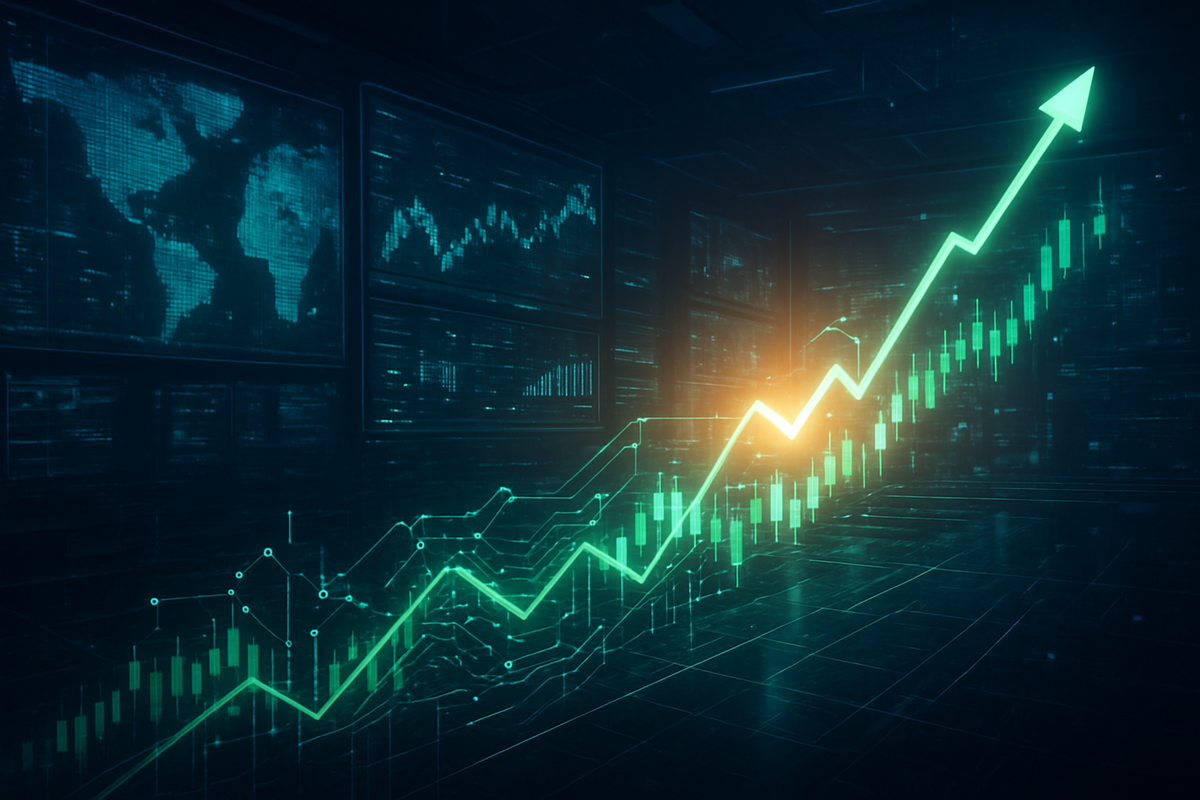
The global financial markets have kicked off 2026 with a decisive display of "New Year Cheer," shaking off a somber end to 2025 with a robust broad-based rally. On January 2, 2026, major indices across the globe surged as investors pivoted from the "valuation fatigue" of December toward a fresh narrative of artificial intelligence (AI) monetization and stabilizing fiscal policy. The S&P 500 snapped a four-day losing streak, while the Nasdaq Composite led the charge, signaling that the bearish sentiment that gripped the final weeks of 2025 may have been a temporary correction rather than a long-term trend.
This early-January rebound suggests a market that is increasingly resilient to the high-interest-rate environment of the past year. With the Federal Reserve holding rates in the 3.50% to 3.75% range and the "One Big, Beautiful Bill" Act (OBBBA) providing new tax certainties for corporations, the immediate implications are clear: institutional capital is rotating back into growth sectors, particularly those at the forefront of the "AI Second Wave."
The Pivot from Gloom to Glow
The transition from the bearish close of 2025 to the bullish start of 2026 was swift and, for many, unexpected. In the final weeks of December, the market faced a "perfect storm" of headwinds. High price-to-earnings ratios—exceeding 22 for the S&P 500—triggered widespread profit-taking, while a late-year U.S. government shutdown created a "data fog" that left investors flying blind on critical labor and inflation metrics. By December 31, major U.S. indices had suffered a painful four-day slide, leaving many to wonder if the bull run of 2025 had finally exhausted itself.
However, the opening bell of 2026 brought a dramatic shift in tone. The "January Effect"—a historical phenomenon where stocks, especially small-caps, tend to rise in the first month of the year—returned with a vengeance. On January 2, 2026, the S&P 500 (INDEXSP: .INX) rose by 0.7%, and the Nasdaq Composite (INDEXNASDAQ: .IXIC) climbed 1.3%. Internationally, the sentiment was even more electric; the FTSE 100 (INDEXFTSE: UKX) hit a historic milestone, topping the 10,000 mark for the first time in history, driven by a surge in mining and metal sectors. In Asia, the KOSPI (INDEXKRX: KOSPI) jumped 2.3%, led by massive demand for AI-related hardware.
The primary catalyst for this shift was a collective reinterpretation of the Federal Reserve's December minutes. While initially viewed as hawkish, analysts now suggest the Fed is preparing for at least two additional rate cuts in 2026. This, combined with the implementation of the OBBBA Act—which permanently extended corporate tax cuts and introduced full expensing for R&D—has provided the "fiscal floor" that investors were craving during the volatile final weeks of 2025.
Winners and Losers in the Rebound
The early-2026 rally has not been a "rising tide that lifts all boats" equally. Instead, it has been a selective surge, favoring companies with tangible AI integration and fortress-like balance sheets. Nvidia (NASDAQ: NVDA) led the tech charge, rising 2.8% as it prepares to unveil its new "Rubin" (R100) architecture at the upcoming CES 2026. Similarly, Micron Technology (NASDAQ: MU) and ASML Holding (NASDAQ: ASML) saw gains of 3% and 5%, respectively, as the demand for high-performance memory and lithography equipment continues to outpace supply.
In the financial sector, JPMorgan Chase (NYSE: JPM) emerged as a primary beneficiary of the stabilizing rate environment. Trading near all-time highs, the bank is being hailed for its ability to automate back-office functions through generative AI, targeting a staggering $95 billion in Net Interest Income for the year. Smaller digital disruptors like SoFi Technologies (NASDAQ: SOFI) also saw a lift, as the easing interest rate outlook improves the prospects for personal and student loan refinancing.
Conversely, some of the market's traditional heavyweights are facing significant headwinds. Apple (NASDAQ: AAPL), despite a modest 1.8% gain on Jan 2, is under intense scrutiny. Analysts warn that the 60% tariffs on Chinese imports, a cornerstone of 2025 trade policy, could add over $600 to iPhone production costs, threatening margins. Meanwhile, Tesla (NASDAQ: TSLA) struggled with a 1% dip as the repeal of the $7,500 federal EV tax credit created a "demand vacuum" for the first quarter of 2026. Small-to-mid-cap retailers are also feeling the pinch, with punitive tariffs on materials from the UK and India forcing price hikes that are cooling consumer activity.
A Historical Echo and Global Implications
The sharp January rebound of 2026 draws striking parallels to the market recoveries of 2019 and 2023. Much like the "Christmas Eve Crash" of 2018, which was followed by a 7.8% surge in January 2019, the current market is benefiting from a "Fed Pivot" narrative and the clearing of tax-loss harvesting sell-offs. This historical precedent suggests that when the market overreacts to year-end uncertainty, the correction is often followed by a period of aggressive "dip-buying" once the new fiscal year begins.
Broadly, this event fits into the 2026 trend of "Profitability over Promise." While 2024 and 2025 were defined by AI hype, 2026 is the year of mandatory compliance and measurable returns. The EU AI Act, set for full implementation in August 2026, is already forcing companies to shift their focus toward high-risk AI safety and documentation. This regulatory shift is creating a bifurcation in the market: companies that can afford the high cost of compliance are winning, while smaller, non-frontier tech firms are seeing their margins compressed.
Furthermore, the global trade landscape is undergoing a massive realignment. With the mandatory review of the USMCA (United States-Mexico-Canada Agreement) scheduled for July 2026, and a critical U.S.-China trade truce set to expire in November, the current "New Year Cheer" may be a window of opportunity before a more volatile second half of the year.
The Road Ahead: CES and Earnings Season
In the short term, all eyes are on the Consumer Electronics Show (CES) 2026, starting January 6. This event is expected to be a major catalyst for the semiconductor sector, as companies like Taiwan Semiconductor (NYSE: TSM) and Advanced Micro Devices (NASDAQ: AMD) showcase the next generation of AI-enabled hardware. Following CES, the Q4 2025 earnings season will serve as the first real "stress test" for the current rally. Investors will be looking for proof that the AI investments of 2025 are finally translating into bottom-line growth.
Long-term, the market must navigate the "Midterm Curse." Historically, U.S. midterm election years (like 2026) bring a period of pre-election drawdown as uncertainty over policy gridlock grows. Strategic pivots will be required for companies heavily reliant on global supply chains, as the "tariff-heavy" environment of 2026 appears to be a permanent fixture rather than a temporary negotiating tactic.
Market Wrap-Up and Investor Outlook
The first two trading days of 2026 have provided a much-needed sigh of relief for global investors. The primary takeaway is that the "AI Trade" is far from over, but it is becoming more sophisticated. The market is no longer rewarding mere potential; it is rewarding scale, compliance, and fiscal discipline. The record-breaking performance of the FTSE 100 and the resilience of the Nasdaq suggest that capital is abundant and looking for a home in a world where inflation is finally cooling.
Moving forward, the market is likely to follow a U-shaped volatility pattern. The first half of 2026 should remain pro-growth, supported by the OBBBA Act and AI infrastructure spending. However, the second half of the year will bring regulatory deadlines and geopolitical reviews that could test the market's mettle. For investors, the coming months should be a time for selective optimism—focusing on "fortress" companies that can navigate both the AI revolution and the new era of protectionist trade policy.
This content is intended for informational purposes only and is not financial advice