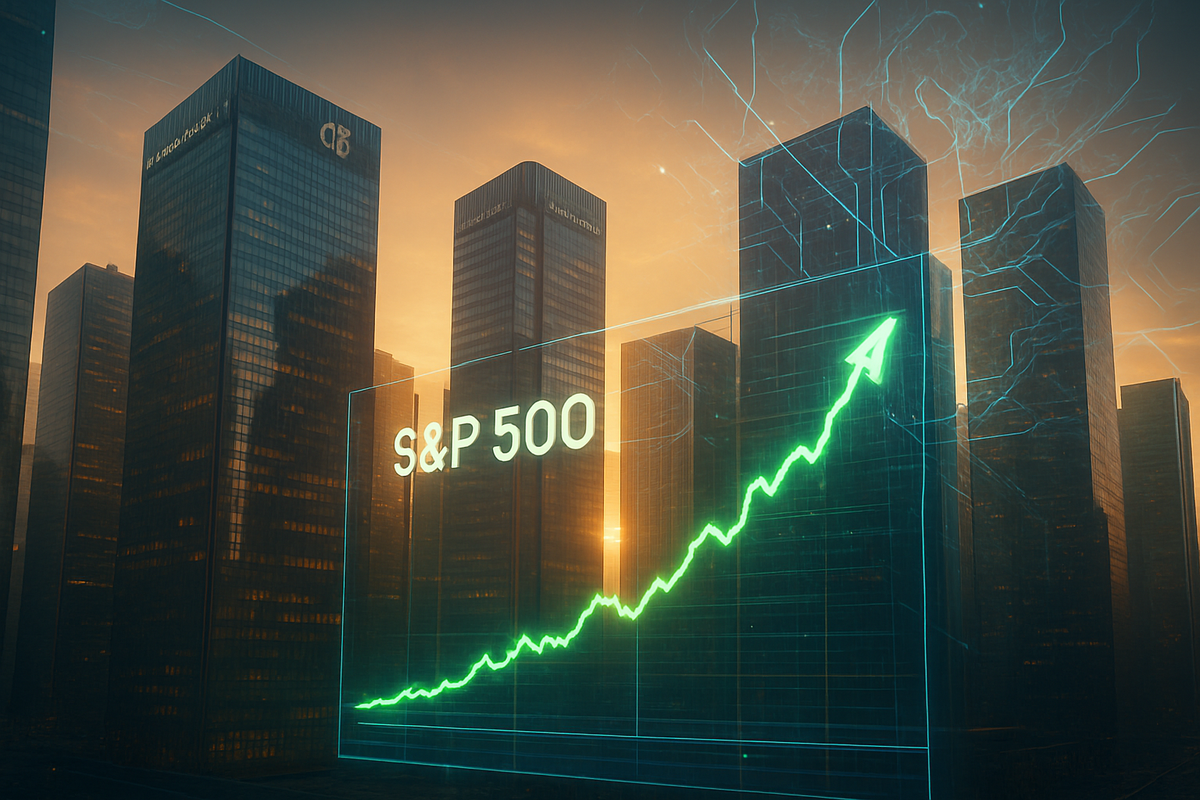
The S&P 500 index reached a historic milestone this week, scaling new all-time highs as a potent combination of robust fourth-quarter bank earnings and a rejuvenated technology sector propelled investor confidence. On January 16, 2026, the benchmark index touched an intraday peak of 6,994.55, flirting with the psychologically significant 7,000 barrier, before settling at a record closing high of 6,966.28. This surge marks a definitive start to the 2026 trading year, underpinned by the implementation of the "One Big Beautiful Bill Act" (OBBBA), a $285 billion fiscal stimulus package that has injected fresh liquidity into the domestic economy through retroactive tax cuts and immediate research and development expensing.
The market's ascent reflects a "Goldilocks" sentiment—growth that is resilient enough to justify record valuations but moderated by a stabilizing, albeit sticky, inflation rate of 2.7%. While the first half of January saw a brief "bank-led wobble" as investors locked in profits following early earnings beats, the broader trajectory remains decidedly bullish. Wall Street analysts point to the "second wave" of the Artificial Intelligence (AI) revolution and a significant expansion in investment banking activity as the primary engines driving this mid-winter rally.
The Path to 7,000: Banks and Big Tech Lead the Charge
The momentum began building in the final weeks of 2025, but the January 2026 rally was solidified by the traditional "First Call" of the earnings season. Major financial institutions, led by JPMorgan Chase & Co. (NYSE: JPM), delivered results that signaled a surprisingly healthy corporate environment. JPMorgan reported an adjusted earnings per share (EPS) of $5.23, handily beating the $4.86 consensus, with CEO Jamie Dimon projecting a staggering $103 billion in net interest income for the full year. This optimism was echoed by Bank of America (NYSE: BAC), which posted a "double beat" on both top and bottom lines, reporting revenue of $28.4 billion. Although Bank of America's shares saw a slight 2.4% dip on initial interest-rate sensitivity concerns, the strength of its consumer lending division provided a solid floor for the sector.
Simultaneously, the technology sector experienced a powerful rebound following a period of consolidation in late 2025. The catalyst was the 2026 Consumer Electronics Show (CES), where Nvidia (Nasdaq: NVDA) CEO Jensen Huang unveiled the "Vera Rubin" AI platform. This next-generation architecture, promising five times the inference speed of its predecessors, reignited the AI trade and pushed Nvidia’s market capitalization toward the $5 trillion mark. Microsoft (Nasdaq: MSFT) also provided a boost to the index as its AI Copilot adoption reached a critical mass of 150 million monthly active users, stabilizing its stock price above the key 200-day moving average and signaling a new phase of revenue reacceleration.
This rally has not been without its hurdles. The first two weeks of January saw high volatility as traders balanced the euphoria of new stimulus with the "Tariff Hangover" resulting from trade policies enacted in 2025. However, the market’s ability to shrug off these concerns and drive toward the 7,000-point threshold suggests a deep-seated institutional belief in the "Great Rotation"—a shift where value stocks and industrials are finally joining the high-flying tech giants in a more balanced, multi-sector advance.
Winners and Losers: A Market of Diverging Fortunes
While the headlines focus on the S&P 500's record highs, the rally has been uneven, creating a landscape of clear winners and struggling laggards. Among the victors, Alphabet Inc. (Nasdaq: GOOGL) has emerged as a standout, officially overtaking Apple Inc. (Nasdaq: AAPL) in market valuation this month to become the world’s second-most valuable company. Alphabet’s Gemini 3 AI model has been lauded as the industry leader, while the company’s core search and cloud businesses continue to benefit from the $285 billion stimulus-fueled consumer spending. Financial heavyweights like Goldman Sachs (NYSE: GS) and Morgan Stanley (NYSE: MS) also sit in the winners' circle, reporting a surge in M&A advisory fees as the global deal-making environment fully thawed in the first weeks of the year.
Conversely, the start of 2026 has been bruising for the former market darling, Apple Inc. (Nasdaq: AAPL). The tech giant suffered an eight-day losing streak in early January, plagued by a perceived "AI deficit" and a leadership transition that has left investors uneasy. Apple’s reliance on partnerships for AI integration, rather than proprietary breakthroughs, has led many to label it a "laggard" in the current cycle. Furthermore, rising component costs due to a global memory chip shortage—hitting peers like HP Inc. (NYSE: HPQ) and Dell Technologies (NYSE: DELL) just as hard—have put significant pressure on Apple’s hardware margins.
The retail sector has also seen significant casualties. Companies heavily dependent on Chinese imports are reeling from the 2025 "Liberation Day" tariffs, which have hit an effective rate of 18%. Target (NYSE: TGT) and Gap Inc. (NYSE: GPS) have both seen their shares tumble as they struggle to pass these increased costs to a consumer base that is becoming more price-sensitive. Perhaps the most dramatic fall has been Five Below (Nasdaq: FIVE), which saw its shares plummet over 20% this month as its low-price business model became unsustainable under the new tariff regime. In the defensive space, even stalwarts like PepsiCo (NYSE: PEP) and Hormel Foods (NYSE: HRL) have lagged, with the latter dropping significantly due to a combination of supply chain disruptions and avian-flu-related recalls.
Broadening the Horizon: AI Wave 2 and Fiscal Abundance
The significance of the January 2026 rally extends far beyond simple index levels; it represents a fundamental shift in the market’s structural drivers. We are currently witnessing "AI Wave 2," where the focus is shifting from purely building infrastructure—benefiting companies like Taiwan Semiconductor Manufacturing Company (NYSE: TSM)—to the actual monetization of AI services at scale. This shift is what allowed the S&P 500 to maintain its momentum even as interest rates remained steady. The market is no longer solely dependent on the Federal Reserve’s "pivot" to lower rates; rather, it is being powered by tangible productivity gains from AI integration across the healthcare, manufacturing, and financial sectors.
Furthermore, the "One Big Beautiful Bill Act" (OBBBA) has fundamentally altered the fiscal landscape. By restoring 100% bonus depreciation for capital equipment, the act has created a $30 billion surge in free cash flow for the technology "hyperscalers," allowing them to continue their aggressive infrastructure builds. This fiscal abundance has acted as a buffer against the 2.7% sticky inflation that might have otherwise spooked the market. Historically, such a combination of high fiscal spending and technological breakthroughs mirrors the mid-1990s, though today’s market is far more concentrated in its top-tier leadership.
The ripple effects are also being felt in the "real economy." Industrials and energy sectors are tracking closely with the broader index, boosted by a de-escalation of geopolitical tensions in the Middle East which saw WTI crude oil drop below $59 per barrel. This has provided much-needed relief to transportation and manufacturing firms. However, regulatory scrutiny remains a shadow over the rally; an ongoing anti-monopoly probe in China has hit international players like Trip.com (Nasdaq: TCOM), serving as a reminder that global policy shifts can still create localized volatility in an otherwise bullish market.
The Road Ahead: June Rate Cuts and $5 Trillion Targets
Looking forward, the market is bracing for a series of pivotal events in the second quarter of 2026. While the Federal Reserve is expected to hold the Federal Funds Rate steady for now, the overwhelming consensus among economists is for a quarter-point cut in June 2026. This anticipated easing of monetary policy, combined with the continued rollout of the OBBBA stimulus, could provide the necessary fuel to push the S&P 500 well past the 7,000 mark. Investors are also closely watching the Supreme Court, which is expected to rule on the legality of the 2025 tariffs by mid-year—a decision that will be make-or-break for the struggling retail sector.
Strategically, we expect to see more companies pivot toward "AI-First" business models to avoid the fate currently befalling Apple. The race for the first $5 trillion market cap between Nvidia and Alphabet will likely dominate financial headlines for the next six months. For the automotive sector, the road remains rocky. General Motors (NYSE: GM), having taken a $6 billion charge on its EV business this month, will need to show a significant strategic shift toward hybrid or high-margin internal combustion vehicles to regain investor trust as consumers cut back on premium discretionary spending.
Final Assessment: A Resilient but Selective Market
In summary, the record-breaking start to 2026 demonstrates the incredible resilience of the U.S. equity markets in the face of shifting trade policies and high interest rates. The S&P 500’s climb to the doorstep of 7,000 is a testament to the dual power of massive fiscal stimulus and a generational technological leap in AI. While the "Magnificent Seven" leadership is being reordered, the broadening of the rally into the financial and industrial sectors suggests a healthier market foundation than we saw in previous years.
For investors, the key takeaway is that the "tide that lifts all boats" era has ended. Moving forward, the market will be defined by extreme selectivity. Success will depend on identifying companies that can effectively monetize AI and those with the supply chain flexibility to navigate a high-tariff environment. As we move deeper into 2026, the focus will remain on the June Fed meeting and the ability of corporate America to maintain these record-high margins amidst a complex global landscape.
This content is intended for informational purposes only and is not financial advice.