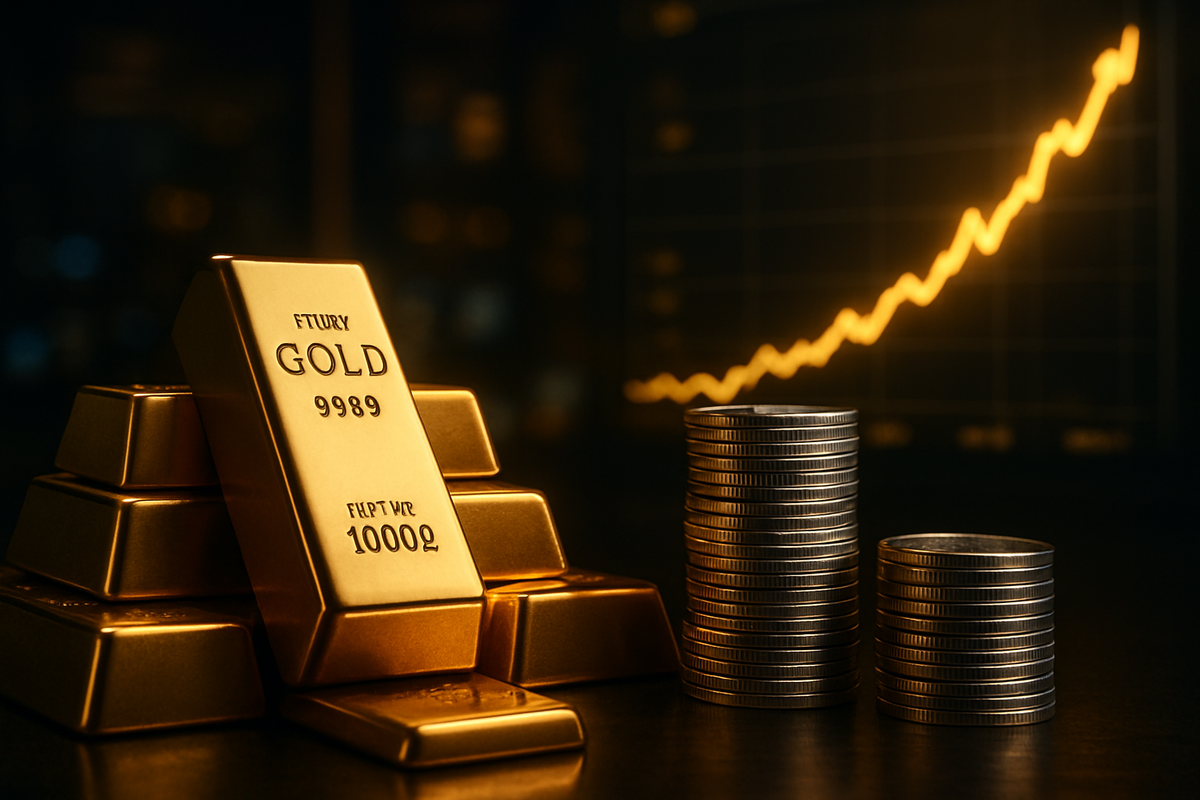
As of December 26, 2025, the global financial landscape is witnessing a historic realignment as gold and silver smash through long-standing psychological and technical barriers to reach record-breaking valuations. Spot gold has firmly established its presence above the $4,500 per ounce mark, while silver has undergone a parabolic transformation, trading near $75 per ounce. This surge represents more than just a momentary spike; it is a fundamental shift in the global monetary order, signaling a massive migration of capital away from fiat-denominated debt and toward tangible assets.
The immediate implications are profound. For the first time in the modern era, the total market value of gold held in global central bank reserves has surpassed the value of their U.S. Treasury holdings. This "de-dollarization" milestone has sent ripples through the currency markets, forcing institutional investors to recalibrate their portfolios as the traditional "60/40" stock-bond model continues to underperform against a backdrop of persistent inflation and mounting sovereign debt.
A Two-Year Ascent: The Path to $4,500 Gold
The journey to these record highs began in earnest during the final quarter of 2024, when gold broke its previous ceiling of $2,100 and never looked back. Throughout 2025, the rally accelerated, driven by a series of Federal Reserve interest rate cuts that brought the Federal Funds Rate down to a range of 3.75%–4.25%. This policy shift, intended to provide a "soft landing" for the U.S. economy, instead lowered the opportunity cost of holding non-yielding assets, providing the fuel for a massive breakout. On December 18, 2025, gold reached an all-time intraday peak of $4,562.70 per ounce, a staggering 60% increase over its late-2024 levels.
Silver’s performance has been even more dramatic, outshining gold on a percentage basis as it transitioned from a "forgotten metal" to an industrial necessity. Trading at approximately $75.14 per ounce as of today, silver has more than doubled its value in just 14 months. The rally was punctuated by a structural supply deficit that has plagued the market for seven consecutive years. Key stakeholders, including the central banks of Poland and China, have been the primary architects of this move, with Poland alone adding over 67 tonnes of gold to its reserves in the first half of 2025 as part of a strategic pivot toward a 30% gold-reserve allocation.
Mining Titans: Record Profits Amidst Operational Headwinds
The unprecedented rise in metal prices has transformed the balance sheets of the world’s largest miners, though the rewards have not been distributed equally. Newmont (NYSE: NEM), the world’s largest gold producer, reported a record $4.5 billion in free cash flow by the third quarter of 2025. The company’s stock has surged over 160% year-to-date as it successfully integrated its Newcrest acquisition, though it continues to grapple with rising All-In Sustaining Costs (AISC) which have climbed to approximately $1,630 per ounce due to inflationary pressures on labor and energy.
In the silver space, Pan American Silver (NYSE: PAAS) has emerged as a high-margin powerhouse. With silver prices at $75, the company’s AISC of roughly $15 per ounce has allowed for massive margin expansion, even as its Escobal mine in Guatemala remains offline due to ongoing regulatory consultations. Meanwhile, Wheaton Precious Metals (NYSE: WPM) has proven to be the most efficient way to play the rally. As a streaming company with fixed costs, WPM reported a staggering 54.7% net profit margin in 2025, as it benefited from the price surge without the direct burden of mining inflation.
However, the sector has not been without its casualties. Barrick Gold (NYSE: GOLD), despite a 181% gain in its share price, faced significant operational setbacks in 2025. The company was forced to suspend operations at its Loulo-Gounkoto complex in Mali following a bitter dispute with the military-led government over new mining legislation. This serves as a stark reminder that while the "gold rush" of 2025 has created immense wealth, geopolitical risk remains the primary threat to the supply of these critical metals. Agnico Eagle Mines (NYSE: AEM) has managed these risks more effectively, maintaining its status as a cost leader with an AISC of $1,300 per ounce, largely due to its focus on low-risk jurisdictions like Canada and its aggressive expansion of the Detour Lake mine.
The "Debt Trap" and the New Global Reserve
The wider significance of this rally lies in the decoupling of precious metals from traditional economic indicators. Historically, rising real yields were a death knell for gold; however, in 2025, gold and silver have rallied alongside positive real rates. This phenomenon is attributed to the "Debt Trap"—the realization among global investors that with $38 trillion in U.S. national debt, the Federal Reserve is mathematically unable to raise interest rates high enough to suppress inflation without triggering a fiscal collapse.
This environment mirrors the late 1970s, where mining stocks initially lagged the physical metal before "exploding" in a late-cycle catch-up. Unlike the 2011 peak, which was characterized by reckless corporate spending and "growth at any cost," the 2025 cycle is defined by extreme capital discipline. Companies like Newmont have instituted multi-billion dollar share buyback programs, choosing to return cash to shareholders rather than overpay for new projects. This shift in corporate strategy has allowed miners to provide the "leverage" to the gold price that investors have long sought but rarely found in previous cycles.
The Road Ahead: Scarcity and the Silver Super-Cycle
Looking toward 2026, the market is entering a phase of technical consolidation, but the long-term outlook remains bullish. The "industrial super-cycle" for silver is only just beginning. With the solar photovoltaic and electric vehicle sectors now consuming more silver than the global mining industry can produce annually, a structural squeeze is inevitable. Analysts predict that unless significant new supply is brought online—a process that takes a decade—silver could test the $100 mark before the end of the decade.
For gold, the focus will remain on central bank activity. If the trend of diversifying away from the U.S. dollar continues at its current pace, gold is expected to become the de facto anchor of a new, multi-polar global reserve system. The primary challenge for investors will be navigating the volatility that comes with record highs. Strategic pivots toward streaming companies and low-cost producers in stable jurisdictions will likely be the winning formula as the market adjusts to this new high-price environment.
Summary and Investor Outlook
The precious metals rally of 2024–2025 has rewritten the rules of the financial markets. Gold’s climb to $4,500 and silver’s surge to $75 have validated the "hard asset" thesis, providing a necessary hedge against currency debasement and geopolitical instability. Key takeaways include the unprecedented dominance of central bank buying and the return of capital discipline to the mining sector, with companies like Agnico Eagle Mines (NYSE: AEM) and Wheaton Precious Metals (NYSE: WPM) leading the way in efficiency.
Moving forward, the market appears poised for a sustained era of high valuations. Investors should closely monitor AISC trends among the major miners and keep a watchful eye on geopolitical developments in West Africa and South America. As the world grapples with a massive debt overhang, gold and silver have once again proven that they are the only assets that carry no counterparty risk—a quality that has become the ultimate premium in the 2025 economy.
This content is intended for informational purposes only and is not financial advice.