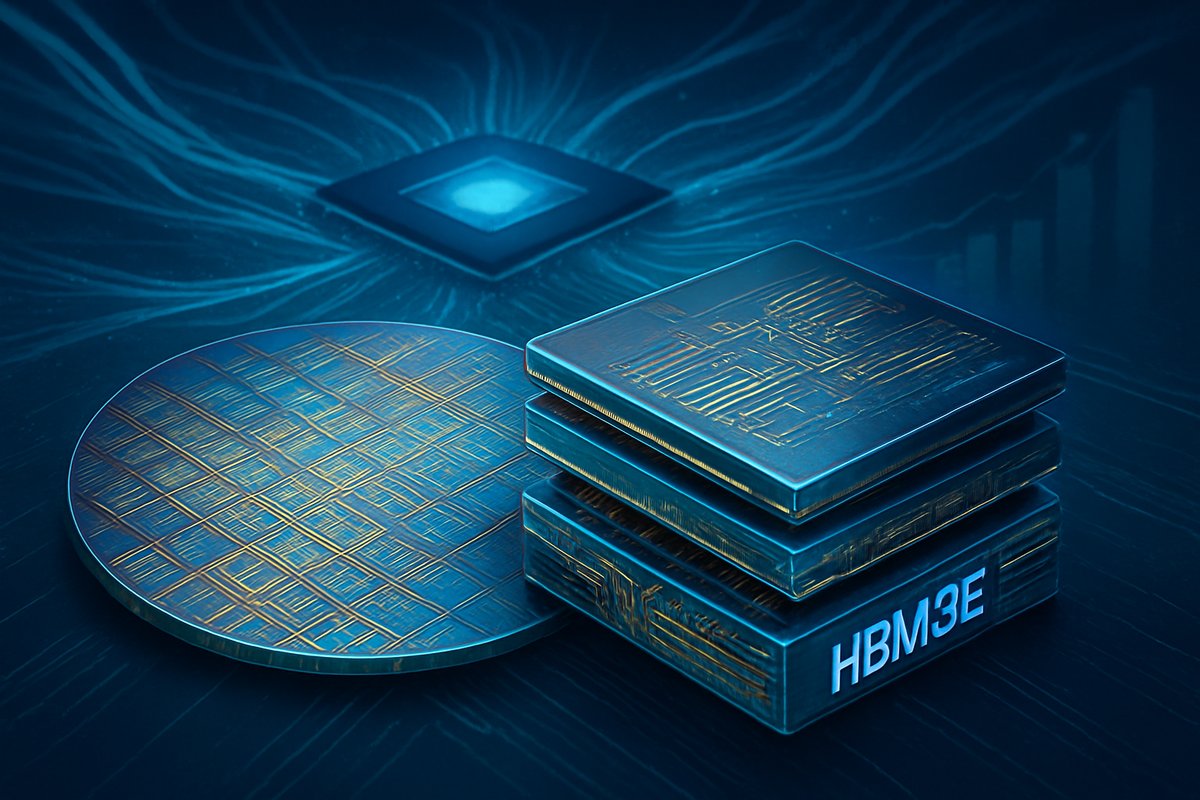
As the curtain closes on 2025, the semiconductor industry is reflecting on a year defined not just by the chips that process data, but by the memory that feeds them. Micron Technology (NASDAQ: MU) has completed a historic pivot, evolving from a cyclical producer of commodity RAM into the indispensable backbone of the generative AI revolution. By securing a massive slice of the High Bandwidth Memory (HBM) market, Micron has not only shattered the previous duopoly held by its Korean rivals but has also seen its valuation soar to heights once reserved for the likes of NVIDIA (NASDAQ: NVDA).
The immediate implications of this "HBM Boom" are profound. With HBM capacity sold out through the end of 2026, the industry is witnessing a structural shift in memory economics. The high-margin nature of these advanced stacks has pushed Micron’s gross margins toward a staggering 70%, effectively decoupling the stock from the traditional boom-and-bust cycles of the PC and smartphone markets. For the broader market, this surge signals that the "Memory Wall"—the bottleneck where data transfer speeds cannot keep pace with processor power—is finally being scaled, enabling the next generation of trillion-parameter AI models.
The Ascent of HBM3E: A Timeline of Micron’s Disruption
The road to Micron’s current dominance began in early 2024, a time when the company held a mere 4% of the HBM market. While SK Hynix (KRX: 000660) enjoyed an early lead as the primary supplier for NVIDIA’s H100 chips, Micron was quietly perfecting its HBM3E (High Bandwidth Memory 3 Extended) technology. The turning point occurred in early 2025, when Micron successfully ramped up volume production of its 12-high HBM3E stacks. These modules offered 36GB of capacity with 30% lower power consumption than competing products, a critical advantage for data center operators grappling with skyrocketing electricity costs.
Throughout 2025, the timeline of success was relentless. By the second quarter, Micron had captured 21% of the global HBM market, a meteoric rise that caught analysts by surprise. Key stakeholders, including NVIDIA CEO Jensen Huang and AMD (NASDAQ: AMD) CEO Lisa Su, publicly lauded the partnership with Micron as essential for their respective Blackwell and Instinct MI350 platforms. The market reaction was swift; Micron’s stock, which started 2024 at roughly $85, spent much of late 2025 trading near the $290 mark, representing a near-tripling of its market capitalization in less than two years.
Winners and Losers in the High-Stakes Memory Race
In the current landscape, Micron (NASDAQ: MU) stands as the undisputed winner of the 2025 memory shift. By focusing on power efficiency and density, they have become a "preferred" vendor for NVIDIA’s ultra-high-end GB200 systems. Joining them in the winner's circle is NVIDIA (NASDAQ: NVDA), which has secured a stable, diversified supply chain for its most advanced GPUs, and Advanced Micro Devices (NASDAQ: AMD), which utilized Micron’s 12-layer HBM3E to power its Instinct MI350X accelerators, allowing it to remain competitive in the high-end AI compute market.
Conversely, the "losers" are those who failed to keep pace with the rapid architectural shifts. Samsung Electronics (KRX: 005930) has found itself in a difficult position; despite its massive scale, it struggled with yield issues on its 12-high HBM3E throughout 2025, leading to lost orders and a shrinking market share in the premium AI segment. While SK Hynix (KRX: 000660) remains a formidable leader and a primary partner for many, it no longer enjoys the near-monopoly it held in 2023. The increased competition from Micron has forced SK Hynix into a margin war that has slightly dampened its once-unrivaled profitability in the HBM sector.
The "3-to-1" Squeeze and the New Industrial Trend
The significance of the HBM boom extends far beyond a single company's balance sheet. It represents a fundamental change in how silicon wafers are utilized. HBM production requires approximately three times the wafer capacity of standard DDR5 memory to produce the same number of bits. This "3-to-1" squeeze has created a systemic shortage of traditional DRAM for PCs and servers, driving up prices across the entire semiconductor sector. This trend has benefited other players like Western Digital (NASDAQ: WDC) and Seagate (NASDAQ: STX), as the rising tide of data center storage needs coincides with the memory crunch.
Historically, the memory industry was viewed as a commodity business, but HBM has turned it into a specialty logic business. This shift is drawing the attention of regulators and policymakers who now view high-end memory as a strategic national asset. The U.S. government’s CHIPS Act funding for Micron’s facilities in New York and Idaho has been vindicated by this boom, as domestic production of HBM is now seen as vital for AI sovereignty. This mirrors the historical precedent of the 1980s semiconductor wars, but with a modern twist: the battle is no longer about who can make the most chips, but who can make the most efficient "brain food" for AI.
The Road to HBM4 and Custom Silicon
Looking ahead to 2026, the focus is shifting toward HBM4. This next generation of memory will feature a 2048-bit interface, doubling the bandwidth of current HBM3E solutions. Micron has already begun sampling HBM4 for NVIDIA’s upcoming "Rubin" architecture. A strategic pivot is also underway: the transition to "Custom HBM." In this scenario, the base logic die of the memory stack is customized for specific AI accelerators, a move that will see Micron collaborating more deeply with foundries like Taiwan Semiconductor Manufacturing Company (NYSE: TSM).
The short-term challenge for Micron will be managing the transition from its proprietary 1-beta process to the even more advanced 1-gamma nodes required for HBM4. While the demand remains insatiable, the risk of over-expansion looms. If hyperscalers like Meta (NASDAQ: META) or Alphabet (NASDAQ: GOOGL) eventually slow their AI infrastructure build-outs, the industry could face a supply glut. However, with current orders locked in through 2026, that scenario appears unlikely in the immediate future.
Final Thoughts: A New Era for Investors
The Micron HBM boom of 2025 marks the end of the "commodity era" for memory. Micron has successfully repositioned itself at the top of the value chain, proving that innovation in memory is just as critical as innovation in compute. The key takeaway for investors is that the AI trade has matured; it is no longer just about the GPU makers, but about the entire ecosystem that enables high-performance computing.
Moving forward, the market will be watching for Micron’s ability to maintain its yield rates on HBM4 and its success in the emerging "Custom HBM" market. As we enter 2026, the semiconductor sector remains the primary engine of global equity growth, with Micron Technology firmly established as one of its most powerful cylinders. Investors should keep a close eye on quarterly "bit shipment" growth and any signs of cooling in data center capital expenditures, though for now, the AI memory gold rush shows no signs of slowing.
This content is intended for informational purposes only and is not financial advice.