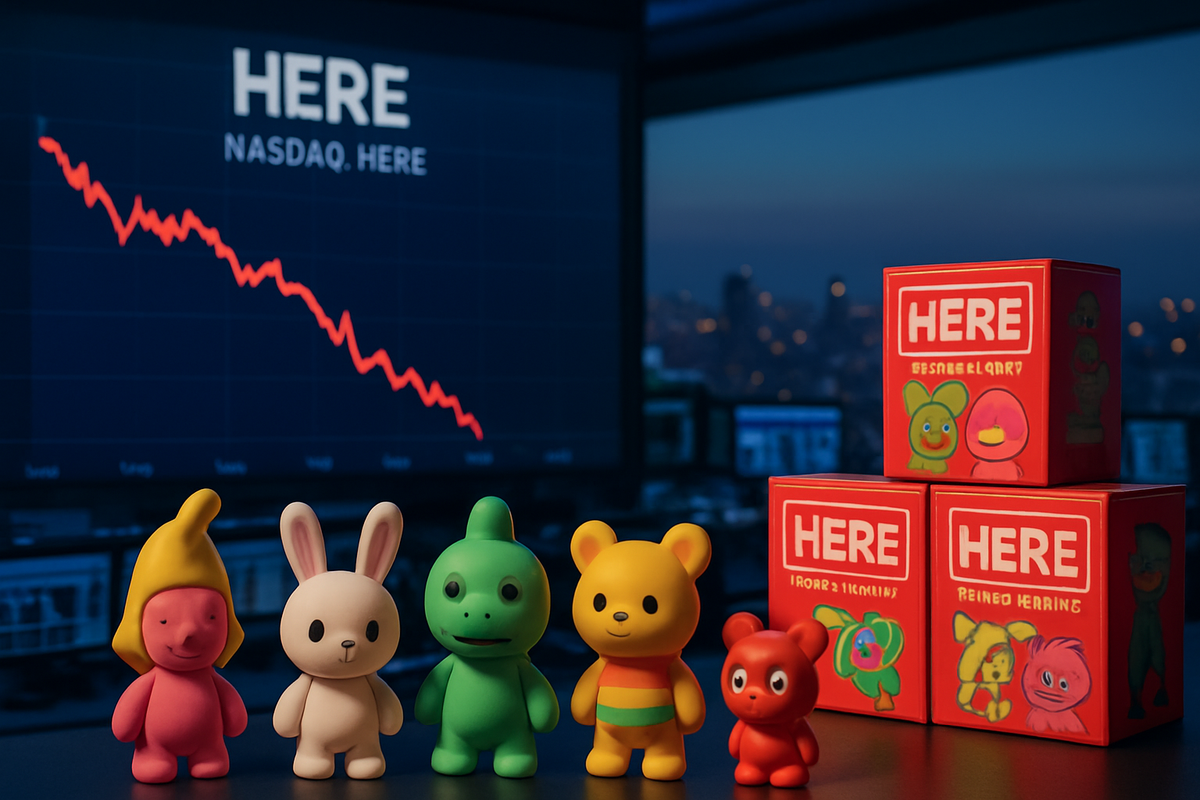
The financial markets often move on sentiment rather than spreadsheets, and few companies embody this paradox in late 2025 more than Here Group (NASDAQ: HERE). Despite reporting a staggering 93.3% quarter-over-quarter revenue surge in its core collectible segment and maintaining a balance sheet flush with over $110 million in net cash, the company’s stock has plummeted 43% from its post-rebrand peak in November. As of December 25, 2025, the shares are languishing near the $5.40 mark, leaving investors to wonder if they are witnessing a falling knife or the buying opportunity of a lifetime.
The immediate implication of this sell-off is a widening "valuation gap" that has puzzled Wall Street analysts. While the company has successfully pivoted from its legacy as an adult education provider to a high-growth "pop toy" powerhouse, the market appears to be struggling with the transition. The aggressive decline suggests a crisis of identity among institutional holders, even as the company's operational engines—led by the breakout success of its WAKUKU brand—are firing on all cylinders.
A Pivot in the Spotlight: From Education to Emotion
The story of Here Group (NASDAQ: HERE) is one of radical transformation. Formerly known as QuantaSing Group Limited (NASDAQ: QSG), the company officially changed its name and ticker on November 11, 2025. This rebranding was not merely cosmetic; it marked the culmination of a year-long strategic shift away from the "Silver Economy" (adult education and wellness) toward the "Emotional Economy" of collectible toys. The pivot was driven by the explosive demand for "kidult" culture in China, a market that reached an estimated RMB 110 billion this year.
The timeline of the current volatility began in early December, following the release of the company’s Q1 FY2026 earnings. While the figures were objectively strong—showing a 93.3% jump in pop-toy revenue to $17.9 million—investors were spooked by the details of the divestiture of the company's legacy EdTech assets. Here Group sold its subscription-based education segments for approximately $25.5 million, a price tag that many retail investors perceived as a "fire sale." This perception, combined with the removal of $54.6 million in liabilities, created a complex financial picture that led to a massive sell-off as short-term traders exited their positions.
Key stakeholders, including CEO Peng Li, have maintained a bullish stance, emphasizing the improved asset-to-liability ratio, which jumped from 2.2x to 4.3x post-restructuring. However, the market’s initial reaction was one of skepticism. The stock, which had touched a high of $15.64 earlier in the year as a legacy entity, failed to find a floor at its $9.50 post-rebrand level, eventually sliding to its current valuation. The decline was further exacerbated by a general cooling in the Chinese consumer discretionary sector, though Here Group’s specific drop far outpaced its peers.
Winners, Losers, and the Battle for the Shelf
In the high-stakes world of collectible toys, Here Group’s primary rival is the industry titan Pop Mart (HKG: 9992). While Pop Mart has seen its own share of volatility in 2025, it remains the dominant player with its "Labubu" and "Molly" IPs. However, Here Group has carved out a unique niche that positions it as a potential "winner" in the long term. By positioning its flagship brand, HERE Dream Island, as a more accessible and "ready-to-buy" alternative to Pop Mart’s scarcity-driven "blind box" model, Here Group is capturing a segment of the market that is weary of the addictive nature of mystery packaging.
Another major player affected by this shift is Miniso Group Holding Ltd (NYSE: MNSO). Here Group’s subsidiary, Shenzhen Yiqi Culture, has leveraged a deep strategic partnership with Miniso to distribute its WAKUKU line across a global network of over 7,900 stores. This partnership has turned WAKUKU into a "Budget Labubu," allowing Here Group to penetrate lower-tier cities in China and Southeast Asian markets where Pop Mart’s premium pricing remains a barrier. For Miniso, the success of Here Group’s IPs provides high-margin "anchor" products that drive foot traffic, making them a clear beneficiary of Here Group's operational growth, regardless of the latter's stock price.
Conversely, the "losers" in this scenario are the legacy EdTech investors who failed to rotate their portfolios during the rebranding. The 43% drop represents a painful recalibration for those who valued the company based on its old subscription models. Furthermore, smaller, independent toy designers who lack the manufacturing and distribution scale of Here Group are finding it increasingly difficult to compete with the "WAKUKU" phenomenon, which sold over 1 million units of its "Fox-Rabbit Mischief Diary" series in just a few months.
The "Supportive-Yet-Strict" Regulatory Landscape
The current event fits into a broader trend of "consumption upgrading" in China, where the government is actively seeking new growth drivers to replace the cooling real estate sector. In November 2025, the Ministry of Industry and Information Technology officially designated "collectible toys" as a priority support category. This regulatory tailwind is a significant tailwind for Here Group, providing a level of policy protection that its previous EdTech business—which faced the "Double Reduction" crackdown years ago—never enjoyed.
Historically, the market has often punished companies undergoing such massive pivots. Similar precedents can be found in the early 2000s tech boom or more recently with companies transitioning into the AI space; the market typically demands several quarters of consistent "pure-play" performance before it awards a new valuation multiple. The current 43% drop in Here Group's stock mirrors the "trough of disillusionment" often seen in Gartner's Hype Cycle, where the initial excitement of a new strategy gives way to the hard reality of execution and financial reporting.
Furthermore, the integration of AI into toys—a field Here Group is actively exploring—represents a new frontier. As the AI toy market in China reached RMB 29 billion in 2025, Here Group’s clean balance sheet and high cash reserves give it the "dry powder" needed to acquire AI startups or develop smart features for its WAKUKU line. This technological shift could redefine the industry, moving toys from passive collectibles to interactive companions, a transition that could eventually force a massive re-rating of the entire sector.
What Comes Next: Closing the Valuation Gap
In the short term, Here Group (NASDAQ: HERE) must focus on "investor education" to bridge the gap between its strong fundamentals and its lagging share price. The market will be looking for the Q2 FY2026 results to confirm that the 93% growth in the pop toy segment was not a one-time fluke but a sustainable trend. If the company can maintain its 41.2% gross margins while continuing its international expansion through Miniso (NYSE: MNSO), the current $5.40 price point may soon look like an anomaly.
A potential strategic pivot could involve a more aggressive move into the "plush" category, which has seen 1,200% growth industry-wide this year. While WAKUKU has already made inroads here, there is room for Here Group to develop higher-end "limited edition" plushies to challenge Pop Mart (HKG: 9992) at the premium level. Additionally, any announcement regarding a stock buyback program—supported by their $110 million cash pile—could serve as a powerful catalyst to arrest the share price decline and signal management's confidence to the street.
Final Assessment: A Buying Opportunity in Disguise?
The 43% drop in Here Group’s stock is a classic example of market "indigestion" following a corporate metamorphosis. The company has successfully shed its legacy liabilities, pivoted into a government-supported high-growth industry, and launched a breakout IP that is already generating significant revenue. Yet, the stock is being traded as if the company is still in the crosshairs of the EdTech crackdown.
For investors, the key takeaways are clear: the fundamentals are robust, the cash position is a safety net, and the operational growth is undeniable. However, the market is currently prioritizing the "narrative" of a messy divestiture over the "reality" of a profitable toy business. As the company continues to report as a pure-play entity in the coming months, the disconnect between the stock price and the balance sheet is likely to narrow. Investors should keep a close eye on WAKUKU’s international sales figures and any further regulatory updates from Beijing, as these will be the primary drivers of the stock’s eventual recovery.
This content is intended for informational purposes only and is not financial advice.