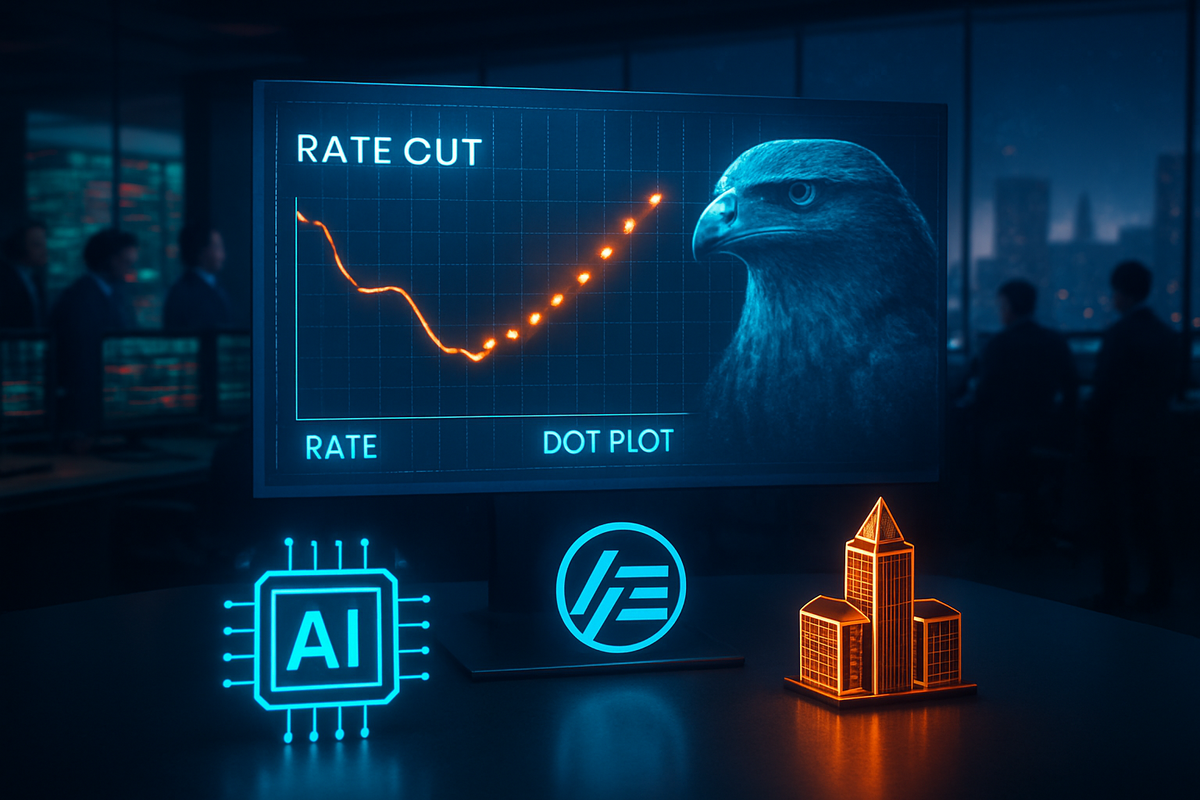
As the holiday lights twinkle across Wall Street this December 25, 2025, investors are unwrapping a complex gift from the Federal Reserve. Earlier this month, the Federal Open Market Committee (FOMC) delivered its third consecutive 25-basis-point rate cut, lowering the benchmark federal funds rate to a target range of 3.50% to 3.75%. While a rate cut is traditionally a cause for celebration, this particular move has been labeled a "hawkish cut," sending a chill through the futures market and signaling a starkly different economic landscape for 2026.
The immediate reaction was one of confusion and caution. Although the S&P 500 managed to scrape together a "Santa Claus Rally" to hit record highs of 6,932.05 by Christmas Eve, the underlying "Dot Plot" projections revealed a central bank that is far more concerned about sticky inflation and robust growth than the market had anticipated. By signaling that the "Pivot Party" may be nearing an early end, the Fed has forced a massive repricing of risk for the coming year.
The 9-3 Split: A House Divided and a Data Blackout
The December 9–10 meeting was marked by a level of internal friction not seen in years. In a rare 9-3 split vote, the committee appeared deeply divided on the path forward. While the majority led by Chair Jerome Powell favored the 25-basis-point reduction, the dissenters highlighted the growing uncertainty within the Eccles Building. Stephen Miran advocated for a more aggressive 50-basis-point cut to get ahead of "cracks" in the labor market, while Jeffrey Schmid and Austan Goolsbee voted to hold rates steady, citing fears that inflation remains too "stubborn" to justify further easing.
Compounding the tension was a 43-day government shutdown that occurred earlier in the fourth quarter of 2025. This shutdown delayed critical reports from the Bureau of Labor Statistics (BLS) and the Bureau of Economic Analysis (BEA), leaving the Fed to "fly blind" during one of the most critical junctures in recent history. Relying on private-sector proxies and "noisy" data, Powell admitted that the Fed was navigating a "challenging tension" between its dual mandates. The revised Summary of Economic Projections (SEP) shocked the market by raising the 2026 median "dot" to 3.4%, implying only one additional cut for the entirety of next year—a sharp reduction from the four cuts previously expected by futures traders.
Winners and Losers: The Yield Curve Shift
The shift toward a "higher-for-longer" floor has created a distinct divide between market winners and losers. Large-cap financial institutions like JPMorgan Chase & Co. (NYSE: JPM) and The Goldman Sachs Group, Inc. (NYSE: GS) have emerged as resilient beneficiaries. While lower rates typically compress net interest margins, the Fed’s "soft landing" narrative and the steepening of the yield curve have stimulated a resurgence in mortgage applications and corporate debt issuance. JPMorgan shares traded near all-time highs this week, supported by analysts who believe the bank is well-positioned for a 2026 recovery.
Conversely, rate-sensitive sectors like real estate have felt the sting of the Fed's hawkish tone. American Tower Corporation (NYSE: AMT) hit a 52-week low of $172.50 in mid-December, as the prospect of sustained high borrowing costs weighed on the capital-intensive infrastructure giant. In the technology sector, the reaction was more nuanced. Nvidia Corp (NASDAQ: NVDA), which recently became the world’s first $5 trillion company, saw a 3% bounce as the market shifted its focus from AI hardware to the "AI productivity" phase. Similarly, Microsoft Corp (NASDAQ: MSFT) reached record levels, with investors betting that the company’s Azure and Copilot services will drive significant earnings growth regardless of the Fed's pace.
A Wider Significance: The "AI Utility" Phase and Fiscal Friction
This "hawkish cut" marks a broader transition in the global economy. The Fed’s decision to upgrade its 2026 GDP growth forecast to 2.3% reflects a belief that the U.S. economy is entering a period of enhanced productivity, largely driven by the integration of artificial intelligence across healthcare, logistics, and manufacturing. However, this optimism is tempered by the looming threat of "tariff pass-through" inflation. Powell’s comments regarding potential trade policies from the Trump administration suggest the Fed is bracing for a one-time price level shift that could keep inflation near 2.5%, well above the 2% target.
Furthermore, the Fed is now operating in the shadow of the "One Big Beautiful Bill Act" (OBBBA), a massive fiscal stimulus package that has injected significant liquidity into the market. This fiscal-monetary friction is a historical rarity; usually, the Fed and the Treasury move in the same direction. Today, the Fed is attempting to tap the brakes with a "hawkish" stance while the government keeps its foot on the gas. This creates a "valuation floor" shock for investors who were hoping for a return to the zero-interest-rate era.
The Road to 2026: Pacing the Final Descent
Looking ahead to the first quarter of 2026, the market is bracing for a "wait-and-see" period. While firms like Morgan Stanley (NYSE: MS) predict at least two more cuts in early 2026, others, including JPMorgan, expect the Fed to pause as early as January. The primary challenge for the Fed will be determining the "terminal rate"—the point where interest rates are neither stimulative nor restrictive. If inflation remains sticky due to trade tensions, the Fed may be forced to hold rates at 3.5% for much of the year, potentially stalling the recovery in housing and small-cap stocks.
Investors should watch for the "broadening out" of the market. As capital moves away from the "Magnificent Seven" and into industrials and financials, the success of the 2026 market will depend on whether earnings growth can outpace the cost of capital. Strategic pivots will be required for companies that relied on cheap debt; the era of "easy money" is officially over, replaced by an era of "earned growth."
Final Thoughts for the 2026 Investor
The Federal Reserve’s December 2025 decision is a reminder that the path to price stability is rarely a straight line. By delivering a "hawkish cut," the Fed has signaled that while it is willing to support the economy, it will not risk a resurgence of inflation for the sake of market sentiment. The 9-3 split and the data distortions from the government shutdown suggest that 2026 will be a year of high volatility and intense scrutiny of every economic data point.
For investors, the key takeaway is that the "soft landing" is largely priced in, but the "higher-for-longer" floor is not. Moving into the new year, the focus must shift from Fed-watching to fundamental analysis. The winners of 2026 will be those with strong balance sheets and the ability to capitalize on the AI-driven productivity boom. As we look toward the January FOMC meeting, the market will be searching for any sign that the Fed is ready to finish what it started—or if this Christmas surprise was just the beginning of a long, cold winter for rate-cut enthusiasts.
This content is intended for informational purposes only and is not financial advice.