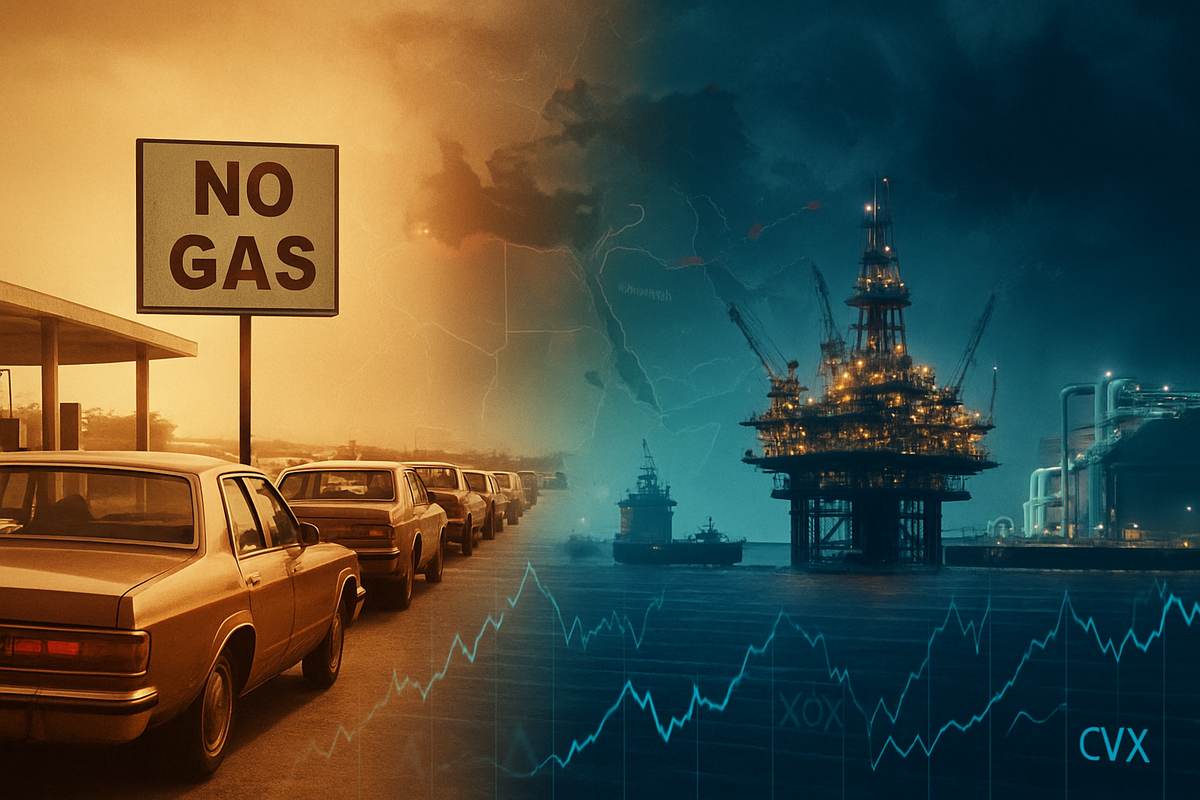
As of December 23, 2025, the global energy market is grappling with a sense of profound déjà vu. Decades after the fuel lines and stagflation of the 1970s, a toxic cocktail of international disagreements, naval blockades, and supply chain fragility has once again pushed energy security to the forefront of the global agenda. While the raw price of Brent crude has hovered in a volatile range between $59 and $62 per barrel this month—down from the triple-digit highs seen in years prior—the underlying instability of the market suggests that the era of "cheap and easy" energy has been replaced by a permanent state of geopolitical friction.
The immediate implications are stark: a "commodity shock" is no longer a localized event but a global contagion. In late 2025, the market is being pulled in two directions. On one side, a massive U.S. naval blockade of sanctioned Venezuelan oil has effectively removed nearly 800,000 barrels per day from the global supply, leaving tankers idling at sea. On the other, a fragile optimism regarding a peace deal in the Russia-Ukraine conflict has kept prices from spiraling, as traders bet on the eventual return of Siberian crude to Western markets. This tug-of-war between supply destruction and diplomatic hope has created a "volatility trap" for investors, reminiscent of the 1973 and 1979 crises.
The 2025 Disruption: A Multi-Front Energy War
The current crisis reached a fever pitch in early December 2025, when the OPEC+ alliance, led by Saudi Arabia and Russia, announced a "calibrated pause" in production increases. After a modest hike of 137,000 barrels per day to close out the year, the group signaled it would freeze output through the first quarter of 2026. This move was a defensive crouch against a looming "oil glut" predicted by the International Energy Agency (IEA), yet it coincided with fresh escalations in the Middle East. Following a brief period of calm, renewed tensions between Israel and Iran have injected a "war risk premium" back into energy futures, with Israeli officials reportedly briefing the U.S. on potential strikes against Iranian energy infrastructure.
Simultaneously, the physical movement of energy has become a high-stakes game of maritime chess. While shipping giants like A.P. Moller - Maersk (CPH: MAERSK-B) have tentatively resumed transits through the Red Sea following a tenuous ceasefire in October, the security of global "choke points" remains compromised. In mid-December, a suspected sabotage of the Central Asia-Center gas pipeline in Russia’s Volgograd region halted flows from Kazakhstan, sending European natural gas prices on a 15% roller-coaster ride in a single week. These events highlight a modern reality: the energy grid is only as strong as its most vulnerable pipeline or shipping lane.
The timeline of this instability traces back to the "double shock" of the early 2020s, where the post-pandemic recovery collided with the weaponization of natural gas. By December 2025, the market has transitioned from a crisis of scarcity to a crisis of reliability. Key stakeholders, including the U.S. Department of Energy and the European Commission, are now treating energy not just as a commodity, but as a primary instrument of national defense, much as they did during the Nixon and Carter administrations.
Winners and Losers in the Volatility Trap
In this environment of persistent uncertainty, the "Big Oil" majors have transformed into defensive fortresses. Companies like Exxon Mobil Corp (NYSE: XOM) and Chevron Corp (NYSE: CVX) have emerged as primary winners, not necessarily because of soaring prices, but due to their "capital discipline" and diversified portfolios. Unlike the 1970s, when majors were often at the mercy of nationalization, today’s giants have pivoted to high-margin, low-carbon-intensity projects in the U.S. Permian Basin and Guyana. ConocoPhillips (NYSE: COP) has also benefited significantly from its focus on domestic production, which remains insulated from the naval blockades affecting South American and Middle Eastern exports.
Conversely, the losers are found in sectors where energy is a non-negotiable input. The airline industry, represented by carriers like Delta Air Lines (NYSE: DAL) and United Airlines Holdings (NASDAQ: UAL), has struggled to hedge against the sudden spikes in jet fuel caused by refining bottlenecks. Similarly, traditional automotive manufacturers like Ford Motor Co (NYSE: F) are feeling the squeeze as high energy costs for manufacturing coincide with a cooling of consumer demand for large, fuel-hungry vehicles. While the 1970s gave birth to the compact car, 2025 is accelerating the "EV or bust" mandate, though even electric vehicle makers are wary of the electricity price volatility triggered by natural gas shortages.
The oilfield services sector, led by SLB (NYSE: SLB), has seen a resurgence in demand as nations scramble to find "friendly" barrels. As investors look for ways to navigate this volatility, the focus has shifted toward companies that control the infrastructure of energy security—such as Cheniere Energy (NYSE: LNG), which provides the liquefied natural gas (LNG) bridge that Europe now relies upon to replace Russian piped gas.
Parallels to the 1970s: The Return of the Commodity Shock
The historical context of today’s market is impossible to ignore. In 1973, the Arab Oil Embargo quadrupled prices almost overnight, ending the era of cheap energy and ushering in a decade of stagflation. Today’s "commodity shocks" are more frequent but perhaps more complex. In the 1970s, the U.S. was a vulnerable importer; in 2025, the U.S. is the world’s leading producer and a net exporter. This shift has fundamentally changed the leverage of OPEC+, yet the psychology of the market remains the same. When energy is used as a weapon, the price reflects fear as much as it reflects supply and demand.
The 1970s taught investors that in an inflationary environment, "real assets" are the only reliable store of value. During that decade, the S&P 500 remained largely flat in real terms, while energy was the standout performer. We are seeing a mirror of this today. As the broader market faces multiple compression due to high interest rates, energy stocks continue to offer high dividend yields and robust buybacks, acting as a hedge against geopolitical chaos.
Furthermore, the "price inelasticity" fallacy of the 70s is being re-examined. Back then, policy-makers believed consumers would pay any price for gas; instead, high prices led to the first CAFE fuel-efficiency standards. In 2025, the "demand destruction" is coming from the rapid deployment of renewables and heat pumps. This creates a "ceiling" for oil prices that didn't exist in 1979, making today’s volatility a two-way street.
What Comes Next: The Strategic Pivot to Security
Looking toward 2026, the energy market is likely to undergo a strategic pivot from "just-in-time" to "just-in-case" supply chains. Short-term, the focus will remain on the potential for a Russia-Ukraine peace settlement. If a deal is reached, a flood of "re-legitimized" Russian oil could hit the market, potentially crashing prices to the $40 range. However, long-term, the "energy security" premium is here to stay. Nations are no longer willing to trade with adversarial regimes for essential calories, leading to a "bifurcation" of the global energy market.
Market opportunities will emerge in "energy transition infrastructure." Investors should watch for a "nuclear renaissance" as a carbon-free security asset, as well as the build-out of domestic battery supply chains. The challenge for investors will be distinguishing between companies that are merely "riding the cycle" and those that are fundamentally retooling for a world of fragmented trade. Strategic pivots toward LNG and hydrogen will likely be the hallmarks of the winners in the late 2020s.
The Investor’s Roadmap
The key takeaway for the end of 2025 is that energy has regained its status as a geopolitical currency. The lessons of the 1970s—that supply can be cut in an instant and that energy security is the bedrock of economic stability—are being relearned by a new generation of traders. Moving forward, the market will likely remain in a state of "high-frequency volatility," where a single tweet or a drone strike can swing prices by 10% in a session.
Investors should watch the "spread" between U.S. domestic prices and international benchmarks. As long as the U.S. remains an energy island of relative stability, domestic producers will continue to be the preferred "safe haven." The coming months will be defined by the resolution of the Venezuela blockade and the outcome of the OPEC+ Q1 pause. In this new era, the most valuable asset an investor can have is not just oil, but the foresight to see how the ghost of the 1970s is shaping the policies of tomorrow.
This content is intended for informational purposes only and is not financial advice