The way people communicate has changed dramatically over the last decade. Traditional voice calls and SMS are no longer the first choice for most users. Today, conversations happen through internet-powered platforms that support text, voice notes, video calls, and large media sharing. Instant Messaging Apps Are Shaping the Future of Telecommunications by redefining how users interact, how data networks are designed, and how telecom providers deliver value in a digital-first world.
Popular platforms like WhatsApp Plus, Telegram, and Signal depend entirely on internet connectivity rather than legacy telecom systems. This shift has forced mobile carriers and broadband providers to rethink their role—from message delivery to high-speed data enablement.
The Decline of SMS and the Rise of Internet Messaging
For years, telecom operators relied on SMS and call charges as primary revenue streams. That model began to weaken once smartphones and affordable mobile data became widespread. Messaging apps introduced a new expectation: communication should be instant, multimedia-rich, and cost-effective.
Users now expect:
- Seamless global messaging without extra charges
- Instant photo, video, and document sharing
- Voice and video calling over data
- Strong privacy and encryption controls
These expectations didn’t eliminate telecom companies—but they changed their priorities. Network quality, latency, and coverage now matter more than per-message billing.
How Instant Messaging Apps Are Shaping the Future of Telecommunications Infrastructure
Modern telecom networks are being built around data usage patterns created by messaging platforms.
Data-Centric Network Planning
Voice traffic is increasingly replaced by VoIP calls and voice notes sent through messaging apps. This pushes carriers to focus on packet-switched data performance rather than traditional circuit-switched voice systems.
Higher Bandwidth Demand
Sharing HD images, long videos, and large files has become routine. Even with compression, the sheer volume of media traffic drives demand for fiber internet, 4G, and 5G expansion.
Always-Connected User Behavior
Messaging apps sync messages across devices in real time. This requires persistent connections, influencing how mobile networks manage background data and optimize battery-friendly connectivity.
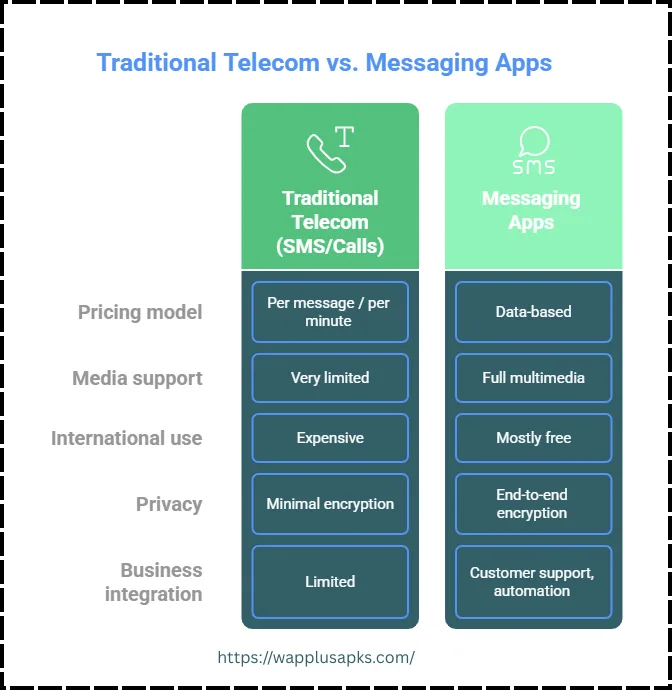
Messaging Apps vs Traditional Telecom Services
| Aspect | Traditional Telecom (SMS/Calls) | Messaging Apps |
| Pricing model | Per message / per minute | Data-based |
| Media support | Very limited | Full multimedia |
| International use | Expensive | Mostly free |
| Privacy | Minimal encryption | End-to-end encryption |
| Business integration | Limited | Customer support, automation |
This comparison explains why users continue to prefer app-based communication over legacy services.
Business Communication and Telecom Synergy
Messaging apps are no longer just personal tools. Businesses use them for customer support, order confirmations, marketing updates, and internal coordination. This evolution benefits telecom providers indirectly:
- Increased data usage boosts demand for higher-tier plans
- Businesses require stable, low-latency connections
- ISPs can bundle broadband, mobile data, and cloud services
Technology companies like Meta and Google are expanding messaging ecosystems with payments, automation, and AI—further increasing reliance on strong telecom infrastructure.
Privacy Expectations and Network Trust
Privacy has become a major factor in messaging app adoption. Features like encrypted chats, disappearing messages, and hidden online status are now standard.
For telecom providers, this means:
- Less involvement in message content
- Greater responsibility for secure data transmission
- Increased focus on infrastructure reliability and trust
Users judge communication quality not just by speed, but by how safe and private it feels.
User Demand for Control and Customization
Many users seek enhanced features beyond official apps, leading them to explore modified platforms that offer advanced customization, file sharing, or privacy controls. Searches for terms like descargar Whatsapp Plus, Whatsapp Plus descargar, and whatsapp plus Última versión reflect a growing desire for flexibility.
Even though these apps operate outside official stores, they still depend on mobile data and broadband networks—reinforcing the idea that Instant Messaging Apps Are Shaping the Future of Telecommunications through user-driven demand rather than carrier-defined services.
FAQs
Are messaging apps replacing telecom companies?
No. Telecom providers remain essential for internet access, data routing, and infrastructure. Messaging apps change usage patterns, not the need for networks.
Why do messaging apps rely on data instead of SMS?
Data-based communication supports multimedia, encryption, and cross-device syncing—features SMS cannot handle efficiently.
Do messaging apps increase mobile data consumption?
Yes. Media sharing, voice notes, and video calls significantly raise average data usage per user.
How does encryption impact telecom operators?
Encryption shifts focus away from content monitoring and toward network performance, security, and uptime.
Will telecom networks be designed mainly for apps in the future?
In practice, they already are. Network planning increasingly assumes heavy app-based traffic rather than traditional calls and texts.
Final Thoughts
The telecom industry is no longer defined by call minutes or text limits. It’s driven by how people actually communicate—through apps, media, and real-time data exchange. Instant Messaging Apps Are Shaping the Future of Telecommunications by pushing networks to become faster, more reliable, and more user-centric.
Telecom providers that embrace this reality and invest in strong data infrastructure will remain central to digital communication. Those that resist change risk becoming invisible pipes instead of strategic enablers.