IBC demand is rising as reusable bulk packaging boosts logistics efficiency, cuts costs, and ensures safe, compliant handling across global industries.
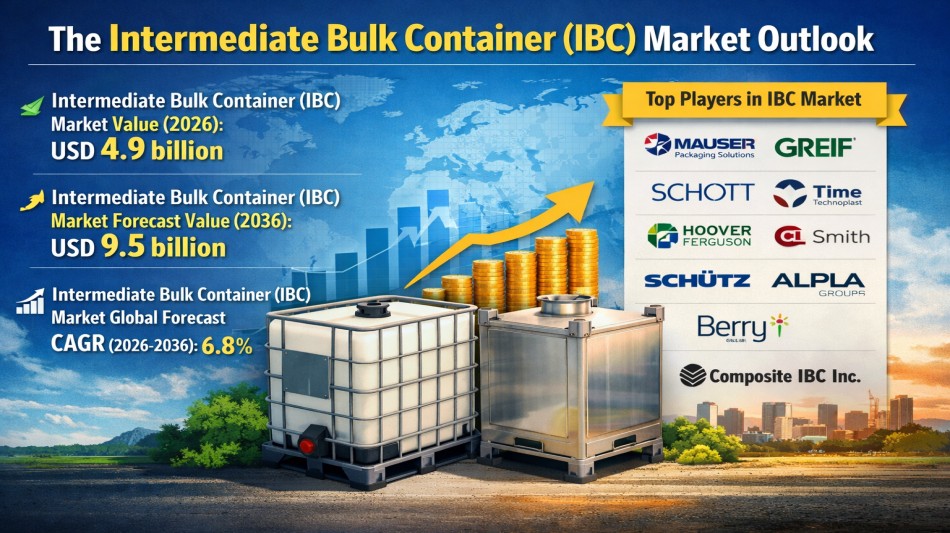
NEWARK, DELAWARE / ACCESS Newswire / February 20, 2026 / The global Intermediate Bulk Container (IBC) market is entering a phase of steady, structurally driven expansion, supported by the growing need for efficient bulk storage and transport solutions across industrial value chains. Valued at USD 4.9 billion in 2026, the market is projected to reach USD 9.5 billion by 2036, advancing at a CAGR of 6.8% during the forecast period. This growth reflects the increasing reliance on high-capacity, reusable packaging systems that optimize logistics efficiency, reduce handling costs, and ensure compliance with stringent safety regulations.
According to a comprehensive strategic outlook from Future Market Insights (FMI), the IBC market's trajectory is closely linked to industrial expansion, global trade flows, and the rising need for safe handling of liquids, powders, and granular materials across sectors such as chemicals, pharmaceuticals, and food processing.
Intermediate Bulk Container (IBC) Market Snapshot (2026-2036)
Metric |
Value (2026-2036) |
Current Market Value (2026) |
USD 4.9 Billion |
Projected Market Value (2036) |
USD 9.5 Billion |
Global Growth Rate (CAGR) |
6.8% |
Leading Segment |
Plastic IBCs (52.3%) |
Top Growth Market |
India (9.7% CAGR) |
Discover Growth Opportunities in the Market - Get Your Sample Report Now: https://www.futuremarketinsights.com/reports/sample/rep-gb-2036
The Structural Shift: From Conventional Packaging to Bulk Efficiency
The IBC market is witnessing a clear shift from traditional drums and barrels toward more advanced bulk packaging formats. IBCs combine stackability, reusability, and higher storage capacity, enabling companies to optimize warehouse space and transportation costs. This transition is particularly evident in industries dealing with hazardous or sensitive materials, where safety, compliance, and contamination control are critical.
Manufacturers are increasingly focusing on durability, modular designs, and compliance with global safety standards. Rigid and flexible IBC variants are gaining traction for their ability to streamline supply chains and minimize product loss during storage and transit.
Pricing Power and Market Consolidation
The competitive dynamics of the IBC market are shaped by high entry barriers and strong pricing power among established players. Large manufacturers leverage economies of scale, long-standing customer relationships, and advanced production capabilities to maintain profitability while offering competitive pricing.
Significant capital investments in manufacturing infrastructure and strict regulatory compliance requirements limit the entry of new players. However, the market remains moderately fragmented due to the wide range of industries served, each with unique storage and transportation needs.
As demand grows, consolidation is expected to accelerate. Larger companies are likely to acquire smaller, niche players to expand their product portfolios, improve operational efficiency, and strengthen their global footprint. This consolidation trend will play a key role in defining market leadership over the next decade.
Growth Trajectory: A Decade of Incremental Expansion
The IBC market is projected to witness consistent growth across the forecast period, with a clear progression in value:
2026: USD 4.9 billion
2031: USD 7.8 billion
2036: USD 9.5 billion
Between 2026 and 2031, the market is expected to grow by USD 2.9 billion, driven by increasing adoption across chemicals, pharmaceuticals, and food and beverage sectors. These industries rely heavily on IBCs for their durability, efficiency, and ability to handle bulk volumes safely.
From 2031 to 2036, the market will add an additional USD 1.7 billion. While growth may moderate slightly as the market matures, demand will remain strong due to the continued expansion of global supply chains and the need for efficient bulk handling solutions.
Segment Spotlight: Material and Application Leadership
Plastic IBCs Dominate Material Demand
Plastic IBCs lead the market, capturing 52.3% of the total share. Their dominance is attributed to their lightweight nature, cost-effectiveness, and strong resistance to corrosion. These features make them suitable for a wide range of applications, including chemicals, food products, and pharmaceuticals.
Additionally, plastic IBCs support sustainability initiatives, as they can be recycled and reused, aligning with the growing emphasis on circular economy practices.
Chemical Storage Drives Application Growth
Chemical storage remains the leading application segment, accounting for 38.4% of the market. The need for safe, reliable, and compliant storage solutions for hazardous and non-hazardous chemicals is a key driver of demand.
IBCs offer superior durability, leak prevention, and ease of handling, making them ideal for transporting large volumes of chemical products. As global chemical production continues to rise, this segment is expected to maintain its dominance.
Key Drivers: Efficiency, Safety, and Sustainability
Several factors are driving the expansion of the IBC market:
Logistics Optimization: IBCs reduce handling time, improve storage efficiency, and lower transportation costs.
Industrial Growth: Expansion in chemicals, pharmaceuticals, and food processing industries is fueling demand.
Regulatory Compliance: Strict safety standards are pushing industries toward standardized bulk packaging solutions.
Sustainability Trends: Reusable and recyclable IBCs support environmental goals and reduce waste.
The integration of automation in manufacturing and logistics is further boosting demand, as IBCs are well-suited for mechanized handling systems.
Challenges: Cost and Operational Complexity
Despite strong growth prospects, the IBC market faces several challenges. The high initial investment required for IBC procurement can be a barrier for small and medium-sized enterprises. Additionally, the need for specialized handling equipment and storage infrastructure increases operational costs.
Supply chain disruptions and fluctuations in raw material prices, particularly plastics and metals, can also impact production costs. Furthermore, strict regulations regarding cleaning, sanitization, and reuse add complexity to operations, particularly in industries such as food and pharmaceuticals.
Regional Powerhouses: Asia Leads Growth
The global IBC market is witnessing strong growth across both developed and emerging regions:
India (9.7% CAGR): The fastest-growing market, driven by rapid industrialization, expanding manufacturing capabilities, and government initiatives supporting infrastructure development.
China (8.4% CAGR): A key hub for manufacturing and exports, with strong demand from chemicals and industrial sectors.
Brazil (7.8% CAGR): Growth supported by agriculture, food processing, and export-oriented industries.
Italy (6.3% CAGR): Steady demand from food, beverage, and chemical sectors.
United States (6.2% CAGR): Mature market driven by sustainability initiatives and advanced logistics infrastructure.
Asia Pacific remains the dominant region, supported by rapid industrial growth and increasing trade activities.
Dynamics of the Decade: Smart and Sustainable IBCs
Looking ahead to 2036, several emerging trends are expected to redefine the IBC market:
Eco-Friendly Materials: Growing adoption of recyclable and biodegradable materials to reduce environmental impact.
Smart IBCs: Integration of IoT-enabled sensors for real-time monitoring of temperature, pressure, and contents.
Hygienic Design: Increased focus on contamination control in pharmaceuticals and food industries.
Automation Compatibility: Development of IBCs optimized for automated logistics and handling systems.
These innovations are transforming IBCs from simple storage containers into intelligent, value-added components of modern supply chains.
Competitive Landscape: Innovation and Scale
The IBC market remains highly competitive, with key players focusing on innovation, customization, and sustainability to strengthen their market positions. Leading companies are leveraging their global presence and manufacturing expertise to offer comprehensive solutions across industries.
Major players in the IBC market include: Mauser Packaging Solutions, Greif Inc., Schott AG, Time Technoplast Ltd., Hoover Ferguson Group, CL Smith, Schutz Container Systems, ALPLA Group, Berry Global Inc., and Composite IBC Inc.
These companies compete by enhancing product durability, improving safety standards, and developing sustainable solutions. As demand for bulk packaging continues to rise, the focus on innovation and efficiency will intensify, shaping the future of the market.
For an in-depth analysis of evolving formulation trends and to access the complete strategic outlook for the Intermediate Bulk Container (IBC) Market through 2036, visit the official report page at: https://www.futuremarketinsights.com/reports/intermediate-bulk-container-market
Related Reports:
FIBC (Flexible Intermediate Bulk Container) Market Share Analysis -https://www.futuremarketinsights.com/reports/fibc-market-share-analysis
Intermediate Bulk Container Industry Analysis in Japan - https://www.futuremarketinsights.com/reports/intermediate-bulk-container-industry-analysis-in-japan
Bulk Container Packaging Market - https://www.futuremarketinsights.com/reports/bulk-container-packaging-market
Bulk Liquid Containers Market - https://www.futuremarketinsights.com/reports/bulk-liquid-containers-market
Bulk Bag Market - https://www.futuremarketinsights.com/reports/bulk-bags-market
About Future Market Insights (FMI)
Future Market Insights (FMI) is a leading provider of market intelligence and consulting services, serving clients in over 150 countries. Headquartered in Delaware, USA, with a global delivery center in India and offices in the UK and UAE, FMI delivers actionable insights to businesses across industries including automotive, technology, consumer products, manufacturing, energy, and chemicals.
An ESOMAR-certified research organization, FMI provides custom and syndicated market reports and consulting services, supporting both Fortune 1,000 companies and SMEs. Its team of 300+ experienced analysts ensures credible, data-driven insights to help clients navigate global markets and identify growth opportunities.
For Press & Corporate Inquiries
Rahul Singh
AVP - Marketing and Growth Strategy
Future Market Insights, Inc.
+91 8600020075
For Sales - sales@futuremarketinsights.com
For Media - Rahul.singh@futuremarketinsights.com
For web - https://www.futuremarketinsights.com/
SOURCE: Future Market Insights, Inc.
View the original press release on ACCESS Newswire