The network structure of traditional silica aerogels is mainly formed through Si–O–Si bonds. Compared with the bonding interactions commonly found in organic materials, the bond energy of Si–O bonds is relatively lower, making them susceptible to bond cleavage and structural degradation at elevated temperatures. This is one of the main reasons why conventional silica aerogels tend to lose structural stability and performance under high-temperature conditions.
Introducing organic components into silica aerogels can effectively enhance the bonding energy within the network structure and improve the overall mechanical properties.
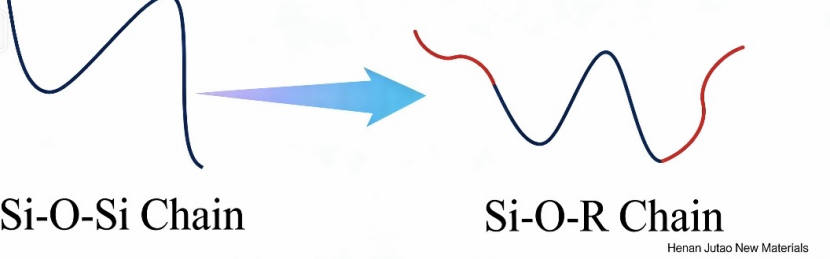
One effective approach is chain extension, which modifies the original bonding structure of silica aerogels. In this process, the initial short-chain network dominated by Si–O–Si linkages is partially transformed into a Si–O–R structure (where R represents a long-chain organic group). This transformation leads to a long-chain network configuration, which increases chain rigidity, reduces molecular vibration, and further complicates the internal network structure of the aerogel. As a result, heat transfer is hindered while the mechanical performance of the composite aerogel is significantly improved. A schematic representation of this structure is shown in Figure 1.
Polymer–Silica Composite Aerogels
Among polymer modifiers, polyimide exhibits excellent thermal stability. However, due to its relatively low rigidity, its ability to enhance the compressive strength of aerogels is limited.
Polyethylene glycol (PEG) can crosslink randomly dispersed silica particles, stabilizing the overall structure and improving the thermal insulation performance of the aerogel.
Similarly, polyesters, owing to their high thermal stability, can provide additional thermal insulation benefits. Their highly active functional groups also enable strong interactions with the silica network, resulting in improved interfacial bonding.
In addition, bacterial cellulose can also be incorporated into silica aerogels. Organic materials with unique skeletal structures can act as favorable carriers for silica aerogels, enabling tight integration between the organic framework and the silica network.
After the incorporation of polymers, silica particles can adsorb onto the surfaces of long-chain polymer structures, forming a larger and more robust network system that enhances the mechanical properties of the aerogel. Furthermore, the polymer network can interpenetrate with the silica particle network, significantly improving the strength and toughness of the composite material.
However, the high-temperature performance of polymer-modified aerogels still requires further improvement. In addition, the introduction of polymers may lead to a certain reduction in porosity, which may negatively affect the thermal insulation performance and therefore requires further optimization.
Non-Polymer–Silica Composite Aerogels
Unlike polymer modifiers, non-polymeric organic compounds are more commonly introduced through grafting reactions. This method modifies the original hydroxyl groups on the silica surface and provides additional reaction sites for the formation of long-chain networks, thereby enhancing the stability of the aerogel structure.
For example, sorbitol, which contains multiple hydroxyl groups, can interact synergistically with silane compounds to form stable structures, thereby improving the overall properties of silica aerogels.
The introduction of non-polymeric organic compounds can provide additional reactive sites for the silica network, enabling the formation of more stable network structures. However, compared with polymers, their relatively fixed crosslinking modes may provide limited improvement in the interfacial bonding strength of silica aerogels, which can affect the overall mechanical performance. Therefore, further research and development on non-polymer-modified silica aerogels is still required.
Although organic modification can significantly enhance the mechanical properties of silica aerogels, organic components generally soften at temperatures around 600 °C or even lower, which may cause the composite aerogel to lose its original structural and functional properties. Consequently, silica aerogels modified with organic materials should avoid high-temperature operating environments whenever possible.
Overall, organic modification improves the mechanical performance of silica aerogels by extending molecular chains and increasing chain rigidity. Meanwhile, the long-chain organic network increases the complexity of heat transfer pathways, thereby reducing the thermal conductivity of aerogels within certain temperature ranges.Jutao Environmental Technology — Specialists in Aerogel Material Solutions
Stay connected with us for the latest updates, industry insights and application solutions in the aerogel sector.
Media Contact
Company Name: HENAN JUTAO NEW MATERIAL CO., LTD
Email: Send Email
Country: China
Website: https://www.jutaoaerogel.com/